
Director’s Guidance on Charging, seventh edition: November 2026
Important: Some provisions in this guidance are published in advance of implementation and are not yet in force. These provisions are clearly identified where they appear by grey highlighting and by a textual disclaimer to ensure their status is clear to users of assistive technology.
- Introduction
- Early Advice
- CPS Direct
- Division of Charging Responsibility
- Supervisor Responsibilities
- Information and material required for a decision
- Prosecutor Review of Police-Charged Cases
- Emergency Charging
- Appealing a CPS decision
- Post Charge Responsibilities
- Monitoring
- Annex 1 – Information and material required for a charging decision
- Annex 2 – National File Standard
- Annex 3 – Division of Charging Responsibility flowchart
- Annex 4 – Disclosure table NOT IN FORCE
1. Introduction
- This guidance is issued by the Director of Public Prosecutions (DPP) pursuant to section 37A Police and Criminal Evidence Act 1984 (PACE). It applies to all Crown Prosecutors and to all investigators (police and non-police) who seek early advice or a charging decision from the Crown Prosecution Service (CPS). It is supplemented by Memoranda of Understanding (MOU) between the CPS and specific investigators which remain in force as additional guidance. References to the singular should be read as references to the plural where appropriate. References to MG forms equally apply to their digital data equivalents.
- Supervisors (police and non-police) should support consistent application of this guidance. Decisions made contrary to this guidance may be subject to legal challenge and may give rise to civil liability, especially if a suspect has been detained in custody.
- Cases are submitted to the CPS through a single route, using one of two file types: red or green. A red submission is one where the suspect is in custody, and there will be a properly justified application for a further remand in custody if charged. All other cases fall into green charging.
- This guidance (referred to simply as DG7) comes into force on 17th November 2026 and replaces all previous editions. The DPP may revise this guidance to reflect changes in practice, legislation, caselaw and/or other guidance and in the event of doing so the update will indicate the revision made. Where a substantive but focused change needs to be made, that will become version DG7.1 of this guidance.
- This guidance includes provision for proportionate disclosure in magistrates’ court cases. Those provisions are subject to amendment of the Attorney General’s Guidelines on Disclosure and the Lord Chancellor’s Code of Practice, completion of the relevant Area Readiness Assessment, and implementation. Unless and until all these changes are in force this guidance makes no change to the current magistrates’ court pre-charge frontloading requirements.
2. Early Advice
- Early advice provides an opportunity for investigators and prosecutors to work together at an early stage where that can assist the investigation. It is a collaborative process where the prosecutor’s advice assists the decisions to be taken by the investigator.
- Early advice is advice sought by an investigator from the CPS at any point prior to a request for a charging decision. It is advice, not a decision.
- Decisions about the investigation, including whether to continue it or close it, remain for the investigator. The investigator may close an investigation without referring it to the CPS where there is insufficient evidence or where prosecution is not in the public interest. This applies even where the case would otherwise fall within CPS charging responsibility. One example may be where the suspect is liable to deportation in connection with other matters.
- The police may seek early advice on a difficult public interest decision, for instance those which arise from sexual activity allegations between suspects and victims who are both under 16.
- Early advice should normally be sought in serious, sensitive, or complex cases to build a case ready for a charging decision. There is no exhaustive list of categories of cases in which early advice should be sought, nor on what topics.
- Illustrative examples include but are not restricted to:
- a death where there is a significant complex legal element, for example gross negligence manslaughter or a mercy killing;
- rape and serious sexual offences cases. Early advice should always be considered if it adds value, but it is not mandatory; examples include cases where there is a complex legal element, for example cases involving conditional consent, third party material or a need for an investigative digital strategy;
- cases involving modern slavery and/or human trafficking where charges under the Modern Slavery Act 2015 are under consideration, including ‘evidence led’ cases involving sexual exploitation and child criminal exploitation, or where the section 45 modern slavery defence is raised or anticipated;
- high-profile media interest cases;
- cases involving international case elements including where evidence is required from abroad through Mutual Legal Assistance (MLA) or Overseas Production Order (OPO), concurrent jurisdiction issues, or if the suspect has fled the jurisdiction;
- where an MOU requires early advice;
- complex fraud cases: examples include cases involving significant volumes of financial material, cryptocurrency transactions, professional enablers, linked investigations, restraint considerations, or international enquiries;
- complex cases involving joint enterprise;
- major police operations including public disorder, public protests, or other civil events;
- cases where the preservation of assets through restraint may be required or should be referred to CPS Proceeds of Crime (POC) Division due to case type, size, or complexity;
- NGAP cases where an Investigation Management Document (IMD) is provided. Early advice should be considered where it would respond to a specific question or issue and add value to the case, but it is not mandatory; or
- any other case that is complex, unusual or novel or where the investigator considers that early advice will add value or is unsure how to proceed.
- The prosecutor and investigator should consider reasonable lines of enquiry and disclosure strategy in every case at the earliest opportunity. In NGAP cases where an IMD has been submitted, and early advice has not been sought, the prosecutor and investigator should discuss and formulate the disclosure strategy before the final charging decision is made, where this would add value. Where either party identifies a need for engagement, there is an expectation this is addressed by both the police and the prosecution. Engagement should continue post-charge where appropriate, with the timing, format and frequency of discussions proportionate to the case and issues identified.
- CPS Areas or Central Casework Divisions (CCDs) give early advice. They should also normally make charging decisions in all cases where early advice has been given. CPS Direct should only make the charging decisions in exceptional circumstances where early advice has been given, see section 3 below.
- Early advice sought by investigators direct from the CCDs is outside this guidance and should be addressed by MOUs specific to this casework.
- A request for advice should identify the question(s) or issue on which early advice is sought and provide any additional material or information which is necessary for the prosecutor to give advice. These should be questions where the prosecutor’s advice will assist in continuing the investigation or, more rarely, to close it. The material needed for early advice will depend on the request. In some cases, the request itself will be enough if it explains what the investigation has established and the question for advice. In others, the prosecutor may need to review material before advising.
- A supervisor to the investigator must confirm both that it is appropriate to seek advice and that sufficient information has been provided to enable the prosecutor to advise.
- Referrals must be made through the digital interface between the police and the CPS where available and used by the police. Alternative arrangements may be put in place by way of agreement between the police and the CPS. This guidance does not seek to alter any notification arrangements in place for complex or anticipated red route charging decision requests.
- Where a prosecutor considers that advice cannot usefully be given, they should assess whether a Real Time Case Conversation (RTCC) approach could help refine the request. A decision to decline should be accompanied by reasons. It can be appealed under the general provisions in section 9.
- Early advice may not be required in every case falling within the categories listed above. However, where an immediate charging decision may be required and early advice has not been obtained, the investigator must contact the relevant CPS Area or CCD at the earliest opportunity to agree referral arrangements. Notification arrangements for such casework should comply with local practice and are not prescribed by this guidance.
3. CPS Direct
- CPS Direct does not give early advice, which is given by CPS Areas and CCDs. Early advice requests should be made digitally and the response recorded within CMS.
- CPS Areas and CCDs normally make decisions on charging where early advice has been sought. Early notification of cases requiring such charging decisions allows CPS Areas and CCDs to manage the provision of such decisions. CPS Direct should only be approached in exceptional circumstances for a charging decision in cases which have been referred for early advice or where early advice would have been appropriate.
- If, exceptionally, CPS Direct is approached for a charging decision in such cases out-of-hours, that request must explain what exceptional circumstances justify doing so and why the charging decision could not be made by CPS Area or CCD. The request must detail any relevant discussion with CPS Area or CCD which preceded this charging consultation.
- The police must notify and consult with CPS Areas to agree management of charging decisions arising from any pre-planned operation, demonstration or other long-running investigation. CPS Areas will co-ordinate and make these charging decisions, regardless of the timing of the charging request, unless the Chief Crown Prosecutor (CCP) for CPS Direct and CCP for the relevant CPS Area have formally agreed otherwise.
4. The Division of Charging Responsibility
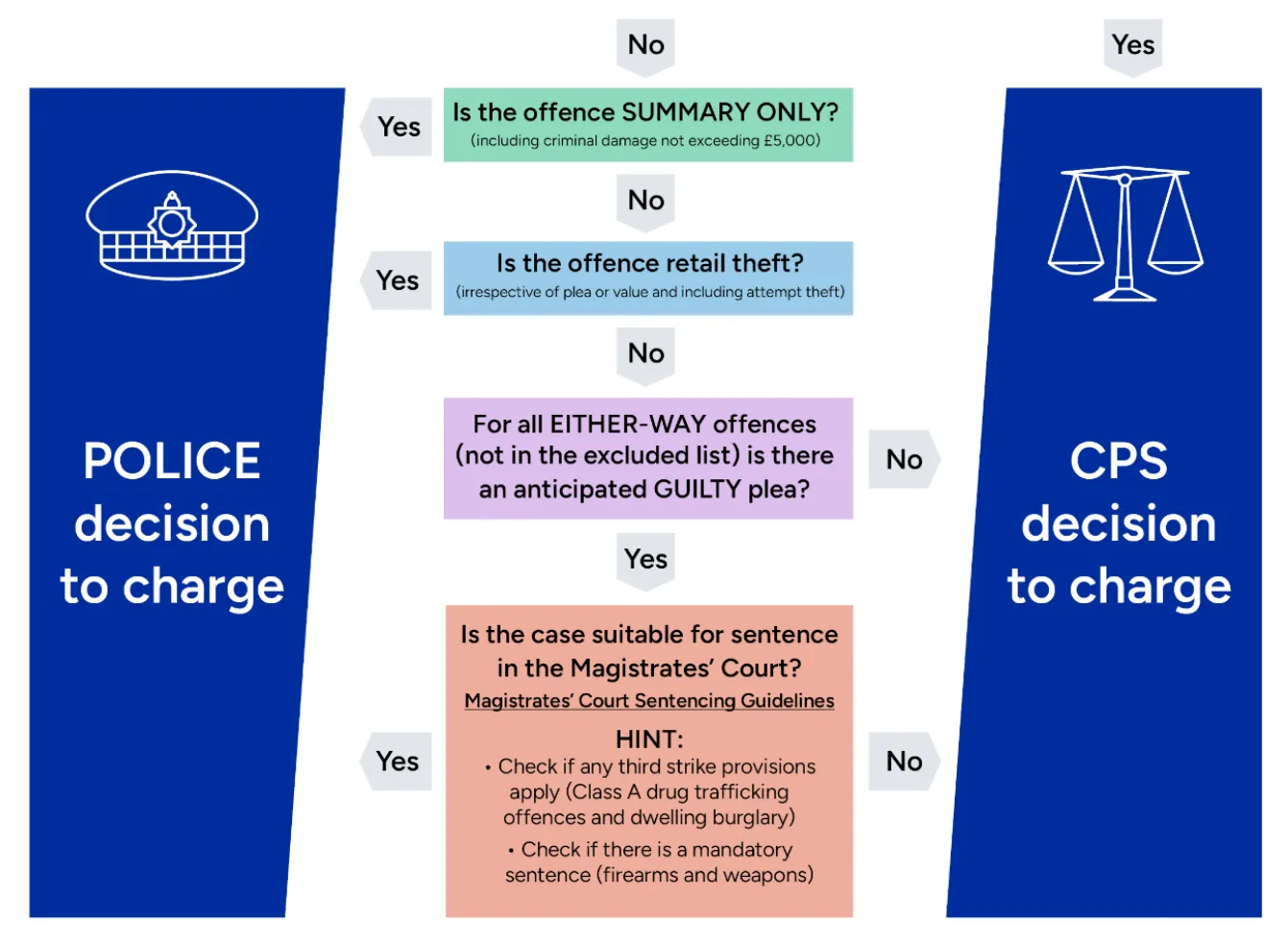
- Annex 3 to this guidance provides a visual guide to the Division of Charging Responsibility. What is important is that, in every case, the police record the rationale for either making the charging decision themselves or referring the case to the CPS for a charging decision.
- The police may charge the following offences unless reserved for CPS charging in paragraph c:
- any summary only offence (irrespective of plea);
- all retail theft including attempted theft (irrespective of plea or value);
- criminal damage with a value not exceeding £5,000 (irrespective of plea); or
- any either-way offence anticipated as a guilty plea and suitable for sentence in the magistrates’ court.
- The CPS will therefore charge all offences triable only on indictment, and any case which:
- requires the consent to prosecute of a Secretary of State, the DPP (personal and delegated) or Attorney General (AG) (check the PNLD);
- involves a death;
- involves terrorist activity (terrorism as defined in section 1 of the Terrorism Act 2000);
- involves offences contrary to the Official Secrets Acts 1911 or 1989;
- involves offences contrary to the National Security Act 2023;
- involves domestic abuse (defined by sections 1 and 2 of the Domestic Abuse Act 2021);
- involves a hate crime: a crime which is motivated by or involves a demonstration of hostility based on actual or perceived race, religion, disability, sex, sexual orientation, or transgender identity;
- alleges harassment or stalking (contrary to sections 2, 2A, 4 or 4A of the Protection from Harassment Act 1997);
- alleges violent disorder or affray (contrary to sections 2 or 3 of the Public Order Act 1986);
- alleges grievous bodily harm or wounding, or actual bodily harm (contrary to section 20 or section 47 of the Offences Against the Person Act 1861); or
- alleges a Sexual Offences Act offence committed by or upon a person under 18.
- A case is suitable for sentence in the magistrates’ court if the likely sentence would not exceed the magistrates’ court’s maximum sentencing powers, taking into account the anticipated plea and the likely sentencing starting point under the relevant sentencing guideline.
- A guilty plea may be anticipated (GAP) where either:
- Clear admission route: the suspect clearly admits the offence during their police interview and does not say anything that could amount to a legal defence or otherwise qualify, contradict or undermine that admission;
- Corroborative evidence and no challenge route: whether or not the suspect has been interviewed, they do not deny the allegation, including making no comment, or suggest they will challenge the allegation, and there is strong, credible and reliable evidence capable of proving both:
- that the offence was committed; and
- that the suspect was the person responsible
- Evidence for the purposes of subparagraph ii may include, but is not limited to:
- police officer witnesses;
- independent witnesses;
- clear video or audio recordings;
- statements made by the suspect that point to their guilt; or
- forensic or other evidence that supports the victim’s account.
- Nothing in this guidance alters the legal requirements governing whether and when a suspect must be interviewed. A suspect may, for example, not be interviewed where they are assessed as unfit for interview while in police custody.
- Separate Out of Court Resolution (OOCR) guidance issued by the DPP sets out who makes the decision when a formal OOCR is in the public interest. There are informal resolutions that can resolve offending, but these sit outside the statutory framework. The police use them at their own discretion. The CPS is not party to the framework for informal resolutions nor the decision-making in relation to them. Where an OOCR is considered appropriate, the victim’s views should be obtained and considered. The victim’s views are not the deciding factor, but form part of the decision-making exercise that must balance all factors. When considering an OOCR the decision maker should address non-conviction-based asset recovery powers to ensure the right powers are available and are used, including:
- payment of compensation to the victim;
- cash, money in a bank or building society account, listed asset, and forfeiture (which needs to be referred to a law enforcement authority) or crypto assets; and
- High Court civil recovery (a power available to the CPS Proceeds of Crime Division).
5. Supervisor Responsibilities
- In this guidance, “supervisor” means the decision maker who approves the submission of a case to the CPS for early advice or a charging decision. The purpose of this section is to highlight how their specific responsibilities can add value to the process.
- The supervisor is responsible for assessing and reviewing evidential material and information to:
- identify the appropriate charge(s);
- determine whether a case is suitable for sentence in the magistrates’ court by identifying and applying the relevant Sentencing Guideline and recording their rationale as to whether the likely sentence would exceed the maximum the magistrates’ court can impose. This is not a full sentencing exercise but a preliminary assessment to determine the sentencing starting point with a justified rationale as to how the conclusion was reached;
- consider whether release under investigation (RUI), bail with or without conditions or a remand in custody is to be sought and is available;
- identify and apply the Full Code Test or the Threshold Test in accordance with the Code for Crown Prosecutors (Code) and determine whether the case is to be submitted via the red route, or the green route which encompasses the green priority route including high-risk domestic abuse;
- determine whether the individual charge and case overall is GAP or NGAP and record the rationale;
- ensure the information and material required for a charging decision complies with Annex 1 and the National File Standard (Annex 2); and
- ensure cases subject to a statutory time limit are submitted in good time.
- consider submission arrangements in the following cases:
- linked suspects and linked offences where the supervisor considers it appropriate to apply the Threshold Test to one or more suspects, including any to be bailed to court, and the intention is to have them tried together. The following provisions apply:
- the intention must be to charge all suspects with a joint or related offence;
- the Threshold Test must be met in full for at least one suspect; and
- if the remaining suspect(s) to be bailed do not meet the Full Code Test, they may be treated as meeting the Threshold Test where they are to be charged with a joint or related offence and conditions 1, 2 and 5 of the Threshold Test are met.
- related cases for the same suspect. The following provisions apply:
- if a case referred to the CPS for a charging decision includes related offences that the police would otherwise be authorised to charge, those offences must also be referred to the CPS;
- offences are related if they arise from the same or connected circumstances as the offences requiring referral to the CPS, or form part of a series of the same or similar offending;
- where a suspect is in custody and a case is submitted by the red route, any outstanding green cases should only be submitted if they are ready for application of the Full Code Test (it is at the discretion of the reviewing lawyer in consultation with the CPS Direct shift lead or Area legal manager as to whether there is capacity to deal with such cases). The police must inform the CPS of any linked cases, whether or not they are submitted for a charging decision;
- if the suspect is in custody in relation to those green cases, for example following arrest for breach of bail or readmission to custody for a PACE interview in response to new evidence, and the cases are not yet ready for the Full Code Test, the Threshold Test may be considered but care should be taken to ensure all conditions are met; and
- unrelated cases that do not fall within the above definition, and for which the suspect is not in custody, cannot be included in a red route referral to the CPS.
- linked suspects and linked offences where the supervisor considers it appropriate to apply the Threshold Test to one or more suspects, including any to be bailed to court, and the intention is to have them tried together. The following provisions apply:
6. Information and material required for a charging decision
- Charging Request
- A request for a charging decision must be made through the digital interface between the police and the CPS, where available and used by the police
- A request for a charging decision must be supported by the information and material set out in Annex 1.
- In respect of magistrates’ courts cases, how the disclosure obligations pre-charge may be modified under amended Attorney General’s Guidelines on Disclosure, Lord Chancellor’s Code of Practice and implementation plans, is set out in Annex 1.
- National File Standard
- This guidance sets out the information and material the CPS requires for charging. The National File Standard (NFS) addresses how and when the police will submit this, including information and material required for post-charge case management.
- The NFS focuses on providing the information and material required at each stage of the case. It should contain only what is necessary and proportionate for effective charging, case management, and prosecution.
- Where information and material have already been submitted to the CPS in support of a request for early advice or a charging decision, it need not be resubmitted unless the content has been updated, for example where the factual summary has been changed.
- Serious or complex cases may require additional information and material. CCDs may agree MOUs to identify any additional information and material to be supplied routinely at different stages of particular case types.
- Compliance
- Compliance with Annex 1 and the NFS should enable charging decisions to be made without the need for further requests for information and material unless the case is complex. Where information or material is missing, the prosecutor and investigator should work together to identify what is needed to enable the Code to be applied.
- Where a request is made for information and material beyond the NFS, the prosecutor must provide the reason for the request. If a request is considered disproportionate or unrealistic, the prosecutor and investigator should discuss how the issue can be resolved proportionately.
- Efficient and effective casework depends on both the police and the CPS complying with this guidance and the NFS and working collaboratively to resolve issues.
7. Prosecutor Review of Police-Charged Cases
- The CPS will complete a proportionate review of all police-charged cases before the first court hearing in accordance with the Code. Proportionality reflects the nature and seriousness of the case and the anticipated plea.
- This includes any case charged by the police where, under the Division of Charging Responsibility above, the charging decision falls to the CPS. If the prosecutor concludes that the applicable Code test is met, the prosecution continues.
- Where the applicable Code test is not met, the prosecutor must make prompt enquiries with the police to determine whether further information or material is available to meet the test or otherwise discontinue the case. The appeal procedure in section 9 applies.
8. Emergency Charging
- Officers must anticipate PACE custody time limits (PACE clock) and the need to seek a charging decision in good time. In rare cases, an officer of the rank of Inspector or above may authorise the charging of an offence which must ordinarily be referred to a prosecutor, provided that such authority is given in accordance with this guidance. The following conditions apply:
- the continued detention of the suspect after charge must be justified. Emergency charging cannot be used if the suspect will be released after charge on bail: it is for red cases where a remand in custody is available and sustainable;
- where a suspect faces more than one charge, only one charge will be charged as a holding charge;
- consideration must have been given to continuing the investigation while the suspect is in custody using a PACE clock extension or warrant of further detention;
- the emergency charging decision must be referred immediately after charge to a prosecutor to review the case for ratification;
- the referral will explain the police charging decision, covering the following:
- the test relied upon (Full Code Test or Threshold Test) with the reasoning addressing the evidential and public interest stage of the Full Code Test or all five conditions of the Threshold Test;
- when the PACE clock was due to expire;
- the time the suspect was charged;
- why it was not possible to extend the PACE clock;
- contact details for the officer in the case; and;
- why it was not possible to obtain a charging decision before the expiry of the PACE clock.
- the officer in the case and prosecutor should be available for a Real Time Case Conversation (RTCC) to resolve any outstanding issues promptly;
- any proposal to discontinue must be notified to the police, preferably orally, to enable a further RTCC;
- where the police have been unable to provide any further information or material promptly (without an action plan) that impacts the decision and have not escalated the decision for further review, the prosecutor will issue notices of discontinuance, and the suspect will be released from custody;
- it is not appropriate to use this power in circumstances where a service level agreement (SLA) has not been met, and the PACE clock has sufficient time available for the CPS to provide a charging decision; and
- if a suspect has been charged after the PACE clock has expired, this must be brought immediately to the attention of the prosecutor. The prosecutor must promptly apply the Code and the Bail Act 1976. The police charge may give rise to civil liability, and the CPS response must therefore be prompt and exacting in its application of the Code and the law:
- Where the case is with a prosecutor for a charging ratification decision, the CPS must not take any step which results in the suspect remaining in detention. The case should be returned to the police so that they can address the custody position before any further charging referral is made. Any resubmission must then be made in accordance with the Code.
- Where the case is already before the court, the prosecutor must apply the Code, the Bail Act 1976, comply with their duty to the court, and act promptly to ensure that the defendant is not unlawfully deprived of their liberty.
9. Appealing a CPS decision
- An officer of the rank of Inspector or above, who is not the officer in the case, may appeal a prosecutor’s decision following referral of a case. Chief Constables or their equivalent may designate a member of police staff to act as the appeal officer.
- The appeal may cover decisions to take no further action, set a case action plan, authorise charges, discontinuance, authorise an OOCR, or to decline to give early advice.
- The appeal must explain in writing why the officer considers the prosecutor’s decision wrong, by reference to the case material. The appeal submission should be made formally via email or direct message.
- The appeal officer assumes the role of officer in the case for the purposes of the appeal and should be prepared to have an RTCC with the legal manager or equivalent handling the appeal.
- If the suspect is in custody and the intention is to detain the suspect after charge (a red case), the appeal must be made before the expiry of the PACE clock. If the appeal is against some, but not all charges authorised, consideration should be given to charging the offence(s) which are not being appealed to stop the PACE clock. The appeal itself does not stop the PACE clock.
- The CPS must respond expeditiously to all appeals, within timescales agreed with the appeal officer, and conduct a further review of the case material and the decision. For a red route decision this should be within the custody PACE clock. For a green route decision, this should typically be within 28 days. A different timescale may be agreed between the police and CPS where justified by the circumstances of the case. The reasons for the appeal decision and the decision itself must be recorded and shared with the appeal officer.
- If this initial appeal review does not resolve the issue, an officer of the rank of Chief Inspector or above may escalate the appeal to a Senior District Crown Prosecutor or other legal manager. Notice of the appeal should be given to the Assistant Chief Constable with responsibility for Criminal Justice, by the police, and to the Deputy Chief Crown Prosecutor, by the CPS, for advisory purposes. There is no further appeal beyond this second escalation.
- This process applies to decisions taken by Senior Crown Prosecutors, District Crown Prosecutors and Specialist Prosecutors. The CPS will engage in deciding how to address challenges to decisions taken by more senior prosecutors at Deputy Chief Crown Prosecutor level and above. This appeal process does not apply to such cases.
- If the referring officer abandons the appeal before it is considered, they must record that decision and tell the CPS as soon as possible.
- A similar but separate process will apply to CPS Direct and non-police investigators.
10. Post Charge Responsibilities: case management, progression, and review
- Once a case is charged, the investigator retains responsibility for the investigation. The investigator must continue to pursue all reasonable lines of enquiry and provide any further information or material required for effective case progression and review of the case. This includes information or material required for:
- compliance with disclosure obligations, including meaningful engagement with the prosecutor, by the RTCC approach where appropriate, on the ongoing review and development of the disclosure strategy;
- the prosecutor’s duty of continuing review under the Code for Crown Prosecutors; and
- effective case management under Better Case Management (BCM), Transforming Summary Justice (TSJ), the Criminal Procedure Rules, and the Criminal Practice Directions.
- Witness issues
- Witness issues and witness attrition can seriously affect case progression. The police must identify and investigate witness issues and support needs early and share that information promptly with the prosecution. This is essential to maintaining witness engagement and securing attendance at court.
- Early special measures assessment supports timely applications and early consideration of evidence-led strategies, including whether relevant issues can be proved by other admissible evidence. Where a witness is abroad, prosecutors should be consulted early so that arrangements can be considered for the witness to give evidence, either by returning to the jurisdiction or by live link. Prosecutors must act promptly to implement any practical trial arrangements.
- Prosecutors must also identify and address witness issues at the earliest stage to help ensure justice is not delayed or denied. The same approach applies where a witness, including a victim, is willing to assist but has needs, vulnerabilities or other circumstances that may affect participation, or has further relevant information to provide. Local procedures, including those involving Witness Care Units, must be clear, robust, and consistently understood and followed by police officers and prosecutors.
- Custody Time Limit (CTL)
- Custody cases must be monitored and prioritised to ensure compliance with the court’s Custody Time Limits, avoid defendants being kept in custody for longer than necessary, protect the public, and prevent release caused by any act or default of the police or prosecutor.
- Case review
- Under the Code, the prosecutor’s duty to review a case is continuous and lasts throughout the life of the case. The evidential and public interest basis for a prosecution may change as the case develops, including because of material from the investigation, views expressed by the victim, or information received from the defence or any other source. Any material change must trigger a further review.
- The police and prosecutors should maintain active communication about any change in circumstances, so that new information can be considered promptly. New information may weaken or strengthen the case and may require reconsideration of charge, case progression, or discontinuance. If these developments are not identified, communicated, and acted on, cases may continue without relevant information or material, proceed when they should be stopped, or fail to meet the court’s expectations for effective case progression.
- Resolution of case issues and escalation
- Post-charge case progression is a priority for both the police and prosecutors. Failure may lead to breach of a court direction and may harm the outcome of the case. Any disagreement must be resolved quickly, through local arrangements agreed between the Chief Crown Prosecutor and the Chief Constable or equivalent. The following principles apply:
- any escalation must be recorded and explain why the case is being escalated;
- the agreement must include at least two stages;
- the agreement must set out who can make decisions at each stage and what managerial oversight is required;
- the final stage of escalation should last at least seven days unless case timescales do not allow this. If a shorter period is used, the prosecution must record and share the reason with the police;
- timescales should be consistent with any court direction or stage date and the applicable timescales under TSJ and BCM; and
- a proposed notice of discontinuance must not be served before the escalation period has ended, subject to the following exceptions:
- the case concerns a minor traffic offence or another minor offence with no victim. A minor offence is one that is not punishable by imprisonment; or
- case timescales do not allow this. The prosecution must record and share the reason with the police.
- All existing local arrangements remain in force on the implementation of DG7.
- Post-charge case progression is a priority for both the police and prosecutors. Failure may lead to breach of a court direction and may harm the outcome of the case. Any disagreement must be resolved quickly, through local arrangements agreed between the Chief Crown Prosecutor and the Chief Constable or equivalent. The following principles apply:
11. Monitoring
- The CPS and the police will monitor compliance with this guidance through jointly agreed performance management arrangements. These must include regular consideration of national and local charging performance, issues, and data.
- Applying the Division of Charging Responsibility may involve finely balanced decisions. Monitoring is not intended to routinely revisit those decisions, but to support consistent application of the framework and identify individual decisions or trends that give rise to concern.
- Any requests for clarification of any part of this guidance should be directed to the relevant NPCC portfolio(s) and to the CPS Policy Directorate.
Annex 1 – Information and material required for a charging decision
Upon implementation of DG7, existing triage requirements and digital submission processes remain unchanged. Some information required by this Annex cannot be shared automatically through legacy digital systems. Where available, it should be provided with the charging decision request or as confidential information, in accordance with existing submission arrangements. Investigators must continue to provide the key information and material necessary for a charging decision through those arrangements. Any changes to triage requirements or digital submission processes to support the requirements in this Annex will be clearly communicated in advance.
1. Information required for a charging decision
- Suspect information required if available:
- name and any aliases;
- address;
- date of birth;
- sex (biological);
- gender (how identifies, if different); and
- ethnicity (self-defined).
- Suspect information required where relevant to the suspect or case type:
- Foreign national offender (FNO) information including immigration status, whether deportation is being considered and is available, victim’s views on deportation of the FNO and the implications on any asset recovery strategy;
- medical information covering any relevant physical and/or mental health issues;
- details of any current or pending investigation and/or proceedings (stage, next dates, allegations in outline and any Unique Reference Number (URN));
- any bad character material (previous convictions or any reprehensible behaviour) which needs to be brought to the attention of the prosecutor as particularly relevant (the PNC print being provided separately); and
- any defence representations made pre-charge.
- Offence information required in every case:
- proposed charge(s);
- factual summary;
- summary of the interview, covering questions asked, any prepared statement and responses given; and
- any identified or likely issues that could affect the charging decision, case presentation, or any subsequent trial.
- Offence information required where relevant to the suspect or case type:
- any summary offence statutory time limit (STL);
- any Secretary of State, DPP or AG consent required, if known;
- details of any proposed ancillary orders, including proposed conditions, particularly protective orders, and compensation details with supporting evidence (receipted expenditure and invoices); and
- asset recovery information:
- Has restraint been considered of any assets? If so, has CPS Proceeds of Crime Division been contacted?
- Is there a benefit in this case? (gain of money, any other asset or property both within and outside the jurisdiction)
- What is the value of the benefit?
- Is there a criminal lifestyle offence?
- Investigation information required in every case:
- Where an IMD exists, this can simply be referred to, but otherwise the information supplied should address:
- CCTV, house-to-house, third party material or other lines of enquiry;
- reasonable lines of enquiry (RLE) which it is proposed be followed post-charge as unlikely to be material to charging decision;
- status of any linked offenders, whether suspects or defendants;
- status of any linked investigation; and
- any local or national sensitivities of which the investigator is aware.
- Where an IMD exists, this can simply be referred to, but otherwise the information supplied should address:
- Victim and witness information required if available:
- name;
- date of birth;
- sex (biological);
- gender (how identifies, if different);
- ethnicity (self-defined preferred or officer identified, if unavailable);
- language spoken including any dialect and whether an interpreter is required;
- whether a victim or witness is supportive of the prosecution and willing to attend court. Supportive witnesses may not be willing to attend court or may only do so with support. There are degrees of support and unwillingness, and so care should be taken to assess this individually;
- whether a victim or witness is vulnerable (as defined by the Youth Justice and Criminal Evidence Act 1999) or intimidated and whether any special measures are required or have been considered and the details of what provision is needed, for example, screens;
- whether the victim or witness’s circumstances mean that delay in any future court proceedings could materially affect their ability to participate effectively or the quality of their evidence, for example, because of health issues not otherwise captured by an assessment of vulnerability; and
- whether participation would be encouraged through a live-link direction being made for a remote appearance (separate to an application for special measures).
- Contact details required in every case:
- The following details should be provided for the officer in the case (OIC) and the supervisor:
- name and rank;
- email address; and
- contact telephone number(s) (MS Teams, station and mobile) – 101 is not appropriate.
- For red route cases in custody, the CPS must be given updated contact details for the OIC and supervisor at each handover, including the time each takes over.
- For green route cases on bail, provide contact details for any replacement officer or supervisor, including the date they take over.
- The following details should be provided for the officer in the case (OIC) and the supervisor:
2. Material required for a charging decision in every case:
- key witness statements;
- key exhibits; and
- suspect PNC prosecutor print. Where the suspect has no trace, confirmation of this is sufficient.
3. Material required for a charging decision if available:
- a Victim Personal Statement (VPS), Impact Statement for Business (ISB) and Community Impact Statement (CIS) should be requested and provided by the victim. These can be crucial to determine the seriousness of an offence and the harm caused. These statements may be addressed as part of another statement or as a separate statement. The VPS should include an indication of the following:
- If the matter proceeds to charge and conviction, whether the statement is to be read out and by whom? For example, the prosecutor or victim; and
- If it is possible, does the victim want to be present for sentence?
- the officer should confirm if the victim has declined a VPS or wishes to provide one at a later time.
4. Checklists and an Investigation Management Document (IMD) required where relevant to the suspect or case type:
- relevant checklists, including:
- domestic abuse;
- stalking and harassment;
- Child Information Form; and
- domestic abuse risk assessments (DASH/DARA).
- the IMD must be provided in the following cases
- Crown Court cases (excluding those where the defendant elected);
- Youth Court cases with indictable-only offences;
- NGAP magistrates’ or Youth Court cases with either-way offences and
- substantial or complex digital material or search parameters set;
- substantial or complex third-party material or overseas material;
- substantial or complex forensic investigations; or
- complexities arising from linked investigations;
- RASSO cases; and
- where the investigator or their supervisor considers an IMD would be beneficial.
5. Red Route Cases
- date and time of arrest for each suspect;
- time of authorised detention;
- custody detention clock expiry (known as the PACE clock);
- have any PACE clock extensions been granted? If no, and the investigation is incomplete, has any PACE clock extension been considered and the reasoning why this has not been pursued?
- remand grounds relied on to support a remand at court under the Bail Act 1976;
- where a suspect has an identified mental health condition, need or vulnerability the following information should be provided:
- diagnosis and treatment including compliance;
- has a mental health assessment occurred in custody? By whom?
- Was the suspect deemed fit for interview? If so, were they represented and did they have an appropriate adult?
- if the victim is a repeat victim or the suspect and victim are known to each other, a summary of any previous incidents. This may be formally submitted in a summary of domestic abuse (DA) history or informally from police records;
- any safeguarding concerns, including any identified risk of further harm to the victim or others; and
- emergency charge information in accordance with section 8 above of the main DG7 guidance.
- In red cases, the information and material set out in this annex should be provided where available. It is recognised that the early stage of the investigation may mean that not all of it is yet available.
6. Disclosure material or information required for a charging decision – magistrates’ court
- Proportionate disclosure build [THIS PROVISION 6a IS NOT YET IN FORCE]
- Disclosure scheduling and Presumed Disclosable (PD) material requirements are moved from the pre-charge stage to the post-plea stage in magistrates’ court cases where a police force and CPS Area have an implementation plan in place and the Attorney General’s Guidelines on Disclosure and the Lord Chancellor’s Code of Practice have been revised.
- Transition provisions
- Unless and until proportionate disclosure is implemented in the relevant police force and CPS Area in accordance with section 1(e), the existing requirements for pre-charge provision of disclosure schedules and PD material remain in force.
- Common law disclosure [THIS PROVISION 6c IS NOT YET IN FORCE]
- Police and prosecutors are reminded that the prosecutor’s common law duty of disclosure may arise from the point of charge and continue post-conviction: see R v DPP, ex parte Lee [1999] 2 All ER 737.
- Examples of what material or information should be disclosed include:
- any previous convictions of the victim or a key witness if that information could reasonably be expected to assist the accused when applying for bail;
- material which might enable an accused to make an early application to stay the proceedings as an abuse of process;
- material which might enable an accused to make representations about trial venue on a lesser charge; or
- material which would enable an accused to prepare for trial which may be significantly less effective if disclosure is delayed (e.g. names of eyewitnesses whom the prosecution does not intend to use).
- In practice, disclosable material should always be identified at the point of charge under this guidance, but this legal duty operates alongside this expectation.
- Pre-charge disclosure [THIS PROVISION 6d IS NOT YET IN FORCE]
- Where a referral is made for a charging decision or the case has been police charged in accordance with this guidance, the following must be provided:
- information about any material identified as potentially undermining of the prosecution case or assisting the defence case, in addition to the investigator’s rationale for that assessment;
- copies of any such potentially disclosable material where available; and
- confidential briefing to include any sensitive information, for example intelligence, and any local or national sensitivities the prosecutor should be alert to. This may be given orally, as information within the charging request or contained within a specific confidential document.
- Where a referral is made for a charging decision or the case has been police charged in accordance with this guidance, the following must be provided:
- Post-charge disclosure [THIS PROVISION 6e IS NOT YET IN FORCE]
- Where a not guilty plea is entered, CPS will inform the police as soon as possible, ideally within 24 hours. The disclosure officer must provide the disclosure schedules and PD material within 21 days of that plea or within 14 days of entry of that plea where the defendant is remanded in custody.
- Where the defendant does not enter a plea at first hearing, an upgrade file should not be requested as standard. This requirement will be case specific.
- For example, if an additional hearing is to take place for the defendant to enter a plea, any upgrade file request should be held until a plea is entered.
- In any instance where the CPS consider an upgrade file is required in the absence of a plea, a clear rationale must be included within the request to policing. For instance, if an adjournment is required to establish whether the defendant is fit to plead.
- The PD material to be provided is:
- crime report (main report only containing investigative updates);
- 999 or 101 call log (containing victim/witness/suspect account);
- where a victim or witness has a PNC trace, the relevant PNC witness print or confirmation of no trace; and
- an item containing a first account from a victim/witness/defendant (there is no requirement to duplicate across item types).
- Should a defendant plead not guilty at first hearing and elect Crown Court trial, the case will no longer fall under the magistrates’ court proportionate disclosure provision. The CPS should communicate to the investigator that the defendant has elected Crown Court trial. Material falling within the wider set of PD material categories as set out in the CPIA Code of Practice (2020), section 6.6, and the Attorney General’s Guidelines on Disclosure (2024), section 86, will be required.
7. Disclosure material or information required for a charging decision – Crown Court and RASSO
- Principle
- Disclosure scheduling and PD material provisions are retained at the pre-charge stage.
- Common law disclosure
- Police and prosecutors are reminded that the prosecutor’s common law duty of disclosure may arise from the point of charge and continue post-conviction: see R v DPP, ex parte Lee [1999] 2 All ER 737.
- Examples of what material or information should be disclosed include:
- any previous convictions of the victim or a key witness if that information could reasonably be expected to assist the accused when applying for bail;
- material which might enable an accused to make an early application to stay the proceedings as an abuse of process;
- material which might enable an accused to make representations about trial venue on a lesser charge; or
- material which would enable an accused to prepare for trial which may be significantly less effective if disclosure is delayed (e.g. names of eyewitnesses whom the prosecution does not intend to use).
- In practice, disclosable material should always be identified at the point of charge under this guidance, but this legal duty operates alongside this expectation.
- Not Guilty Anticipated Plea (NGAP) cases submitted via the green route and the red route:
- Where a referral is made for a charging decision on the Full Code Test (FCT) or the case has been police charged in accordance with this guidance on the FCT, the following must be provided:
- schedules of unused material or equivalent information provided through the digital interface;
- copies of relevant potentially disclosable material and the rationale for reaching that conclusion; and
- copies of PD material, and an explanation as to whether it passes the disclosure test with the reasons for that decision.
- The disclosure test is whether the material is capable of undermining the prosecution case against the accused or of assisting the case for the accused.
- The PD material is identified in accordance with the Attorney General’s Guidelines on Disclosure (2024) or any subsequent edition at the time in force.
- Where a referral is made for a charging decision on the Full Code Test (FCT) or the case has been police charged in accordance with this guidance on the FCT, the following must be provided:
- Exception to the Not Guilty Anticipated Plea (NGAP) cases submitted via the red route:
- Where it has not been feasible to provide the information in section 7(c)(i) above at the time of seeking a charging decision, for example because the arrest was not planned or the threshold test is to be applied, the following should be provided in lieu of the schedules and information above:
- Information about any material identified as potentially undermining of the prosecution case or assisting the defence case, in addition to the investigator’s rationale for that assessment;
- copies of any such material where available; and
- confidential briefing to include any sensitive information for example, intelligence. This may be given orally, as confidential information within the charging request or contained within a specific confidential document.
- Where it has not been feasible to provide the information in section 7(c)(i) above at the time of seeking a charging decision, for example because the arrest was not planned or the threshold test is to be applied, the following should be provided in lieu of the schedules and information above:
- Guilty Anticipated Plea (GAP) cases submitted via the green route and the red route:
- Where a subsequent not guilty plea is later entered, the disclosure officer must provide the schedules and relevant material within 14 days. These are not required pre-charge.
- Large and complex investigations:
- In these cases, it is recognised that the preparation of schedules continues beyond the point of charge due to the quantity and complexity of data to be analysed. It may not be feasible to provide the schedules while a charging decision is sought. The following should be provided:
- information about any material identified as potentially undermining of the prosecution case or assisting the defence case, in addition to the investigator’s rationale for that assessment;
- copies of any such material where available; and
- confidential briefing to include any sensitive information for example, intelligence.
- In these cases, it is recognised that the preparation of schedules continues beyond the point of charge due to the quantity and complexity of data to be analysed. It may not be feasible to provide the schedules while a charging decision is sought. The following should be provided:
8. Further guidance on specific information and material considerations:
- Key evidence
- key evidence means the evidence on which the prosecution relies to establish the elements of the offence, including identification of the suspect, any relevant state of mind, and any other evidence that can further strengthen the case by contradicting or otherwise undermining any explanation raised by the suspect.
- key witness statements are witness accounts which form part of the key evidence and are relied on to prove the offence or to rebut or undermine an explanation advanced by the suspect.
- for the purposes of obtaining a charging decision, non-key evidence may include:
- procedural statements;
- exhibiting statements where the origin of the exhibit is unlikely to be in dispute;
- continuity evidence; and
- multiple witness accounts that merely replicate the key evidence.
- Homicide
- Key evidence in such cases should include, where available:
- Evidence that life extinct has been pronounced. A hearsay account would be sufficient for a red charging decision.
- A provisional or final autopsy report. A hearsay account from an officer attending the autopsy would be sufficient for a red charging decision.
- Key evidence in such cases should include, where available:
- International elements
- For cases with an international element, investigators should consider providing the following information:
- whether police-to-police enquiries have been made, including through the National Crime Agency (NCA) Joint International Crime Centre (JICC), to obtain foreign conviction, intelligence, or communications data;
- if the identified suspect is outside the UK:
- whether the suspect is known to have fled or left the UK and is unlikely to return voluntarily;
- the suspect’s nationality, immigration status, and current location;
- whether CPS assistance is sought in relation to extradition;
- if extradition is being considered whether any specialty issues arise; and
- if the suspect is a foreign national, whether there is a deportation or exclusion order in place and what arrangements exist for removal if the suspect is acquitted of all charges.
- whether there are concurrent jurisdiction issues, including whether any offending occurred outside England and Wales, whether another country may claim the right to prosecute, whether there is a risk of parallel proceedings, and whether liaison has taken place with the other jurisdiction, including through Eurojust where appropriate;
- whether witnesses are abroad, whether they are willing to return to the jurisdiction to give evidence or give evidence via live link, where they are located, and whether statements have been taken or remain outstanding;
- whether evidence or other material is required from abroad through Mutual Legal Assistance (MLA) or an Overseas Production Order (OPO);
- whether any material has already been provided by another jurisdiction and whether approval has been given or sought for its use in criminal proceedings in England and Wales; and
- whether assets are located in another jurisdiction, whether an international asset recovery strategy has been considered with CPS POC Division, and whether any action has been taken to preserve or restrain those assets.
- The following material should be supplied, where applicable:
- foreign criminal records obtained through ACRO Criminal Records Office.
- For cases with an international element, investigators should consider providing the following information:
- Medical evidence
- Medical evidence may be required to prove an element of the offence, the nature and extent of injury, or to corroborate an allegation.
- Minor, visually obvious and non-complex injuries could be proven by observations, photographs, or medical records without formal medical evidence.
- For red route cases (Threshold Test and Full Code Test) the evidence required will depend on the injury and may include an officer’s description, body-worn video, photographs, medical records, or hearsay account of a verbal update from a doctor. Internal injuries will usually require medical evidence, though this may not be in an admissible statement format.
- For green route cases (Full Code Test) medical evidence must be provided only where needed to prove the injury, treatment plan, and/or prognosis.
- Express medical consent should be informed and freely given. Reluctant victims may give express medical consent, notwithstanding that they do not wish to give evidence. Refusal to give medical consent and reasoning should be communicated to the prosecutor.
- Streamlined Forensic Report (SFR)
- An SFR is a summary of the forensic evidence and is sufficient for charge and first appearance in the magistrates’ court. It may cover:
- finger mark identifications (speculative or targeted from casework enquiries);
- DNA profiles (speculative or targeted from casework enquiries);
- data recovery and digital interrogation;
- drug identification;
- footwear comparisons;
- marks and traces;
- firearms;
- medical (including injury diagnosis and treatment); and
- toxicology.
- The SFR (stage 1) should cover the following:
- the relevant contextual information, such as the location and position of the recovered evidence, the nature of the analysis undertaken, and its significance;
- any other findings, including DNA and fingerprints, which do not relate to the suspect, whether they have been attributed to another person, and whether they have been eliminated from the enquiry and why;
- crime scene photographs and diagrams should be provided where they assist charging decisions or case management. These should be included with the SFR; and
- the estimated time required to complete a stage 2 SFR to support effective case management.
- Disclosable material must be provided at the point of charge, including analysis pointing away from the suspect being responsible or pointing towards another being responsible.
- An SFR is a summary of the forensic evidence and is sufficient for charge and first appearance in the magistrates’ court. It may cover:
- Bad Character evidence
- This evidence is any evidence of misconduct by the suspect which means reprehensible conduct, and may include:
- previous convictions in the PNC print;
- information relating to other allegations of criminality which may include:
- previous allegations;
- incident reports (particularly in domestic abuse cases);
- any outstanding investigations; or
- previous acquittals or discontinuances.
- information relating to other reprehensible behaviour which may include:
- a pattern of excessive drinking;
- use of illegal drugs; or
- membership of, or involvement with, a violent gang.
- Where information about bad character is provided and is relevant to the charging decision or future case strategy, the prosecutor should ensure that an evidential strategy is in place to obtain and, where appropriate, adduce admissible evidence.
- This evidence is any evidence of misconduct by the suspect which means reprehensible conduct, and may include:
- Digital/multi-media evidence
- Digital and multi-media evidence means evidence held in electronic form, including messages, emails, social media content, photographs, audio recordings, video recordings, CCTV, body-worn video, and data recovered from digital devices.
- Only relevant and proportionate digital material should be supplied when requesting a charging decision.
- The level of digital interrogation should be proportionate to the issues in the case. A screenshot or other targeted extraction may in some cases provide sufficient evidence, whereas other cases may require a forensic examination.
- Where audio-visual evidence can be provided, it should be clipped, and a summary provided with relevant timings for the evidential parts only. This will rarely exceed 10 minutes. The suspect should be clearly identifiable in the summary with a visual image shown of the suspect and any relevant clothing worn. The custody picture may be a useful comparison.
- Where audio-visual evidence cannot be provided, a viewing statement should be provided by an officer which details the following:
- whether it captures all or part of the incident;
- start and finish point of the footage reviewed;
- description of the actions and people involved and the evidential significance;
- an explanation of the basis of the identification and any clothing worn; and
- an assessment of the quality of the recording.
Annex 2 – National File Standard
The National File Standard (NFS) supports charging decisions, effective case management, compliance with disclosure obligations and trial readiness. It governs the provision of material and information throughout the life of a case and applies to all investigators whose cases are prosecuted by the CPS. Annex 1 principally sets out WHAT information and material is required, while the NFS identifies WHEN it should be provided and the relevant forms.
| Principles | Requirement |
|---|---|
| Digital by default | Information and material should be submitted through the digital interface where available and in use. Reference to MG forms may include local or digital equivalents. |
| Proportionality | Only information and material that is relevant, necessary and proportionate to the stage of the case should be provided. |
| Timely and appropriate provision | Information and material should be provided at the earliest appropriate stage to support effective and timely decision making. |
| No unnecessary duplication | No duplicated information and material unless it has been updated or is specifically requested by the prosecutor. |
| Collaborative case building | The NFS does not require a full prosecution file at a single point. Investigators and prosecutors should build the case collaboratively, with information and material provided incrementally as the investigation and case progress. |
| Disclosure by design | Disclosure obligations must be considered throughout the case. Disclosure information and material should be provided according to the case type and stage. |
Early Advice
Where early advice is sought, investigators must provide sufficient information and material to enable the prosecutor to understand:
- the circumstances of the case
- the question on which advice is sought
- the current status of the investigation
- any identified legal, evidential or disclosure issues
The information and material required will depend upon the nature of the advice sought; early advice does not require a full charging file.
National File Standard – case build requirements by stage, plea and venue:
| Charging Referral GAP | Charging Referral NGAP | Initial Hearing GAP | Initial Hearing NGA | Upgrade File |
|---|---|---|---|---|
EVERY CASE MUST INCLUDE:
CASE SPECIFIC REQUIREMENTS:
| In addition to the Charging Referral GAP requirements: EVERY CASE MUST INCLUDE:
CASE SPECIFIC REQUIREMENTS:
EXCEPTIONS:
| In addition to the Charging Referral requirements: EVERY CASE MUST INCLUDE:
CASE SPECIFIC
| In addition to the Initial Hearing GAP requirements: EVERY CASE MUST INCLUDE:
CASE SPECIFIC REQUIREMENTS:
| In addition to the Initial Hearing requirements: EVERY CASE MUST INCLUDE:
CASE SPECIFIC REQUIREMENTS:
|
| References to MG forms include any local or digital equivalents. They are retained to assist investigators in forces and organisations that continue to use them. Information and material should be transferred digitally where the relevant capability is available and in use. | ||||
National File Standard – case build requirements by stage, plea and venue: NOT IN FORCE
| Charging Referral magistrates’ court ALL & Crown Court GAP | Charging Referral Crown Court NGAP | Initial Hearing GAP | Initial Hearing NGA | Upgrade File magistrates’ court | Upgrade File Crown Court |
|---|---|---|---|---|---|
EVERY CASE MUST INCLUDE:
CASE SPECIFIC REQUIREMENTS:
| In addition to the magistrates’ court requirements: EVERY CASE MUST INCLUDE:
CASE SPECIFIC REQUIREMENTS:
EXCEPTIONS:
| In addition to the Charging Referral requirements: EVERY CASE MUST INCLUDE:
CASE SPECIFIC
| In addition to the Initial Hearing GAP requirements: EVERY CASE MUST INCLUDE:
CASE SPECIFIC REQUIREMENTS:
| In addition to the Initial Hearing requirements: EVERY CASE MUST INCLUDE:
CASE SPECIFIC REQUIREMENTS:
| In addition to the Upgrade File magistrates’ court requirements: EVERY CASE MUST INCLUDE: Presumed Disclosable material (original requirements as per the Attorney General’s Guidelines on Disclosure (2024)) |
| References to MG forms include any local or digital equivalents. They are retained to assist investigators in forces and organisations that continue to use them. Information and material should be transferred digitally where the relevant capability is available and in use. | |||||
Annex 3 – Division of Charging Responsibility
These offences are EXCLUDED from police charging and MUST be referred to the CPS, whether admitted or not, when the Full Code Test (or Threshold Test for Remand in Custody cases) is met and a charging decision is sought.
The police may decide to take no further action in these cases on both evidential and public interest grounds.
Is the offence one which:
- is indictable-only
- requires the consent to prosecute of a Secretary of State, the DPP or Attorney General (check on PNLD)
- involves a death
- involves terrorist activity: terrorism is interpreted within section 1 Terrorism Act 2000
- involves offences contrary to the National Security Act 2023
- involves domestic abuse as defined by sections 1 and 2 of the Domestic Abuse Act 2021
- involves a hate crime: a crime which is motivated by or involves a demonstration of hostility based on actual or perceived race, religion, disability, sex, sexual orientation, or transgender identity
- alleges harassment or stalking contrary to sections 2, 2A, 4 or 4A of the Protection from Harassment Act 1997
- alleges violent disorder or affray contrary to sections 2 or 3 of the Public Order Act 1986
- alleges grievous bodily harm or wounding, or actual bodily harm contrary to section 20 or section 47 of the Offences Against the Person Act 1861; or
- alleges a Sexual Offences Act 2003 offence committed by or upon a person under 18?
The next text provides an accessible version of the steps in the flowchart image that follows.
If the answer is to any of these questions is Yes, then the case must be passed to the CPS for a Charging Decision; if No, then the following steps must be considered:
Step 1. Is the Offence Summary Only (including criminal damage not exceeding £5,000)? If the answer is:
- Yes, then the charging decision can be made by the police.
- No, then go to Step 2
Step 2. Is the Offence retail theft (irrespective of plea or value and including attempted theft)? If the answer is:
- Yes, then the charging decision can be made by the police.
- No, then go to Step 3
Step 3. For all either-way offences (not in the excluded list, above) is there an anticipated guilty plea? If the answer is:
- Yes, then go to Step 4
- No, then the charging decision must be made by the CPS.
Step 4. Is the case suitable for sentence in the magistrates’ court? (See Sentencing Guidelines (Hint: Check if any third strike provisions apply (Class A drug trafficking offences and dwelling burglary). Check also if there is a mandatory sentence (firearms and weapons).)) If the answer is:
- Yes, then the charging decision can be made by the police.
- No, then the charging decision must be made by the CPS.
Annex 4 – Disclosure Table NOT IN FORCE
| Case Type | Pre-charge requirement | Post-charge requirement |
|---|---|---|
| Magistrates’ court | Information about potentially undermining or assisting material and rationale. Copies of potentially undermining or assisting material. Confidential briefing where relevant. | Due within 21 days of NG plea entered: •Schedules of unused material or equivalent digital information. •Copies of any additional potentially undermining or assisting material. •Copies of PD material. |
| Crown Court / RASSO NGAP | Schedules of unused material or equivalent digital information. Copies of potentially undermining or assisting material. Copies of PD material. | Continuing disclosure obligations |
| Crown Court / RASSO GAP | Information about potentially undermining or assisting material and rationale. Copies of potentially undermining or assisting material. Confidential briefing where relevant. | Due within 14 days of NG plea entered:
|
| Red route exception to Crown Court / RASSO NGAP only | Where full provision is not feasible:
| Full requirements as soon as practicable:
|
| Redaction | Police must ensure that material supplied to the CPS is appropriately redacted before submission, in accordance with data protection, disclosure and confidentiality obligations. Any exception must be justified and rectified as soon as practicable. | |