
Crown Prosecution Service Gender Pay Gap Report for year ending March 2025
1. Executive Summary
The CPS has prepared this report as part of the legislative requirement for public authorities to report annually on their gender pay gap. It sets out our pay gaps based on analysis of information at the snapshot date of 31 March 2025 along with the reasons why those gaps exist. It also identifies measures and initiatives we have in place that will help narrow them.
The CPS is a non-ministerial government department with a total headcount of 7,653 employees on 31 March 2025, of which 7,509 are ‘full pay relevant’ employees as defined under the Gender Pay Gap reporting specification.
Our analysis shows that the proportion of women in the organisation has increased by 1.1%, despite a reduction in headcount compared to 2024. However, although almost half of our female workforce sit within our most junior grades, the 2024/25 pay settlement provided significant awards to this group. This, alongside other changes in the organisation’s gender composition, has contributed to a decrease in the mean gender pay gap from 10.1% to 9.6%.
The median gender pay gap has increased from 21.1% to 27.4% driven largely by the change in distribution of our male and female employees. Essentially, we have a higher proportion of women in the two lowest pay quartiles than the year before whereas the reverse is the case for men. This has resulted in a smaller increase in the median pay for women compared to the increase in median pay for men.
The CPS gender demographic continues to see a significantly higher proportion of our total female workforce (c45%) situated in our most junior and lower paying grades (AA, AO and EO) compared to only 33% of the male workforce in these grades. This is the main driver for the mean and median pay gaps and addressing this remains a key focus for the CPS. Notwithstanding, women are well represented across all our grades.
The mean bonus pay gap is 10.2%, down from 22.1% in 2024. As in previous years, the female and male average bonus values are largely impacted by the performance related pay awards to the CPS’ most senior employees. The awards to these senior groups can vary considerably in value, whereas for those in the grades below, the award value is fixed.
The median bonus pay gap remains unchanged at 0%.
The action plan setting out initiatives to help reduce CPS’ gender pay gaps is covered at section 6 and Annex A.
2. Introduction
In 2017, the government introduced legislation that made it mandatory for organisations with 250 or more employees in post on a specific date each year to report on their Gender Pay Gap. Government departments are covered by the Equality Act 2010 (Specific Duties and Public Authorities) Regulations 2017. These regulations underpin the Public Sector Equality Duty and require relevant organisations to publish their Gender Pay Gap data by 30 March each year. The measures are:
- the mean and median gender hourly pay gaps
- the mean and median gender bonus pay gaps
- the proportion of male and female employees who received bonuses; and
- the proportions of male and female employees in each pay quartile.
The Civil Service Gender Pay Gap figures, published on GOV.UK under the annual Civil Service Statistics release, provides an overall picture across government. Alongside these figures this report fulfils the CPS’ individual reporting requirements for 2025.
3. Organisational context and gender composition
The CPS total headcount (staff in post) on 31 March 2025 was 7653 employees. Of these 7509 employees were identified as “full pay relevant employees” as set out in the Gender Pay Gap regulations and included in the calculations for the mean and median hourly pay gap.
CPS uses the Civil Service grading system, which provides roles ranging from Administrative Assistant - the most junior grade - to Senior Civil Service (SCS) - the most senior grade. Grades are determined by the level of responsibility held for each job role and apart from those at AA to HEO (where spot rate salaries apply) each has a set pay range. The range is aligned to a National or London-designated pay zone as determined by the CPS.
The composition of the CPS workforce by gender and grade at 31 March 2025 using the standard Civil Service grading is illustrated at Table 1.
Table 1 – 2025 distribution of relevant full pay employees by grade and gender
| Grade | Headcount of women | % women | Headcount of men | % men | Total |
|---|---|---|---|---|---|
| Admin Assistant (AA)/Admin Officer (AO) | 1104 | 74% | 389 | 26% | 1493 |
| Executive Officer (EO) | 1190 | 75% | 406 | 25% | 1596 |
| Higher Executive Officer/Senior Executive Officer | 757 | 68% | 362 | 32% | 1119 |
| Grade 7/6 | 2034 | 63% | 1171 | 37% | 3205 |
| Senior Civil Service* | 58 | 60% | 38 | 40% | 96 |
| Total | 5143 | 68% | 2366 | 32% | 7509 |
* The CPS has two senior legal grades which are equivalent to the SCS. These have been included within this group.
Typically, there has been an increase in the organisation’s year-on-year headcount since Gender Pay Gap reporting began. However, this year there has been a reduction - in both the total headcount and the number of full pay relevant employees.
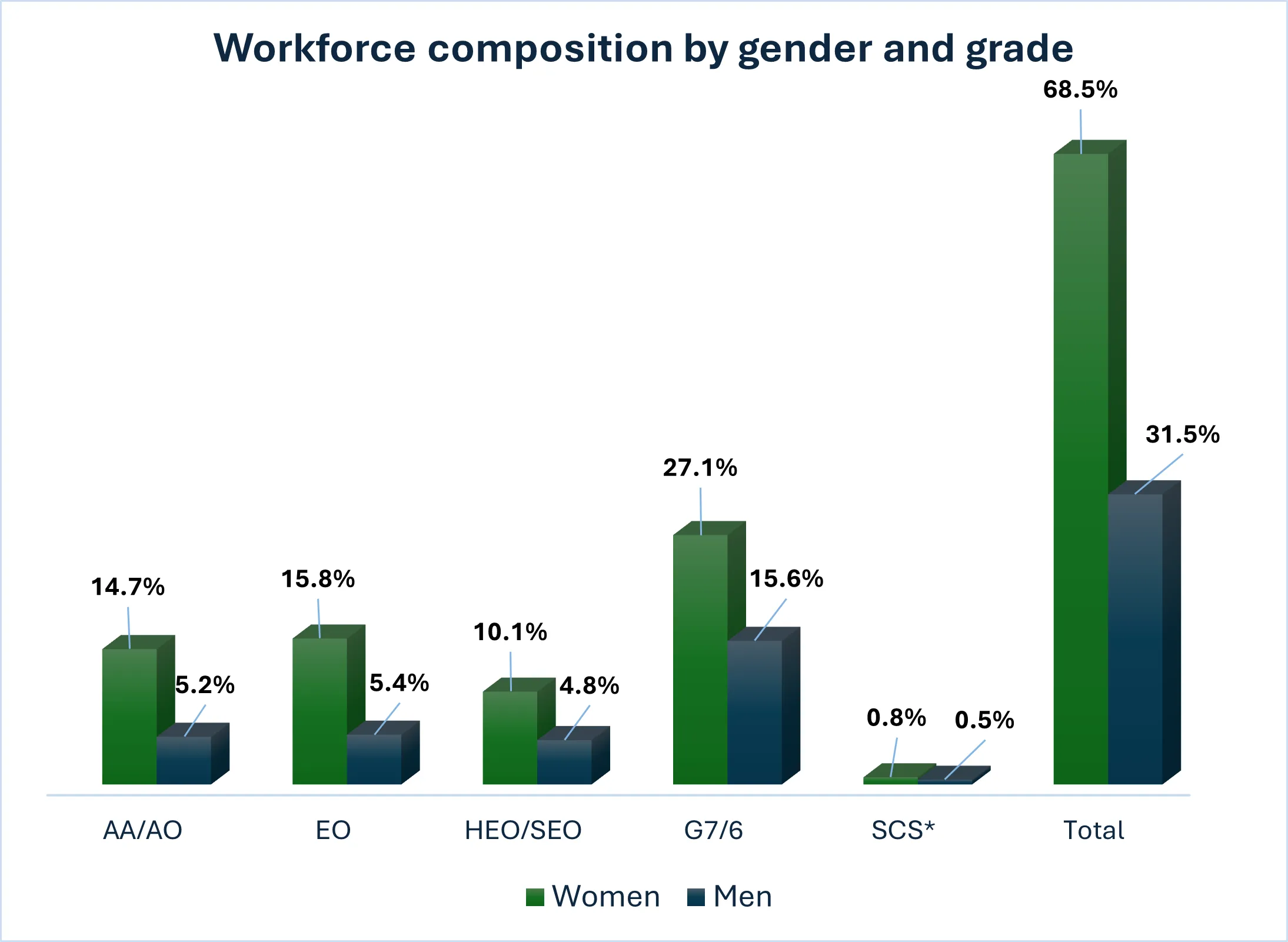
The bar chart, Figure 1, shows the percentage breakdown of the workforce by gender and grade. It illustrates the high representation of women in the more junior and lower paid grades of Administrative Assistant (AA), Administrative Officer (AO) and Executive Officer (EO). Women in these grades represent 30.6% of the entire workforce compared to only 10.5% of men in these grades.
The difference in gender distribution within these junior grades is the most significant contributing factor to the CPS gender pay gap as it substantially lowers both the mean and median hourly pay for women. The overall gender distribution for the organisation and across each individual grade remains broadly similar to previous years.
Figure 1 – Percentages by Gender and Grade across CPS Workforce
4. Gender Pay Gap Measures: Summary outcomes
CPS six gender pay gap figures reported for 2025 are set out in Table 2, Figure 2 and Table 3 below. For comparison the reported figures for both 2023 and 2024 are also included.
Table 2 - CPS Gender Pay Gap Figures 2025
| Gender Pay Gap Metric | 2025 | 2024 | 2023 |
|---|---|---|---|
| Mean Hourly Pay Gap | 9.60% | 10.10% | 10.50% |
| Median Hourly Pay Gap | 27.40% | 21.10% | 26.40% |
| Mean Bonus Pay Gap | 10.20% | 22.10% | 5.00% |
| Median Bonus Pay Gap | 0.00% | 0.00% | 0.00% |
| Proportion of males and females receiving a bonus | Men: 98.4% Women: 97.4% | Men: 53.0% Women: 49.0% | Men: 95.7% Women: 96.0% |
The data shows an overall decrease of 0.9 percentage points in the mean pay gap over the last three years and an increase of 1 percentage point in the median pay gap over the same period.
The mean bonus pay gap is a factor of the performance related pay scheme - available to the CPS’ most senior employees (SCS and equivalent grades) - and the corporate recognition schemes available to those in grades below. Whilst there is no targeted distribution for either scheme, the payment values under the former can vary significantly whereas those for the latter are a fixed value. Consequently, mean bonus pay outcomes are subject to fluctuation year on year. Notwithstanding, the majority of bonus payments are attributed to the corporate recognition schemes which results in a median bonus pay gap of zero.
The charts at Figure 2 illustrate the distribution of both men and women within each respective pay quartile. There is a significantly higher representation of women across all pay quartiles, with the greatest concentration in the lower, and lower middle quartiles where the more junior grades reside.
Figure 2 - 2025 Distribution of women and men within each pay quartile
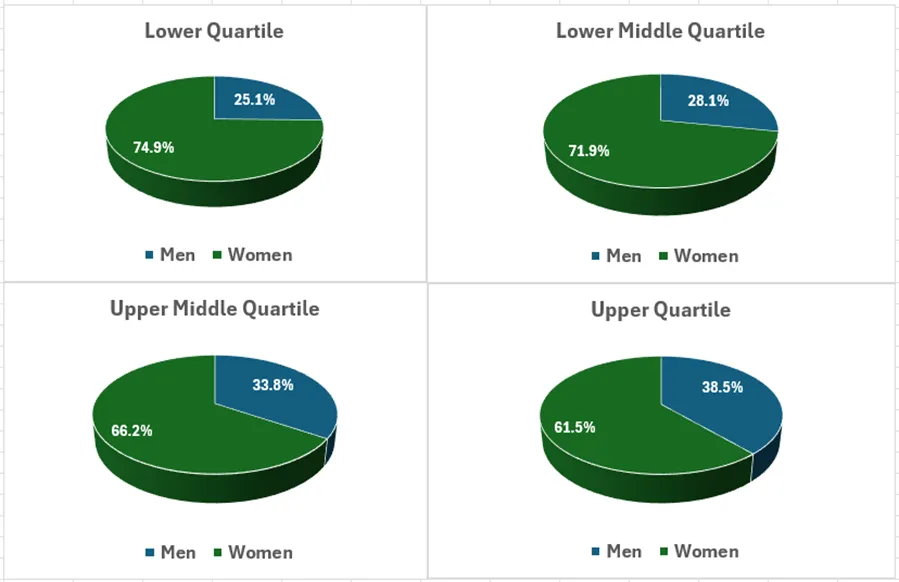
Table 3 sets out the comparative pay quartiles for the last three years. It shows a relatively consistent trend in the gender distribution albeit in 2025 there has been an increase in the proportion of women within the lower pay quartiles.
Table 3 - CPS Gender Pay quartiles 2023 to 2025
| Quartile | 2025 | 2024 | 2023 |
|---|---|---|---|
| Lower Quartile | Men: 25.1% Women: 74.9% | Men: 26.5% Women: 73.5% | Men: 26.2% Women: 73.8% |
| Lower Middle Quartile | Men: 28.1% Women: 71.9% | Men: 28.9% Women: 71.1% | Men: 29.5% Women: 70.5% |
| Upper Middle Quartile | Men: 34.3% Women: 65.7% | Men: 33.8% Women: 66.2% | Men: 34.3% Women: 65.7% |
| Upper Quartile | Men: 38.5% Women: 61.5% | Men: 39.8% Women: 60.2% | Men: 40.6% Women: 59.4% |
5. Analysis of Mean, Median and Bonus pay gaps
With respect to the monetary value, analysis of the 2025 mean and median GPG figures shows the difference in mean and median hourly pay for men and women is £2.64 and £8.00 respectively.
The CPS mean and median pay gaps are not due to men being paid higher salaries than women, but rather due to a higher concentration of women populating more junior roles (and therefore in receipt of lower salaries) when compared to men. The effect is a lower mean and median hourly rate of pay for the female workforce.
Mean Hourly Pay Gap
(Down by 0.5 of a percentage point – from 10.1% to 9.6% compared to 2024)
The average hourly pay for men increased by £2.49 to £27.57, for women the average hourly pay increased by £2.38 to £24.93. The increase in hourly pay for women is proportionally higher - a 10.55% increase compared to men where the increase equates to 9.88%.
The decrease in the mean pay gap is due to a combination of factors including but not limited to:
(1) 2024/25 pay settlement
The award provided significant increases to the most junior grades (AA/AO), along with the introduction of spot rates for all equivalent grades at EO/HEO which resulted in pay awards of up to 10%. This compares with awards up to 6% for SEO, Grade 7 and Grade 6. With a considerably higher proportion of women in grades at HEO equivalent and below, this will have contributed to the increase to the mean/average hourly pay for women.
(2) Employee turnover and recruitment
For the period April 2024 to March 2025, circa 650 employees left CPS and of these 63% were women and 37% men. Of those who joined the organisation, women comprised 76%, and men only 24%.
Within the most junior grades (AO to EO), women made up 80% of those new to CPS contributing to the increased proportion of women in the lowest pay quartiles. Coupled with the enhanced pay awards for these junior grades, this further contributed to the increased mean hourly pay for women.
Median Hourly Pay Gap
(Up 6.3 percentage points – from 21.1% to 27.4% compared to 2024)
The high concentration of women in the junior grades of AA to EO (which all place within the lower and the lower middle quartiles) means that the mid-point of the women’s pay dataset is a significantly lower hourly rate than the mid-point of the dataset for men’s hourly pay. Staff turnover as well as recruitment has impacted the median pay gap.
Although the overall CPS headcount has reduced, we have seen an increase in the proportion of women in our most junior grades (AA to EO), whereas the proportion of men in these grades has decreased. This is the net impact of both recruitment and turnover. As these junior grades place within the lowest pay quartiles, this has contributed to a smaller increase in the median pay for women compared to men. Consequently, the median gender pay gap has widened.
In actual monetary values, between 2024 and 2025, the median hourly rate of pay for men increased by £4.97 or 20% (from £24.21 to £29.18) compared to women’s median hourly pay which increased by £2.85 or 15% (from £18.95 to £21.18).
Mean Bonus Gap
(Down 11.9 percentage points – from 22.1% to 10.2% compared to 2024)
CPS maintains its in-year employee recognition schemes which rewards employees for substantial corporate contribution through the use of vouchers. Additionally, the CPS operates a non-consolidated performance related pay scheme (in-year and end-of-year) for its’ SCS and equivalent grades.
The awards under the latter scheme (available to a group of CPS’ most senior grade, equal to 1.3% of the workforce) vary in value whilst those for the former are a fixed amount. There is no target distribution for any of the schemes, but they are linked to individual performance and/or contribution which can vary. As such the mean bonus gap is subject to considerable fluctuation.
Median Bonus Gap
(0% - Unchanged from the 2024 outcome)
As with previous years, we report no median bonus gap as the monetary value of the median bonus payment is the same for both men and women.
6. Work on Reducing the Gender Pay Gap
The CPS gender ratio is slightly higher than 2:1, women to men, with almost 45% of female employees populating our most junior grades (AA/AO/EO), compared to male employees where only 33% populate these grades. To facilitate the narrowing of the pay gaps, CPS’ efforts continue to focus on removing any barriers for women to move into more senior roles. Notwithstanding, many of our career advancement and development opportunities are also available to men
Career Pathways and Talent Management
Career Pathway
The CPS Career Pathway is an online resource designed to support employees in planning their careers and exploring roles across various Civil Service professions. It provides access to development resources and highlights opportunities for lateral moves, ensuring career growth is not limited to promotion alone.
At CPS, we are committed to fostering an inclusive environment where every employee is supported in their career development regardless of their role or ambition. Whether aspiring to senior leadership or seeking to broaden expertise and/or maximise impact in their current role, we recognise that collective talent is vital to our success, and every contribution is valued.
To help everyone reach their full potential, CPS offers a broad range of development opportunities and programmes so that all our employees can find the path that’s right for them. These include on-the-job development such as project work and job shadowing; self-development – through mentoring, coaching, buddying; learning programmes – focussed on management development; Prosecutor Pathways (bespoke programmes to help individuals become qualified prosecutors); apprenticeships; learning - access to a diverse range of learning resources through the LinkedIn and Civil Service Learning (CSL) platforms.
Talent Management
At the CPS we do not believe that talent is reserved for a select few but instead that every individual has talent. Our talent strategy aims to deliver an inclusive and evidence-based approach to talent development via a model that engages our entire workforce. The model has four key pillars centred on:
- Quality succession/Workforce planning - to ensure we have the right workforce capacity and skills in place for the future;
- Engaging our most senior leaders - to take ownership and accountability for optimising the skills of the workforce;
- Developing our workforce – by supporting individuals to unlock their potential through the various programmes and opportunities available to them; and
- Measuring Talent impact - through timely analysis of relevant and specific data.
Strategic Programmes for Women’s Career Advancement
As an organisation that has a majority-female contingent, the CPS places significant emphasis on supporting women’s career progression. CPS has a number of programmes in place to help advance women’s careers (as well as men’s) and through these, work towards narrowing the gender pay gap.
The CPS offers sponsorship to external Civil Service development programmes such as Future Leaders and Beyond Boundaries, with ring-fenced places for women. Initiatives such as Beyond Boundaries focus on leadership development for mid-career women, achieving 75% female participation. Recognising the ongoing gaps in pay and representation at senior grades, the CPS has piloted initiatives including the 12-month Crossing Thresholds programme, which supports women at junior grades to progress into more senior roles. This programme has been particularly impactful, with 76% of participants achieving promotion or moving into more fulfilling positions within a year.
Pay and Reward
Equality remains a core priority within CPS’s pay and reward strategy, and the 2024/25 pay settlement reflects this commitment. Guided by our annual pay analysis, which monitors pay gaps across protected characteristics by grade, and helps to fulfil the CPS Public Sector Equality duty. We know that most of our pay gaps are within a tolerance of 3% to 5%. We recognise that the length of our pay ranges provide room for salary variation and our last several pay settlements have significantly reduced the majority of them.
Additionally for the 2024/25 settlement, the CPS introduced spot rates for all EO-equivalent roles. These spot rates deliver more meaningful and consistent pay outcomes by simplifying the pay structure and making it more transparent. The structure ensures employees receive a defined rate for the job, independent of other factors and removing any pay gaps.
Recruiting, Retaining and Developing an Inclusive Workforce
Our recruitment activity is either ‘internal’ (applications limited to existing CPS employees only) or ‘external’ (open to existing employees, the wider civil service, and the general public). During 2024/25 women accounted for almost 69% of all applications (internal and external) and almost 74% of all appointments (internal and external).
CPS recruitment complies with the Civil Service Commission Recruitment Principles that ensure appointments are on merit, following fair and open competition. To safeguard against bias at the shortlisting stage of the selection process the CPS follows an approach where each application submitted is name and gender blind (i.e. anonymised). All our panel members must complete success profile training as well as CPS e-learning modules covering equality, diversity and inclusion and its application in recruitment to help protect against unconscious bias.
The Crown Prosecution Service has a robust marketing strategy to attract quality candidates across all its core roles through a range of initiatives including proactive brand and campaign-specific awareness through LinkedIn, Instagram, paid Google search, Indeed, Glassdoor, DWP jobs, Jobs in Wales, The Student Room and legal trade publications. Our recruitment marketing content is designed to appeal to the candidates the department aims to attract and reflects where growth in certain characteristics would be beneficial. Our marketing material promotes our family-friendly and inclusive policies, aiming to demonstrate that our people can balance personal and professional responsibilities. For example, we ensure that our video, social media and written content contain profiles of employees who are reflective of the candidates we’re trying to encourage into particular roles or grades. This is intended to demonstrate the variety of role models available within the organisation and to encourage applications from those who may identify with these individuals.
Whilst our recruitment campaigns are not tailored to be gender specific, our Go Prosecute campaign over the summer of 2025, was aimed at those returning to criminal law practice, following a break. Campaigns such as this may naturally attract women who are more likely than men to have taken a break for caring responsibilities. National labour market data shows that women are significantly more likely than men to take extended breaks due to caring responsibilities.
Inclusive and Family-Friendly Workplace Policies and charters
The CPS remains committed to creating a workplace where all employees can thrive through family-friendly and inclusive policies. These include enhanced parental leave, flexible and hybrid working options, part-time opportunities, and targeted support for carers, helping staff balance professional and personal responsibilities. Such measures have contributed to maintaining a stable female workforce of 66–68% over the past 11 years and have ensured that CPS continues to exceed Civil Service averages for female representation across most grades, including the Senior Civil Servant grade. By embedding flexibility and inclusion into everyday practices, the organisation continues to foster an environment that supports long-term career sustainability, particularly for women.
The CPS has been recognised as one of the UK's most inclusive employers, we are a signatory to the Business in The Community, Race at Work Charter, have been recognised as a Disability Confident Leader, a Carer Confident organisation and named a top 10 family-friendly workplace by Working Families for the 8th consecutive year.
Furthermore, our Carers Association received the Carer's Champion award for the best Civil Service Carers Network of 2024.
CPS Staff Networks and Associations
The CPS staff associations and networks help raise awareness, shape the organisation’s culture and make it a more inclusive place to work.
Staff Associations
- Advocate for gender equality as part of broader diversity objectives.
- Influence policy developments to ensure fair treatment and equal opportunities.
- Support initiatives addressing gender pay gaps and career progression.
Staff Networks
- Provide safe spaces for discussion on gender related issues.
- Raise awareness of challenges faced by women, men, and non-binary colleagues.
- Encourage allyship and engagements in gender equality campaigns.
These groups play a vital role in advancing the CPS’ 2030 inclusion objectives by reducing barriers to career progression, promoting flexible working arrangements, supporting caregivers (often associated with traditional gender roles), and fostering a culture of respect and equality at all organisational levels.
7. Declaration
We confirm that data reported by the Crown Prosecution Service is accurate and has been calculated according to the requirements and methodology set out in the Equality Act 2010 (Specific Duties and Public Authorities) Regulations 2017.
Helen Starkey
Chief People Officer
Crown Prosecution Service
March 2026
Tackling the Gender Pay Gap – Action Plan
On 31 March 2025 the CPS reported workforce gender representation of 68.5% women and 31.5% men. Despite the overall headcount reduction in 2025 compared to 2024, the proportion of women in the organisation increased by 1.1%.
However, the majority of the female workforce sit within the most junior grades (AA-EO), representing 30.6% of the entire workforce, compared to only 10.5% of men in the same grades.
The 2024/25 pay settlement provided significant increases to the most junior grades (AA-EO), resulting in an increase in women’s average hourly pay of 10.5% compared to men where the average hourly pay increased by 9.9%. While this is a positive step, we acknowledge that further progress is necessary. Women are well represented across all CPS grades, however the proportions steadily decrease the higher the grade, whilst the reverse is the case for men. CPS’ action plan aims to improve gender representation as well as contributing towards reducing our gender pay gaps.
Actions to date:
Increased data and transparency
- Producing the Annual Equalities in Employment Report which sets out by each protected characteristic, the demographic make-up of the organisation, highlighting where barriers to inclusion exist throughout the employee workplace experience.
Inclusive and Family-Friendly Policy and Practice Review
- Set out a 3-year plan to review policies that support our people, particularly those that impact staff with protected characteristics – 2026/27 will see the review of Occupational health and the Employee Assistance provider, Respect Policy and Domestic Abuse.
- The CPS remains committed to creating a workplace where all employees can thrive through family-friendly and inclusive policies. These include enhanced parental leave, flexible and hybrid working options, part-time opportunities, and targeted support for carers, helping staff balance professional and personal responsibilities.
Leadership and Accountability
- The introduction of the CPS Leadership framework has focused the CPS on standardisation of leadership behaviors and practice across all levels and grades. It has also provided a mechanism to frame inclusive conversations around development of leadership skills, for all staff.
2026/27 Actions
The following actions, if sustained over time, will address the barriers to equitable workplace experience for all and reduce the pay gaps identified.
Data and Transparency
- In April 2026, development of the Annual Equalities in Employment Report (AEER), which will detail the workplace experiences for every protected characteristic (not just gender) specifying key data sets necessary to improve representation, advancement, and overall employee experience. Align this report with the financial year end to maintain consistency in workforce metrics. Success will be measured by the completion of the report, inclusion of actionable insights, and its use to inform targeted interventions and monitor year-over-year progress in workforce metrics.
Inclusive Policy and Practices
- Continue to monitor and improve engagement metrics through new listening approaches introduced in 2026 via the Cabinet Office’s new Employee Insights Programme, if filtering by protected characteristics is available.
- By December 2026, review and update the Respect, Violence Against Women, Domestic Abuse, Safeguarding against Sexual Exploitation and Harassment, Fertility, and Miscarriage policies to develop and implement a comprehensive framework that ensures a more supportive and structured approach throughout the employee lifecycle. Success will be measured by a demonstrable increase in employee engagement metrics in the 2026/27 People Survey. Updating these policies ensures CPS creates an inclusive workplace with respect to all protected characteristics, not just gender.
Leadership and Accountability
- Launch and embed the CPS Leadership Framework; an overarching set of behavioral standards in support of CPS 2030, our organisational priorities and the communities we serve to see improvement in the engagement metrics within the new Cabinet Office Employee Insights Program.
| Theme | Objectives | Actions | Success Measure | Timeframe |
|---|---|---|---|---|
| Increased data and transparency | Increase business awareness of gender representation and other protected characteristics across the organisation. | Provide an annual report on the workplace experience for each protected characteristic and identify essential data sets that will facilitate enhancing representation, progression, and employee experience. | Completion of the report and inclusion of actionable insights to inform targeted interventions and monitor year-over-year progress in workforce metrics. | April 2026 |
| Inclusive Policy and Practices | Review the Respect, Violence Against Women, Domestic Abuse, Safeguarding, Fertility, and Miscarriage policies to ensure fit for purpose. | Undertake a comprehensive analysis and review of each of the policies working closely with internal and external stakeholders. Ensure an equality impact assessment is carried out on all policy changes and that mitigations are addressed. | Monitor and improve engagement and reporting metrics. | December 2026 |
| Leadership and Accountability | Ensure our leaders have clear inclusion objectives aligned to CPS 2030 strategy | Launch the CPS Leadership Framework; an overarching set of behavioral standards in support of CPS 2030, our organisational priorities and the communities we serve. | See improvement in the engagement metrics within the new Cabinet Office Employee Insights Program. | November 2026 |