
Performance overview
The Performance overview provides a summary of the Crown Prosecution Service (CPS) and our purpose, objectives and performance during the year. It sets out at a high level the key risks and issues we have faced and how we have managed them. Further detail can be found in the Performance analysis.
Who we are and what we do
The CPS is at the heart of the criminal justice system in England and Wales, working with our partners to deliver justice through independent, fair and effective prosecutions. Our vision is to become:
“a leading voice in transforming the criminal justice system, using our legal expertise and digital capability to make the public safer and build the confidence of our diverse communities.”
We have more than 7,000 highly trained staff whose duty is to make sure the right person is prosecuted for the right offence, that victims are supported and that trials are fair so that offenders are brought to justice whenever possible. We are proud to be recognised as a leading employer, committed to supporting a diverse workforce that reflects the community we serve.
The CPS:
- decides which cases should be prosecuted – every charging decision is based on the same two-stage test in the Code for Crown Prosecutors
- determines the appropriate charges in more serious or complex cases, and advises the police during the early stages of investigations
- prepares cases and presents them at court; and
- provides information, assistance and support to victims and prosecution witnesses
We do not investigate crime or choose which cases to consider; our prosecutors must review every case referred to us by the police or other investigators. We provide expert legal advice early in investigations to help build strong cases or identify where a suspect should not be charged.
We make our decisions independently of the police and of government. We must always be fair, objective, and impartial to secure justice for victims, witnesses, defendants and the public.
Last year the CPS brought just under 450,000 prosecutions, with just over four in every five cases leading to a guilty plea or verdict. However, our success is not measured by the conviction rate alone. A fair trial, properly brought, may lead to a guilty or not guilty verdict. Our job is not to seek an ever-higher proportion of guilty verdicts, but to make sure that every case which satisfies the legal test set out in the Code for Crown Prosecutors goes before the courts and is prosecuted independently and fairly.
We work with criminal justice partners across borders to tackle serious economic, organised and international crime and use our powers to confiscate the proceeds of crime at home and abroad.
Because we review every case sent to us, our work is extremely varied and can be complex in nature. We prosecute offences ranging from burglary and terrorism to domestic abuse and multi-million-pound fraud cases. What these cases all have in common is that they can have a devastating impact on victims.
Significant cases that the CPS has dealt with during 2024-25 include:
- Operation Greenbank related to the devastating attack that took place on 29 July 2024 in Southport. The defendant, Axel Rudakubana, went to a Taylor Swift themed dance and yoga class which was attended by 26 girls aged between 6 and 11 years and carried out a horrific attack on those present. The prosecution team worked through extensive footage and evidence to achieve justice for the victims and their families. The CPS authorised charges of three counts of murder, ten counts of attempted murder, possession of a bladed article, production of a biological toxin, namely, ricin and possession of a document likely to be useful for terrorism. He pleaded guilty to all counts on the indictment on the morning of trial. On the 23 January 2025 he was sentenced to 52 years’ imprisonment.
- Operation Longacre – Nicholas Prosper, who was 18 years old at the time of the offences, purchased a gun and ammunition illegally and shot his family in the early hours of 13 September 2024. After a neighbour knocked repeatedly on the door, he fled his home armed with the gun intending to commit a mass shooting at his former primary school. However, after hiding for over two hours he left the gun and cartridges hidden in some bushes and made his way to a nearby road where he was arrested by police. The CPS built its case on extensive evidence including internet searches and downloads and plans that Prosper wrote in prison; all of which showed the extent of his plot to become the country’s most notorious school shooter. The defendant entered guilty pleas to three counts of murder, purchasing a firearm without a firearm certificate, possession of a firearm with intent to endanger life and possession of a bladed article. He was sentenced on 19 March 2025 to life imprisonment with a minimum term of 49 years.
- Operation Skirp was one of the largest foreign intelligence operations in the UK and involved a conspiracy to commit espionage by a team of six Bulgarian operatives on behalf of the Russian State. The operatives were all UK-based, albeit their activity spanned several countries and targeted individuals and locations of interest to the Russian State. Working closely with the Metropolitan Police’s Counter Terrorism Command, the prosecution team built a case based on a large body of evidence, including extensive Telegram communications; evidence of travel; financial evidence; and numerous technical items found at their home addresses after they had been arrested. All six defendants were convicted (three following a trial) and sentenced in May 2025 to terms of imprisonment ranging from five years and six weeks to ten years and eight months.
- Operation Stovewood is a criminal investigation by the National Crime Agency (NCA) which commenced in April 2015. Its terms of reference are non-familial child sexual exploitation and abuse (CSEA) in Rotherham between 1997 and 2013. The operation was instigated following release of the Jay Report into the handling of CSEA in Rotherham in 2014 and has at its core 1400 files from an outreach/youth organisation operating between 1997 and 2012 called Risky Business. A total of 75 offenders have been charged by the CPS with 389 offences across 47 separate cases since the commencement of Operation Stovewood. The CPS has worked closely alongside law enforcement to prosecute these complex and challenging cases. To date 42 offenders have been convicted of 204 offences.
Our values
Our values are central to everything we do.
We will be independent and fair – We will prosecute independently, without bias and will seek to deliver justice in every case.
We will be honest and open – We will explain our decisions, set clear standards about the service the public can expect from us and be honest if we make a mistake.
We will treat everyone with respect – We will respect each other, our colleagues, and the public we serve, recognising that there are people behind every case.
We will behave professionally and strive for excellence – We will work as one team, always seeking new and better ways to deliver the best possible service for the public. We will be efficient and responsible with taxpayers’ money.
How we are organised
The CPS operates across England and Wales, with 14 geographical Areas prosecuting cases locally. Each Area is typically structured into magistrates’ and Crown Court teams, in addition to specialist teams for Rape and Serious Sexual Offences (RASSO), and complex casework. Each Area is headed by a Chief Crown Prosecutor and works closely with local police forces and other criminal justice partners.
Nationally, we have an out-of-hours team, CPS Direct, who provide charging advice and authorisation to police forces outside normal business hours, and two Central Casework divisions, who deal with some of the most complex cases we prosecute.
Sitting within the Serious Economic, Organised Crime and International Directorate is the CPS Proceeds of Crime Division, a dedicated division responsible for all restraint, enforcement, and serious confiscation work, and the Organised Child Sexual Abuse Unit.
We also have a number of Headquarters Directorates, which provide corporate services and support to the prosecution teams. Our staff work closely with specialist investigators from a range of organisations, including the National Crime Agency, HM Revenue & Customs and the Independent Office for Police Conduct, as well as police forces across England and Wales.
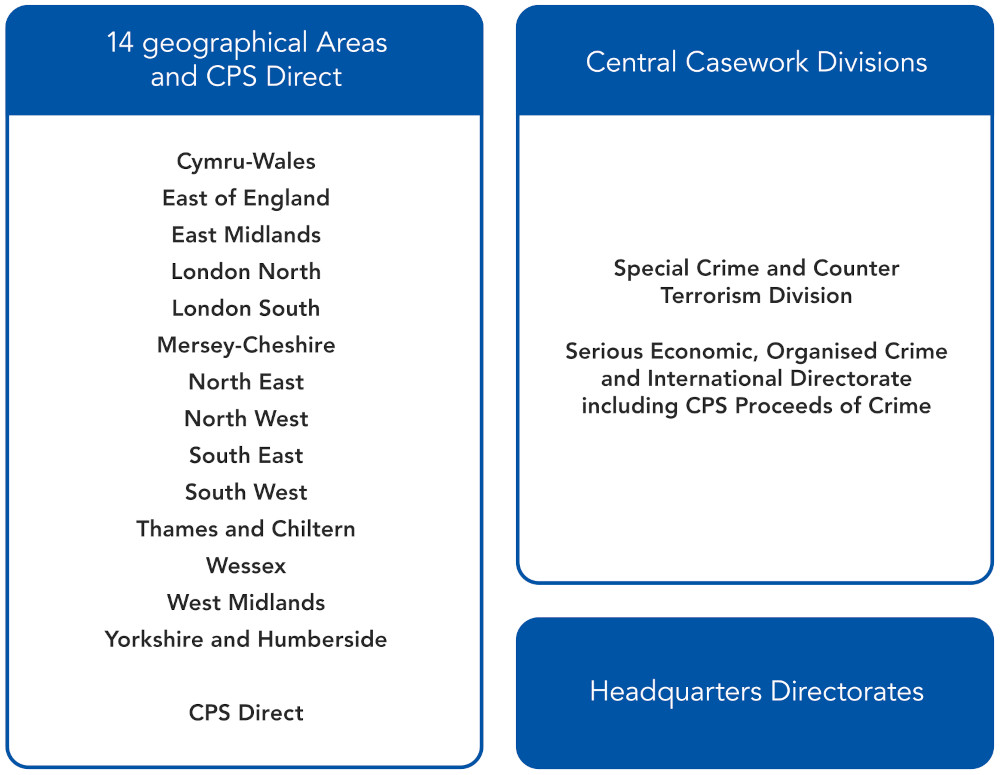
14 geographical Areas and CPS Direct
- Cymru-Wales
- East of England
- East Midlands
- London North
- London South
- Mersey-Cheshire
- North East
- North West
- South East
- South West
- Thames and Chiltern
- Wessex
- West Midlands
- Yorkshire and Humberside
- CPS Direct
Central Casework Divisions
- Special Crime and Counter Terrorism Division
- Serious Economic, Organised Crime and International Directorate including CPS Proceeds of Crime
Headquarters Directorates
Our operating environment and key challenges
This year’s annual report represents our work in the final year of delivering our CPS 2025 strategy. We have experienced a change in government, which has included navigating a Spending Review and responding to changes in policy. In this complex and evolving environment, we continue to strive to improve our performance, services and public confidence.
Operational effectiveness
The volume of cases we handle remains challenging, and caseloads have continued to increase throughout this year as receipts into court have outpaced finalisations. This was further exacerbated by the disorder that occurred in Summer 2024, which required an unprecedented and co-ordinated response by the criminal justice system to deliver justice for the perpetrators.
The strength of the CPS is its staff. Retaining experienced staff and attracting legal professionals is key. We are continuing to ‘grow our own’, with clear progression pathways and are starting to see good results.
We continue to strive to be as effective as possible, exploring emerging technologies such as AI and digital tools. We have introduced new digital services and automated processes to improve casework management. The digital jury bundles programme will improve our efficiency and sustainability.
Violence against women and girls (VAWG)
Tackling VAWG remains a high priority. Despite the progress we have made, we recognise that much more work is needed to improve our prosecution processes and victim support.
Our work to improve our performance in Rape and Serious Sexual Offences (RASSO) cases includes the new National Operating Model for adult rape prosecutions, based on the independently reviewed Operation Soteria.
As part of our Advocacy Strategy, we have increased the number of specialist RASSO external advocates by 44% to nearly 1,000.
We have also improved our support for adult victims of RASSO through dedicated Victim Liaison Officers – a consistent point of contact for victims within the CPS – and now offer a pre- trial meeting with members of the prosecution team.
Our work to improve our approach to Domestic Abuse (DA) prosecutions includes a new Joint Justice Plan, which focuses on stronger collaboration with the police to transform how we investigate and prosecute these cases, including through updated training.
Fairness for all
Maintaining public confidence in the criminal justice system is an ongoing challenge. This requires us to deliver prosecutions that are in the public interest as well as services that treat victims with empathy and defendants fairly.
This year we have built upon our work with Leeds University which identified racial disparities in charging decisions, with further research to understand its drivers. We then used this evidence base to develop an ambitious action plan to eradicate disproportionality from our legal decision-making.
Our strategy
Our organisational strategy CPS 2025 was launched in 2020 and ended in March 2025. Within the strategy, we outlined five strategic aims.
- Our people – Support for the success and wellbeing of our people enables everyone to thrive.
- Digital capability – Our investment in digital capability helps us adapt to the rapidly changing nature of crime and improve the way justice is done.
- Strategic partnerships – The CPS is a leading voice in cross-government strategies and international cooperation to transform the criminal justice system.
- Casework quality – CPS legal expertise, casework quality and collaboration across the criminal justice system keep the public safer.
- Public confidence – We work with partners to serve victims and witnesses and uphold the rights of defendants in a way that is fair and understood by all communities.
Everything we have done over the past five years has been designed to deliver the strategic vision of CPS 2025. The performance analysis section explores the progress we have made against each of our five strategic aims.
Performance summary
This section touches on the main themes and highlights of our performance during the last year. These are then explored in more detail in the Performance analysis section below.
While our performance reflects our challenging operational environment we delivered significant and important achievements this year. We have improved our charging and casework quality, while enhancing digital benefits for case progression. We have improved our services to victims and witnesses; and the way we engage and motivate our people. We have increased awareness about who we are and what we do, through building stronger strategic relationships.
High-quality casework is crucial for fair and effective prosecutions. This year, we improved processes by implementing a new operating model in both the Crown Court and magistrates’ court, enhancing legal decision- making and case management.
As a central part of the criminal justice system, we recognise the importance of developing strong relationships with our strategic partners and stakeholders. This year we worked proactively with criminal justice system partners to stabilise and improve the criminal justice system in the short, medium and long term.
This included providing operational insights and expertise to support the development of the Government’s Safer Streets Mission, with landmark reviews into sentencing and the criminal courts. We also contributed to the coordinated and robust response across the criminal justice system to the public disorder in summer 2024.
We are dedicated to improving the service we provide to victims of crime. As of November 2024, every CPS Area now has at least one Victim Liaison Officer in its rape and serious sexual offences unit. Adult victims of rape and sexual offences are offered a pre-trial meeting with members of the prosecution team to have their questions answered.
In two CPS Areas, we are piloting directly informing victims about our charging decisions. This year we explained charging decisions and signposted support services to over 1000 victims.
We have maintained momentum in delivering our ambitious programme of digital projects, enhancing our capabilities, and increasing capacity. We have restructured our digital and technology functions to align to the government’s digital and data professions.
We have invested in our internal capability and skills, while getting the right support from carefully selected suppliers, to enable us to meet the needs of frontline teams.
Our Casework App has delivered significant benefits and automation, reducing time spent managing case files. We also launched a faster online service for witness expenses. We continue to use automation and digitisation to drive out inefficiencies and improve file quality.
Our people are central to the delivery of the CPS’ core purpose. We are committed to creating a diverse and inclusive workforce that reflects the communities we serve – attracting and supporting talented professionals to realise their potential.
This year’s Civil Service People Survey (CSPS) showed that our people remain dedicated to our shared purpose and that results on learning and development remained above wider Civil Service benchmarks.
We have continued to make our work and insight available to Parliament and government which has promoted greater awareness and understanding about the CPS’ core role and functions. This has included 102 MP meetings with Chief Crown Prosecutors across all 14 CPS Areas since the General Election in July 2024. We also responded to 55 Parliamentary Questions – fewer than average due to the 2024 General Election hiatus.