Performance analysis
This section provides a summary of the CPS’ performance against our CPS 2025 strategic aims and outcomes, most of which come from the delivery of the Business Plan 2024-25.
1. Our people
Support for the success and wellbeing of our people enables everyone to thrive.
Strategic workforce
Through the attraction, development and retention of our people across all professions, we have built firm foundations for a future focused workforce with the right skills and capability. Whilst the labour market has continued to bring challenges for our legal workforce, we have seen high internal promotion rates across Operational Delivery and specialist professions, indicating the success of our development, talent and succession strategies.
Our `grow our own’ approach – through our established Prosecutor Pathways – has remained essential within our legal workforce. As a result, we have limited our legal vacancy rate to 2.6%, and over 40% of Crown Prosecutor roles have been filled by internal candidates.
We use data from the CSPS to monitor the engagement and wellbeing of our people and deliver changes to improve their overall experience. The CPS response rate this year was 46% which showed a -15-percentage point (pp) decrease on the 2023 survey (61%) and was 15pp lower than the Civil Service. Research demonstrated that this was primarily due to high workloads and a lack of trust in the survey, both of which CPS are proactively working to resolve. The CPS is partnering with DTUS to drive a more productive response rate, rebuild trust in the survey and increased staff engagement for 2025. The CPS is using different approaches such as pulse surveys, combined with a robust approach to action planning, to ensure quality and timeliness of improvements to support our peoples’ experience in work.
We have introduced new initiatives such as `Go Prosecute’ to attract criminal law barristers and solicitors back into the profession following career breaks; and a new Crown Advocate 1 (CA1) role to secure development and progression pathways into advocacy. This saw 40 CPS employees moving into CA1 roles, boosting our crown advocacy resource.
We remained above the Civil Service Employee Engagement Index (EEI) benchmark for 2024 (64%). This is one of our highest EEI scores ever, and many of the core themes in the latest survey remained close to their highest historic levels. For example, we are proud that `Organisational Objectives and Purpose’ remained our highest scoring theme (90% positive), reflecting our people’s deep understanding of, and commitment to, their part in delivering justice. We are also pleased that `Learning and Development’ maintained its highest ever score (63% positive) for the fifth year running and remains 7pp above the Civil Service benchmark. This investment in training and talent has remained key to supporting our strategic workforce plan and developing our people in successful CPS careers.
We are also proud that a benchmark against government HR functional standards reinforced our best-in-class service for how we recruit and onboard new people into the CPS – reflecting our strong track record in securing the right workforce and being an employer of choice for criminal law.
All parts of our workforce are diverse and inclusive
This year we remained in the Top 10 employers for Working Families, hold Disability Confident Leader status, were recognised as a Carer Confident Employer, are signatories to the Business In The Community Race at Work Charter and are a top 75 Employer in the Social Mobility Index.
Our diversity and inclusion initiatives remain evidence led, and data driven. We introduced measures such as a targeted coaching offer, career development workshops and interview skills development for groups where positive action is needed. These initiatives formed part of our commitments in the CPS’ Disproportionality Action Plan.
2. Digital capability
Our investment in digital capability helps up adapt to the rapidly changing nature of crime and improve the way justice is done.
The maturity of artificial intelligence has progressed at pace last year bringing with it opportunities and risks. The CPS has continued to work with criminal justice partners and expert practitioners to explore how AI can improve productivity and efficiency.
Building on our momentum from previous years we have designed and launched new digital services and automated processes for frontline colleagues to improve how casework is managed.
We have successfully tested replacing paper jury bundles with digital ones, improving sustainability and driving efficiencies. We have developed a plan to pilot the service at a number of court sites in 2025-26, gathering user and colleague feedback to inform a national roll out.
This year, we restructured our digital and technology functions to align to government digital and data professions, making sure we have the right balance of in-house capability and support from carefully selected suppliers to meet the digital and technology needs of frontline colleagues.
Creating efficiency through new digital tools
Our Casework App has delivered significant benefits over the past year, saving an estimated 150,000 working hours.
We have streamlined the management of emails through email automation: automatically processing messages and forwarding them to our Case Management System. We have now automatically processed over 2.2 million emails, significantly reducing the time spent on manual tasks and saving over 20,000 working hours. Staff can now focus on higher value work, while reduced manual intervention has also improved data accuracy, and the overall quality of case information.
Easier ways for our people to identify priority work
We have introduced new Work Management dashboards that provide managers with a daily summary of tasks and directions across Magistrates and Crown Court Units. Using Power BI-based reporting, we have automated existing processes, reduced manual intervention, and improved data accuracy – helping managers more effectvely oversee and support their teams.
We have also replaced the existing task management interface with a new, user-friendly tool designed to improve case progression and prioritisation, making it easier for teams and individuals to manage tasks.
Introducing a new online service for victims and witness expenses
The CPS’ first digital service for victims and witnesses simplifies the process of claiming expenses ensuring timely payments and enhancing accessibility and transparency. The application is designed to be accessible to all users, including those with disabilities, so that everyone can easily claim backs costs to support their attendance at court.
The new system provides clear guidance and information on the expenses claim process, helping witnesses understand what they can claim and how to do so. By digitising the expenses claim process, we have eliminated the need for paper forms and postal submissions, with 99.9% of witness claims now processed digitally.
3. Strategic partnerships
The CPS is a leading voice in cross-government strategies and international cooperation to transform the criminal justice system
The CPS worked closely with criminal justice partners to provide operational insight into the Safer Streets Mission. We continue to work with cross government criminal justice governance to support the government’s aim of improving confidence within the criminal justice system.
We have contributed to the independent review of the criminal courts and the sentencing review to inform the radical changes needed to stabilize and improve the criminal justice system in the short, medium and longer term.
Operational policy/Local Criminal Justice Boards
The CPS has worked closely with the National Police Chiefs’ Council (NPCC) to improve frontline communication. We have designed and implemented national guidance and increased casework conversations between prosecutors and police officers across CPS Areas.
We have continued to engage with Police and Crime Commissioners (PCCs) on issues central to their role as conveners of Local Criminal Justice Boards, such as race disproportionality in CPS decision-making. We also contributed to the induction programme for those PCCs who were newly elected in May 2024.
We lead on futures thinking to understand issues across the criminal justice system
Last year, we prioritised our work around two insights: the changing nature of work and skills; and the impact of disinformation and a loss of public trust in the justice system.
We shared these insights and helped build capability to allow teams to consider futures thinking when building plans and long-term strategies. This included supporting the development of the CPS’ next organisational strategy and the Safer Streets Mission, including through a cross-CJS futures exercise for Permanent Secretaries.
We advise Parliamentarians and Ministers on the operational implications of law and policy
We have continued to work collaboratively with government departments on draft legislative proposals and bills. We have provided prosecutorial expertise on the Crime and Policing Bill, the Border Security, Asylum and Immigration Bill and the Victims, Courts and Public Protections Bill.
We have developed our organisational position around AI, ensuring we are aligned to wider government priorities, strategies and publications from central government.
This included working with both the Ministry of Justice and the Home Office to share prosecutorial insights on proposed AI offenses, and the potential impact of AI on the criminal justice system. We also engaged with the Department for Science, Innovation and Technology (DSIT) in developing wider frameworks and governmental AI strategies.
We deliver justice across borders through effective international collaboration
We have supported the Home Office and law enforcement partners with the national roll out of Crime Overseas Production Orders (COPO). By sharing our expert legal and international knowledge, to shape processes and policies, we have safeguarded the admissibility of COPO material and shaped Home Office activities to maximise the impact of this valuable tool in criminal investigations and prosecutions – while supporting a strong and effective relationship with the United States of America.
We played a key role in shaping the Border Security Command, including influencing the Border Security, Asylum and Immigration Bill to strengthen our ability to prosecute pilots of small boats. We have also engaged with international partners to strengthen our cooperation abilities, including securing agreement between key countries to share real time evidence and seize small boat equipment, supporting the government and NCA’s disruption priorities.
Our international work also supports UK domestic casework outcomes, achieving justice for UK victims by developing international casework strategies that carefully navigate complexities in cross border crimes.
Through international cooperation and our Liaison Prosecutor Network, we have secured the return of individuals, assets and evidence from overseas. For example, our Liaison Prosecutor in Pakistan was essential in securing vital evidence in the conviction of Urfan Sharif, Beinash Batool and Faisal Malik for the murder of Sara Sharif in December 2024. They were sentenced to a combined total of over 89 years in prison.
4. Casework quality
CPS legal expertise, casework quality and collaboration across the criminal justice system keep the public safer
Casework quality remains central to the work of the CPS. The Code for Crown Prosecutors sets out key principles for our decision making, while our published legal guidance supplements this by addressing specific areas of our work. By keeping our guidance under review, we continue to provide a clear and effective framework for our decision-making.
Cases are progressed in a timely manner
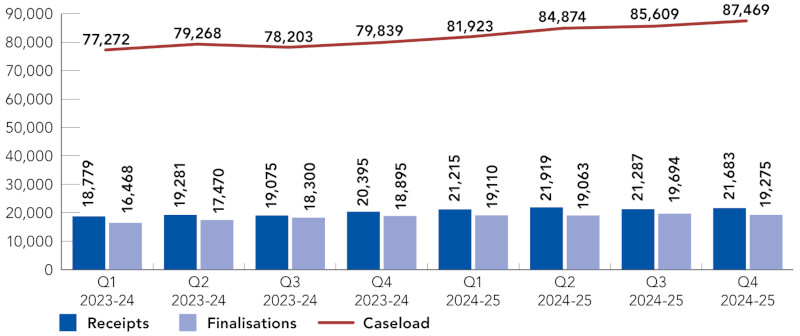
Last year, Crown Court backlogs remained an unprecedented challenge for the criminal justice system. The CPS Crown Court backlog stood at 87,469 in March 2025, which is significantly higher than the pre-pandemic February 2020 baseline of 44,317 cases.
We have continued delivering our full range of core functions throughout these challenging times through proactive investment in digital capability, strong governance, a nationally led approach, and the management of regional variance in caseloads through our Central Prosecutor Team (CPT).
This year we have completed the roll out of our new operating model for both the Crown Court and magistrates’ court, with a focus on casework strategy, to improve the quality of legal decision making and ensure thorough strategic planning throughout the case. We saw a slight decline in overall charging performance in 2024-25 as show in table 1. The main reason for this was the 6% increase in the number of pre-charge decision referrals from the police. This was further exacerbated by the pre-charge decision workload being at an all-time high. The increase in case complexity and case mix prolongs the time it takes to verify that police file submissions are of appropriate quality to ensure a timely charging decision can be made.
Table 1 – Success Measure: % of charging decisions completed on time 1
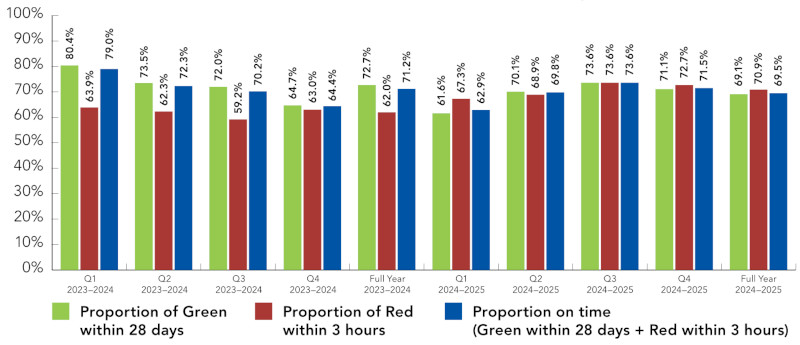
| Period | Q1 2023-24 | Q2 2023-24 | Q3 2023-24 | Q4 2023-24 | Full Year 2023-24 | Q1 2024-25 | Q2 2024-25 | Q3 2024-25 | Q4 2024-25 | Full Year 2024-25 |
|---|---|---|---|---|---|---|---|---|---|---|
| Proportion of Green within 28 days | 80.4% | 73.5% | 72.2% | 64.7% | 72.7% | 61.6% | 70.1% | 73.6% | 71.1% | 69.1% |
| Proportion of Red within 3 hours | 63.9% | 62.3% | 59.2% | 63.0% | 62.0% | 67.3% | 68.9% | 73.6% | 72.7% | 70.9% |
| Proportion on time (Green within 28 days + Red within 3 hours) | 79.0% | 72.3% | 70.2% | 64.4% | 71.2% | 62.9% | 69.8% | 73.6% | 71.5% | 69.5% |
- Previous data published in the Annual Report and Accounts only included the 14 CPS Area rate and will be different from the figures shown in this graph. For publication purposes we publish national data which also includes the work of the Casework Divisions, which are not region-specific and deal with specialised caseloads such as organised crime and terrorism. Future publications will be consistent with the data provided in this graph.
We are a demand-led service and receive case files from the police and a small number of other investigatory agencies. The timeliness of our charging decisions is affected by the quality of the referrals we receive. We measure the quality of files through compliance with the Director’s Guidance 6th Edition, which is issued by the Director of Public Prosecutions under the provision of section 37A of the Police and Criminal Evidence Act 1984. The Director’s Guidance sets out what should be included in police submissions for the CPS to determine whether and what to charge in each case.
To aid compliance, this year, we published a joint Director’s Guidance Assessment (DGA) frequently asked questions document, as well as rolling out supervisor training. Compliance is assessed by the application of the DGA and table 2 shows the CPS’ compliance.
In 2024-25 police compliance as shown through DGA stood at 60.4%, a 2.6 percentage point improvement on 2023-24 performance (which stood at 57.8%). To ensure strong prosecution reviews and decisions, 35% of cases require further information to ensure a quality decision and or outcome.
Table 2 – Director’s Guidance Assessment Compliance
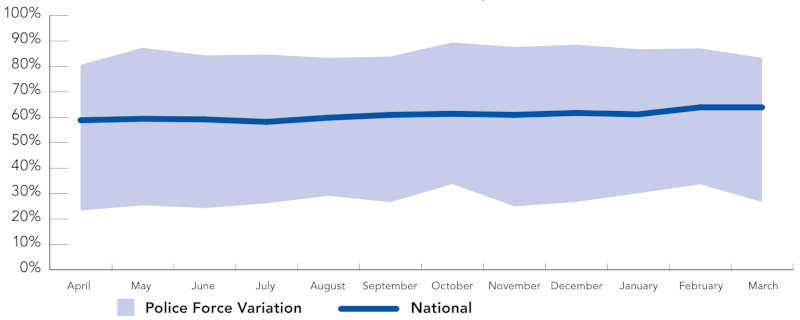
| April | May | June | July | August | September | October | November | December | January | February | March | |
|---|---|---|---|---|---|---|---|---|---|---|---|---|
| Police Force Variation | 78.4% | 84.5% | 81.8% | 82.1% | 80.9% | 81.4% | 86.4% | 84.8% | 85.6% | 84.0% | 84.3% | 80.9% |
| 26.3% | 28.2% | 27.2% | 28.9% | 31.6% | 29.3% | 35.8% | 27.8% | 29.4% | 32.5% | 35.7% | 29.4% | |
| National | 58.6% | 59.1% | 58.9% | 58.0% | 59.5% | 60.5% | 60.9% | 60.5% | 61.2% | 60.7% | 63.2% | 63.2% |
Table 3 – Magistrates’ court caseloads
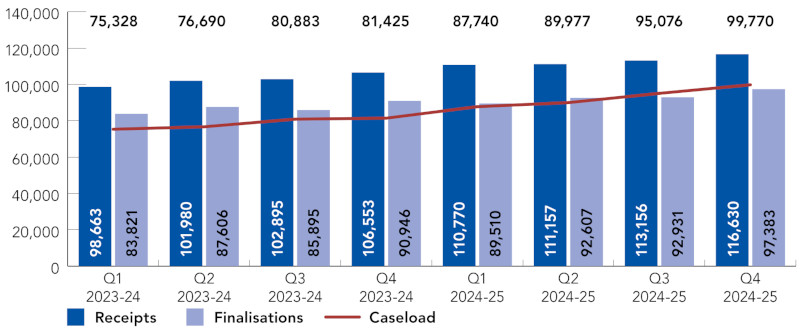
| Period | Q1 2023-24 | Q2 2023-24 | Q3 2023-24 | Q4 2023-24 | Q1 2024-25 | Q2 2024-25 | Q3 2024-25 | Q4 2024-25 |
|---|---|---|---|---|---|---|---|---|
| Receipts | 98,663 | 101,980 | 102,895 | 106,553 | 110,770 | 111,157 | 113,156 | 116,630 |
| Finalisations | 83,821 | 87,606 | 85,895 | 90,946 | 89,510 | 92,607 | 92,931 | 97,383 |
| Caseload | 75,328 | 76,690 | 80,883 | 81,425 | 87,740 | 89,977 | 95,076 | 99,770 |
Table 4 – Crown Court caseloads
| Period | Q1 2023-24 | Q2 2023-24 | Q3 2023-24 | Q4 2023-24 | Q1 2024-25 | Q2 2024-25 | Q3 2024-25 | Q4 2024-25 |
|---|---|---|---|---|---|---|---|---|
| Receipts | 18,779 | 19,281 | 19,075 | 20,395 | 21,215 | 21,919 | 21,287 | 21,683 |
| Finalisations | 16,468 | 17,470 | 18,300 | 18,895 | 19,110 | 19,063 | 19,694 | 19,275 |
| Caseload | 77,272 | 79,268 | 78,203 | 79,839 | 81,923 | 84,874 | 85,609 | 87,469 |
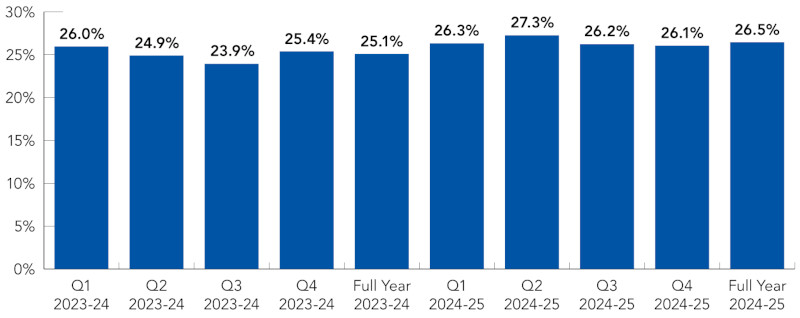
The CPS has a responsibility to continually review cases and take account of any change in circumstances. If the prosecutor considers that the case no longer meets the evidential or public interest test set out in the Code for Crown Prosecutors then it is their duty to drop the case. If a prosecution is to be dropped it is fairer and more efficient to drop it at the earliest opportunity. Table 5 shows the proportion of dropped cases that were not dropped until the third or subsequent hearing. Dropped cases include those discontinued in advance of the hearing, where the CPS offered no evidence, those withdrawn at court, and cases where the defendant was bound over to keep the peace. There is a slight increase in cases dropped at third or subsequent hearing in 2024-25 when compared to 2023-24. While there is a driving factor of victims and witnesses disengaging with the process and withdrawing their support for prosecutions due to delays in the system, this reduction highlights the fact that our revised operating models have encouraged earlier reviews of cases.
This has allowed us to take prompt action when a victim or witness disengages; ensuring that action is taken to either support the victim or witness where appropriate, or that the case is promptly taken out of the system and that unnecessary hearings do not take place – reducing inefficiency.
Table 5 – Success measure: % of Magistrates’ court cases dropped at 3rd or subsequent hearing
| Period | Q1 2023-24 | Q2 2023-24 | Q3 2023-24 | Q4 2023-24 | Full Year 2023-24 | Q1 2024-25 | Q2 2024-25 | Q3 2024-25 | Q4 2024-25 | Full Year 2024-25 |
|---|---|---|---|---|---|---|---|---|---|---|
| % MC dropped at third | 26.0% | 24.9% | 23.9% | 25.4% | 25.1% | 26.3% | 27.3% | 26.2% | 26.1% | 26.5% |
Cases are dealt with effectively
Under joint CPS-Police governance, a new charging model has been rolled out from September 2022 across all CPS Areas and their respective police forces. Over the last year, we completed the roll out of the model.
The new model was jointly agreed between policing and the CPS after extensive testing. It affords priority to the most serious cases in terms of threat, risk, and harm. It also simplifies submission routes for all cases by using more efficient digital processes, focusing on quality, timeliness and better real-time communication between the CPS and police investigators.
The initial six-month evaluation of the new model confirmed it was achieving the anticipated benefits. A second evaluation report was produced before the end of July 2024 to further monitor progress – and again confirmed it was proving beneficial.
This year we have continued to improve our approach to case strategies. Our ability to express a clear case strategy is an essential element of our work and we have continued to deliver a programme to enhance prosecutors’ skills and capabilities in this area. We have continued to support prosecutors by developing podcast training and publishing updated legal guidance which gives clear direction on evidential and public interest factors to support charging decisions.
We have continued to prioritise improvements in how we progress rape and serious sexual offences cases. We have analysed the wide range of activity and approaches undertaken by CPS Areas in response to Operation Soteria to address falls in referrals, efficiency and effectiveness of rape prosecutions, support for victims, and engagement with specialist services providers and interest groups. This analysis has been informed by the findings of an independent academic review. This work culminated in the CPS National Operating Model for prosecuting adult rape – launched in July 2023 and consisting of 29 elements to ensure a uniform approach, rooted in best practice, across the CPS.
By the end of 2024, all 29 recommendations having been delivered.
These include joint agreements with police concerning aspects of early advice from the CPS during investigations, refreshed training for prosecutors, guidance on ‘suspect-centric’ approaches, specialist case progression resources, and dedicated communications channels for specialist Independent Sexual Violence Advisers.
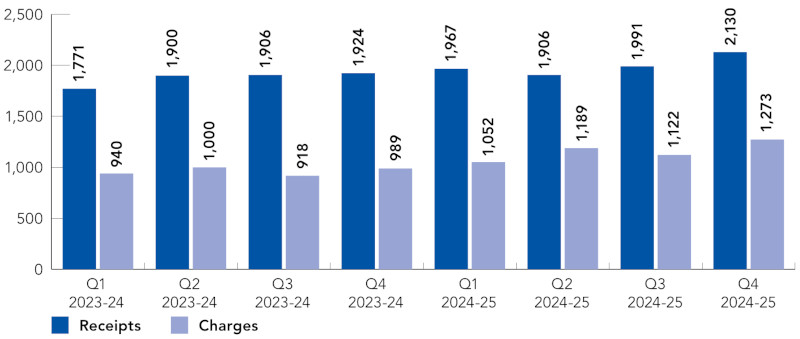
Table 6 – Rape receipts and charges
| Period | Q1 2023-24 | Q2 2023-24 | Q3 2023-24 | Q4 2023-24 | Q1 2024-25 | Q2 2024-25 | Q3 2024-25 | Q4 2024-25 |
|---|---|---|---|---|---|---|---|---|
| Receipts | 1,771 | 1,900 | 1,906 | 1,924 | 1,967 | 1,906 | 1,991 | 2,130 |
| Charges | 940 | 1,000 | 918 | 989 | 1,052 | 1,189 | 1,122 | 1,273 |
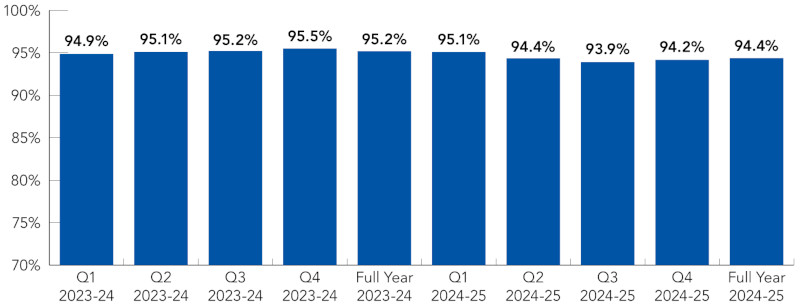
Table 7 – Success measure: % of Judge directions that are complied with on time
| Period | Q1 2023-24 | Q2 2023-24 | Q3 2023-24 | Q4 2023-24 | Full Year 2023-24 | Q1 2024-25 | Q2 2024-25 | Q3 2024-25 | Q4 2024-25 | Full Year 2024-25 |
|---|---|---|---|---|---|---|---|---|---|---|
| % Judge Directions completed on time | 94.9% | 95.1% | 95.2% | 95.5% | 95.2% | 95.1% | 94.4% | 93.9% | 94.2% | 94.4% |
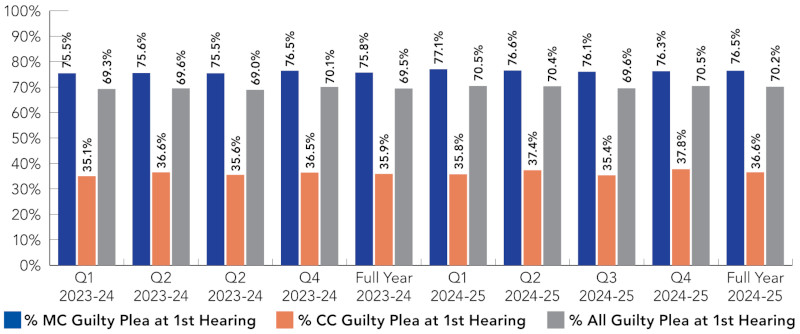
Table 8 – Success measure: % of guilty pleas at first hearing
| Period | Q1 2023-24 | Q2 2023-24 | Q3 2023-24 | Q4 2023-24 | Full Year 2023-24 | Q1 2024-25 | Q2 2024-25 | Q3 2024-25 | Q4 2024-25 | Full Year 2024-25 |
|---|---|---|---|---|---|---|---|---|---|---|
| % MC Guilty Plea at 1st Hearing | 75.5% | 75.6% | 75.5% | 76.5% | 75.8% | 77.1% | 76.6% | 76.1% | 76.3% | 76.5% |
| % CC Guilty Plea at 1st Hearing | 35.1% | 36.6% | 35.6% | 36.5% | 35.9% | 35.8% | 37.4% | 35.4% | 37.8% | 36.6% |
| % All Guilty Plea at 1st Hearing | 69.3% | 69.6% | 69.0% | 70.1% | 69.5% | 70.5% | 70.4% | 69.6% | 70.5% | 70.2% |
Guilty pleas at first hearing are expressed as a percentage of all guilty pleas. There is a 0.7 percentage points improvement from the previous year.
The quality of our casework is enhanced through partnership working
We remain determined to improve our work on Domestic Abuse (DA) cases. We have developed a Domestic Abuse Joint Justice Plan (DAJJP) that is transforming how we investigate and prosecute domestic abuse cases, while providing flexibility to respond to local needs and service provision. The DAJJP promotes collaboration between the CPS and policing, which is key to securing justice for victims and holding offenders to account.
We conducted extensive stakeholder engagement activities and considered the academic research from Operation Soteria and inspectorate recommendations to inform the strategic priorities of the DAJJP.
We have also worked with police and the Home Office to develop Domestic Abuse Protection Order pilots and set up Local Partner Steering Groups. We have updated our guidance on DA, stalking and harassment and coercive and controlling behaviour to support prosecutors with their case strategy. Training has also been improved across VAWG casework with compulsory DA refresher training and modules on stalking and coercive control offences now available to all prosecutors.
5. Public confidence
We work with partners to serve victims and witnesses and uphold the rights of defendants in a way that is fair and understood by all communities
The public rightly expect us to effectively deliver independent and fair prosecutions. Having a service that treats victims and defendants properly is key to building the public’s confidence in the CPS and the wider criminal justice system.
This year we have worked to improve the way we communicate with victims and witnesses, challenged ourselves to tackle racial disproportionality and worked with partners to respond swiftly and effectively to the violent disorder seen last summer – including communicating our work effectively to the public.
Victims and witnesses have a fair experience interacting with us, regardless of outcome
As well as our work to improve our support to all adult victims of rape and serious sexual offences, we have taken wider action to improve the standard of our communications with all victims, including a thorough review of our Victim Communication and Liaison Scheme letters.
As of April 2025 over 800 staff in victim facing roles will have received training in trauma informed communication.
We have provided new letter templates and guidance for communicating with victims, developed jointly with victim input. Our work on improving the service we offer to victims of crime is ongoing. Looking forward, we will continue to improve our service, including through staff training and improved monitoring. We will evaluate our pilots and take a decision about next steps.
We understand how best to serve our diverse communities
We have published an ambitious plan to tackle racial disproportionality and safeguard fair prosecution decision-making for all.
Our plan was developed after research, commissioned by the CPS and overseen by an independent Disproportionality Advisory Group, found that defendants from minority ethnic backgrounds were significantly more likely to be charged for a comparable offence than white British defendants.
The public understand our value
In summer 2024, during the worst disorder the UK had seen for over a decade, we worked hard to tackle misinformation and share clear messages direct to the public. We used media engagement, broadcast interviews and digital content on social media to explain the law on violent disorder, publicise our charging decisions and make sure the public knew that those responsible for the disorder were being prosecuted quickly and effectively – all contributing to deterring further offending.
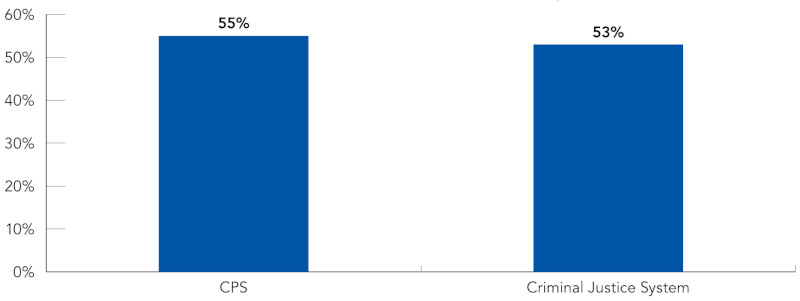
Our programme of public polling helps us understand and track the level of public confidence in our work. We surveyed levels of confidence in the fairness, effectiveness, and independence of the CPS and of the wider criminal justice system. All three CPS measurements saw improvements from the previous reporting year and tracked higher than measurements for the wider criminal justice system, with more than half of those surveyed online agreeing that the CPS is fair and independent.
Table 9 – Confidence that the CPS and CJS are “fair”
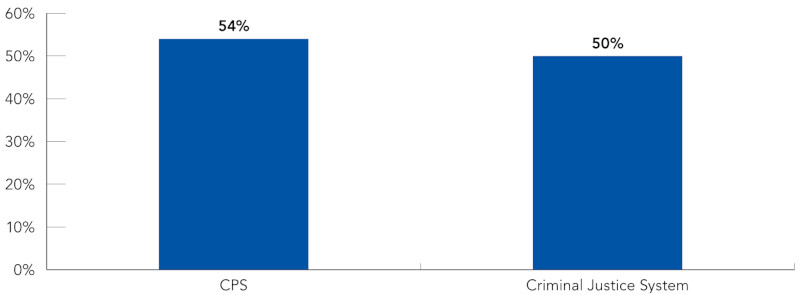
Table 10 – Confidence that the CPS and CJS are “effective”
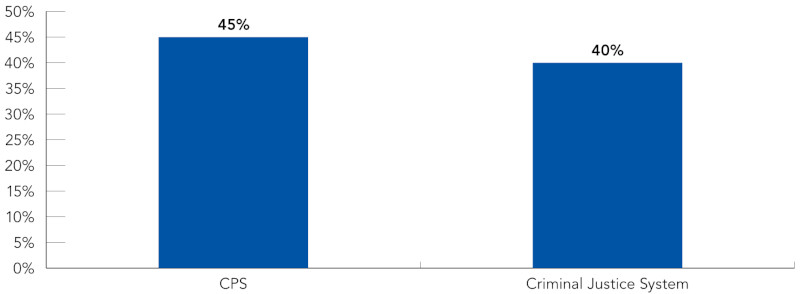
Table 11 – Confidence that the CPS and CJS are “independent”