
Corporate governance report
This report explains the composition and organisation of our governance structures and how they support the achievement of our strategic objectives.
Governance statement
This Governance Statement sets out our governance, risk and assurance management and internal control framework for both the Departmental Resource Accounts and the CPS Trust Statement, and how, during 2025-26, we managed the significant risks to the achievement of our strategic objectives.
Governance framework
Our top-level governance structure as at 31 March 2026 is set out below.
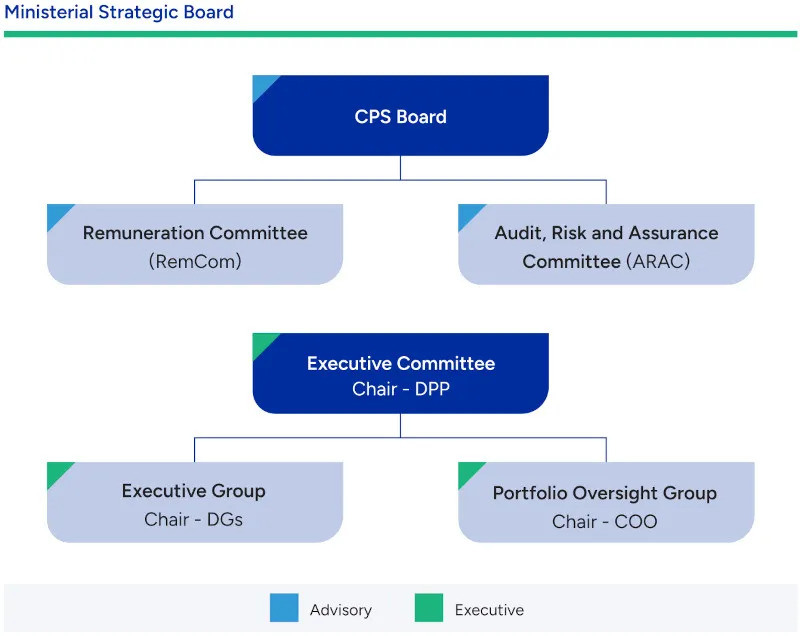
- Ministerial Strategic Board
- CPS Board (Advisory)
- Remuneration Committee (RemCom) (Advisory)
- Audit, Risk and Assurance Committee (ARAC) (Advisory)
- Executive Committee, Chair - DPP (Executive)
- Executive Group, Chair - DGs (Executive)
- Portfolio Oversight Group, Chair - COO (Executive)
- CPS Board (Advisory)
The relationship between the CPS and Attorney General’s Office and the role of the Ministerial Strategic Board is set out in the Framework Agreement between the Law Officers and DPP.
Board membership and attendance
Overview of Board’s activities
The CPS Board provides strategic leadership and is collectively responsible for delivering our organisational objectives. It plays a key role in ensuring that the organisation is equipped to provide a professional, efficient and high-quality service and is supported by committees. Our Board is chaired by Caroline Corby, the Lead Non-Executive Board Member. The role of the non-executive Board Members and independent committee members is to provide external perspective, challenge and advice on matters referred to the Board or committees. The primary function of the CPS Board is to agree the strategic direction and priorities for the CPS and to provide a forum for constructive challenge on proposals and the implementation of decisions by the Executive Committee as appropriate.
The CPS Board met seven times in 2025-26, areas of focus included CPS 2030 Strategy, business planning, performance, strategic workforce planning, sustainability, international and organised crime strategies, people survey and staff wellbeing. The minutes of CPS Board meetings are published on the CPS website.
A board effectiveness review is planned for 2026-27.
Board membership and attendance meetings attended out of those eligible to attend 1 April 2024 to 31 March 2025.
| CPS Board | |
|---|---|
| Non-executive board members | Attended/Eligible |
Caroline Corby, LNEBM/Chair (from Sept 25) | 4/4 |
| Dr Peter Kane | 6/7 |
Rachel King (from Nov 25) | 3/3 |
| Manny Lewis (from Nov 25) | 3/3 |
| Dr Subo Shanmuganathan | 7/7 |
Monica Burch, LNEBM/Chair (to Jul 25) | 3/3 |
Executive board members | Attended/Eligible |
Stephen Parkinson, DPP | 7/7 |
Julie Lennard, Chief Operating Officer | 5/7 |
Grace Ononiwu, Director General Legal Delivery (from Jun 25) | 4/5 |
| Steve Buckingham, Chief Finance Officer | 6/7 |
Sub-Committees of the Board and Executive Committee
Some activities are undertaken on the Board’s behalf by its two committees which regularly report to the Board. These are the Audit and Risk Assurance Committee (ARAC) and Remuneration Committee (RemCom).
Audit and Risk Assurance Committee (ARAC)
ARAC has delegated responsibility and authority for advising the CPS Board on key elements of effectiveness linked to risk management, assurance management, and the framework of internal control. The ARAC also reviews the comprehensiveness and reliability of assurances provided by internal audit, external audit, and the Executive Committee, and challenges where necessary when gaps in processes are identified and where weaknesses are exposed.
ARAC met four times in 2025-26, areas of focus included NAO financial and value for money audits, GIAA audits, HMCPSI reports, cyber security, insider risk, anti-fraud and corruption, and recruitment and retention.
An ARAC effectiveness review is planned for 2026-27.
| Audit and Risk Assurance Committee | |
|---|---|
Non-executive members | Attended/Eligible |
Dr Peter Kane, Chair | 4/4 |
| Caroline Corby | 2/2 |
| Rachel King (from Nov 25) | 1/1 |
| Manny Lewis (from Nov 25) | 1/1 |
| Dr Subo Shanmuganathan | 4/4 |
Michael Dunn | 2/4 |
Executive members | Attended/Eligible |
Stephen Parkinson, DPP | 3/4 |
Julie Lennard, Chief Operating Officer | 4/4 |
| Grace Ononiwu, Director General Legal Delivery (from Jun 25) | 0/2 |
| Steve Buckingham, Chief Finance Officer | 4/4 |
Remuneration Committee (RemCom)
The purpose of the RemCom is to scrutinise CPS senior staff remuneration and incentive structures, provide assurance on the development of senior leaders from diverse talent pools, and provide assurance on effectiveness of succession planning.
RemCom met three times in 2025-26, areas of focus included pay and performance and talent pipeline.
Remuneration Committee | |
|---|---|
Non-executive members | Attended/Eligible |
Rachel King, Chair (from Nov 25) | 1/1 |
| Caroline Corby (from Sep 25) | 1/1 |
| Monica Burch (to Jul 25) | 2/2 |
Executive members | Attended/Eligible |
Stephen Parkinson, DPP | 3/3 |
Julie Lennard, Chief Operating Officer | 3/3 |
Grace Ononiwu, Director General Legal Delivery (from Jun 25) | 1/2 |
Executive Committee (ExCo)
The purpose of the ExCo is to oversee the CPS’s overall performance and delivery. Its membership consists of the senior leaders responsible for the day-to-day running and strategic development of CPS. This work covers all aspects of the organisation, from prosecution policy to communications and from finance to digital service.
ExCo is chaired by the DPP and meets monthly (although for part of the year met fortnightly) resulting in 16 meetings in 2025-26. Some of its functions are delegated to the Executive Group (chaired by a Director General) and in relation to oversight of departmental programmes Portfolio Oversight Group (chaired by the Chief Operating Officer).
Executive Committee | |
|---|---|
Executive members | Attended/Eligible |
Stephen Parkinson, DPP (Chair) | 13/16 |
Julie Lennard, Chief Operating Officer | 16/16 |
Grace Ononiwu, Director General Legal Delivery (from Jun 25) | 12/16 |
| Steve O’Connor, Chief Digital and Information Officer (from Mar 25) | 15/16 |
| Steve Buckingham, Chief Finance Officer | 13/16 |
Helen Starkey, Chief People Officer | 13/16 |
| Lisa Benbow, Director of Communications | 14/16 |
| Nick Price, Director of Legal Services | 13/16 |
| Suzanne Llewellyn, Director of Legal Services (from Jul 25) | 8/9 |
| Tristan Bradshaw, Director of Transformation and Change | 14/16 |
| Baljit Ubhey, Director of Policy | 12/16 |
Compliance with the Governance Code and board effectiveness
The CPS is a non-ministerial department that is not subject to the protocol on enhanced departmental boards. The CPS has nonetheless sought to comply as far as possible with the practices set out in Cabinet Office’s and HM Treasury’s Corporate Governance Code of Good Practice. The Board has broadly met the requirements of the Managing Public Money and Governance Code as it applies to the CPS. The Board has fulfilled its principal roles as set out in the Governance Code:
- Strategic clarity – The CPS Board provided insight and advice on development of CPS 2030 Strategy and the 2026-27 Business Plan, ensuring it built on last year’s improvements to set clear objectives and strengthen accountability.
- Talented people – The CPS has undergone significant recruitment this year, including recruitment into several key senior roles. Despite ongoing challenges on workloads, the Employee Engagement Index improved to 68% in the 2025 Civil Service People Survey. The Board continues to challenge the CPS to maintain its focus on improving employee experience and improving leadership capability at all levels.
- Results focus - The Board reviews performance on a quarterly basis, including scrutinising progress against key performance measures and delivery of HMCPSI and GIAA recommendations.
- Management information - The Board is provided with appropriate and reliable management information and data on a quarterly basis, to fully consider operational and corporate performance on a range of issues.
Given the turnover in NEBMs in 2025-26 a Board effectiveness review was not completed in year but is planned for 2026-27.
Risk management
Our approach to risk management
We follow the Orange Book’s five risk management principles, using clear processes to help us identify and manage risks at all levels. This approach supports better decision- making, efficient use of resources, and stronger contingency planning.
Good oversight ensures that risks are reported to the right groups, including the Executive Committee (ExCo), the Audit, Risk and Assurance Committee, and the Board. Our risk landscape is regularly reviewed from both a top down and bottom up perspective, helping guide both our Internal Audit programme and the work of HM Crown Prosecution Service Inspectorate to make sure all major risks are properly covered.
Our ExCo reviews and refreshes the Strategic Risk Register and Corporate Risk Register every quarter to ensure they remain current and adequately reflects the biggest areas of risk to our strategic objectives. ExCo also has clearly defined risk appetite statements which set firm thresholds that help us both focus attention on those risks close to or exceeding our organisational risk appetite while keeping control of our risk environment.
We review risk reports every quarter and regularly take a closer look at specific areas. This helps us understand the main risk issues from each CPS Area and Directorate and allows the Executive team to keep track of risks at strategic, corporate and operational levels. No new principal risks have been identified during this financial year.
Risk appetite
Averse Avoidance of risk is a priority |
| Minimalist Preference for very safe options with minimal risk tolerated where reward is not a key driver |
| Cautious Preference for safe delivery options where only low-level, managed risk is tolerated in pursuit of objectives |
| Open Willing to consider all potential options including those of a higher risk if appropriately controlled, where benefits far outweigh impacts |
Data and Information Management | Security | Estates | Policy | |||
Legal | Governance | Finance | People | |||
|
| Commercial | Technology | |||
Strategy | External Communications |
Roles and responsibilities
Entity | Role and responsibilities |
|---|---|
Accounting Officers (Director of Public Prosecutions and Chief Operating Officer) | Accountable to Parliament for effective risk management across the organisation. |
Chief Finance Officer and Risk and Assurance Team | Coordinate risk management efforts, ensure a consistent approach, and report top risks to senior groups. |
Senior Managers | Own and manage risk registers for their areas. |
Teams or Individuals (Risk Owners) | Responsible for managing specific individual risks. |
Executive Committee | Reviews top risks quarterly, agrees on necessary controls and mitigation, and monitors emerging risks. Sets the overall risk appetite for the organisation. |
Audit and Risk Assurance Committee | Has delegated responsibility from the Board for oversight of Risk Management. Provides quarterly oversight of strategic risks and tracks progress on mitigation actions. Reviews risk appetite and strategic risks and provides constructive challenge as appropriate. |
Functional Standards
We are currently assessing our compliance with the mandatory elements of the Government Functional Standards via rigorous, evidence-based assessments and utilising inter-government peer reviews to ensure appropriate challenge and scrutiny. Where areas for improvement are identified, including for non-mandatory elements, we are developing action plans to address these during 2025-26.
Identifying and managing conflicts of interest
The Civil Service Management Code sets out standards of propriety expected of civil servants in respect of external interests. We have a policy in place for the declaration and management of interests for all staff, which includes declaration of any interests that may give rise to a conflict or perceived conflict of interest and adheres to the requirements of the Code.
In addition to the established processes in place for managing interests, an annual audit exercise takes place which requires all staff to make a declaration of any private, personal, or financial interests or, for those in Senior Civil Servant (SCS) and equivalent grades and senior employees in a commercial role, to make a nil declaration.
Where a conflict or perceived conflict of interest arises, these will be recorded, considered, assessed and managed by appropriate senior managers with the support of risk and HR practitioners.
Our annually published register of interests can be found at: www.cps.gov.uk/publications/governance/declaration-interests
Business appointments
In compliance with business appointment rules (BAR), we are transparent in the expectations of, and advice given to senior staff. There were no SCS leavers in 2025-26 who required a BAR application, with conditions set.
His Majesty’s Crown Prosecution Service Inspectorate (HMCPSI)
HMCPSI inspects the CPS and the Serious Fraud Office (SFO). It provides independently assessed evidence to help drive improvement and build public confidence in the prosecution process.
HMCPSI priorities for inspection are set out in an annual Business Plan and it reports annually to the Attorney General on the performance of the CPS, in addition to other individual and thematic inspection reports.
During 2025-26, HMCPSI completed eight inspections. The full reports are available online at Our reports – HM Crown Prosecution Service Inspectorate and our responses are available online at Inspectorate responses.
Review of effectiveness
The Accounting Officer has responsibility for reviewing the effectiveness of our system of internal control.
Their review is informed by the work of Internal Audit and members of ExCo, which has responsibility for the development and maintenance of the internal control framework, and comments and recommendations made by the external auditors in their annual management letter and other reports.
The Chief Operating Officer has performed the role of the Additional Accounting Officer of the CPS since November 2024.
Internal audit
We use the Government Internal Audit Agency (GIAA) to provide objective insight aimed at helping achieve better outcomes and value for money for the public. In 2025-26 GIAA assessed our overall level of assurance as a whole to be ‘moderate’.
This reflects that some improvements were identified to further enhance the adequacy and effectiveness of the framework of governance, risk management and control.
GIAA also conducted one advisory audit during 2024-25. Advisory audits involve GIAA working together with subject matter experts from across the CPS in an advisory role and are not subject to an opinion.
The advisory audit carried out in 2024-25 was relating to a high-level review of our assurance framework, with the report being issued in June 2025.