
Performance overview
The Performance Overview provides a summary of the Crown Prosecution Service (CPS) and our purpose, objectives and performance during the year. It sets out at a high level the key risks and issues we have faced and how we have managed these. Further detail can be found in the Performance Analysis.
Who we are and what we do
The CPS is at the heart of the criminal justice system in England and Wales, working with our partners to deliver justice through independent and fair prosecutions. Our vision is to become:
“a leading voice in transforming the criminal justice system, using our legal expertise and digital capability to make the public safer and build the confidence of our diverse communities.”
We have more than 7,000 highly trained staff whose duty is to make sure the right person is prosecuted for the right offence, that victims are supported and that trials are fair so that offenders are brought to justice whenever possible. We are proud to be recognised as a leading employer, committed to supporting a diverse workforce that reflects the community we serve.
The CPS:
- decides which cases should be prosecuted – every charging decision is based on the same two-stage test in the Code for Crown Prosecutors;
- determines the appropriate charges in more serious or complex cases, and advises the police during the early stages of investigations;
- prepares cases and presents them at court; and
- provides information, assistance and support to victims and prosecution witnesses.
We do not investigate crime or choose which cases to consider; our prosecutors must review every case referred to us by the police or other investigators. We provide expert legal advice early in investigations to help build strong cases or identify where a suspect should not be charged.
We make our decisions independently of the police and of government. We must always be fair, objective, and impartial to secure justice for victims, witnesses, defendants and the public.
Last year the CPS brought just under 420,000 prosecutions, with four in every five cases leading to a guilty plea or verdict. However, our success is not measured by the conviction rate alone as a fair trial, properly brought, can lead to a guilty or not guilty verdict. Our job is not to seek an ever-higher proportion of guilty verdicts, but to make sure that every case which satisfies the legal test set out in the Code for Crown Prosecutors goes before the courts and is prosecuted independently and fairly.
We work with criminal justice partners across borders to tackle serious economic, organised and international crime and use our powers to confiscate the proceeds of crime at home and abroad.
Because we review every case sent to us, our work is extremely varied and can be complex in nature. We prosecute offences ranging from burglary and terrorism to domestic abuse and multi-million-pound fraud cases. What these cases all have in common is that they can have a devastating impact on victims.
Our values
Our values are central to everything we do.
We will be independent and fair – We will prosecute independently, without bias and will seek to deliver justice in every case.
We will be honest and open – We will explain our decisions, set clear standards about the service the public can expect from us and be honest if we make a mistake.
We will treat everyone with respect – We will respect each other, our colleagues, and the public we serve, recognising that there are people behind every case.
We will behave professionally and strive for excellence – We will work as one team, always seeking new and better ways to deliver the best possible service for the public. We will be efficient and responsible with taxpayers’ money.
How we are organised
The CPS operates across England and Wales, with 14 geographical Areas prosecuting cases locally. Each Area is typically structured into magistrates’ and Crown Court teams, in addition to specialist teams for Rape and Serious Sexual Offences (RASSO), and complex casework. Each Area is headed by a Chief Crown Prosecutor and works closely with local police forces and other criminal justice partners.
Nationally, we have an out-of-hours team, CPS Direct, who provide charging advice and authorisation to police forces outside of normal business hours, and two Central Casework Divisions, who deal with some of the most complex cases we prosecute.
The two casework divisions are:
- Special Crime and Counter Terrorism Division (SCCTD)
- Serious Economic, Organised Crime and International Directorate (SEOCID)
Sitting within the Serious Economic, Organised Crime and International Directorate is the CPS Proceeds of Crime Division (CPSPOC), a dedicated division responsible for all restraint, enforcement, and serious confiscation work, and the Organised Child Sexual Abuse Unit (OCSAU).
We also have a number of Headquarters Directorates, which provide corporate services and support to the prosecution teams. Our staff also work closely with specialist investigators from a range of organisations, including the National Crime Agency, HM Revenue & Customs and the Independent Office for Police Conduct (IOPC), as well as police forces across England and Wales.
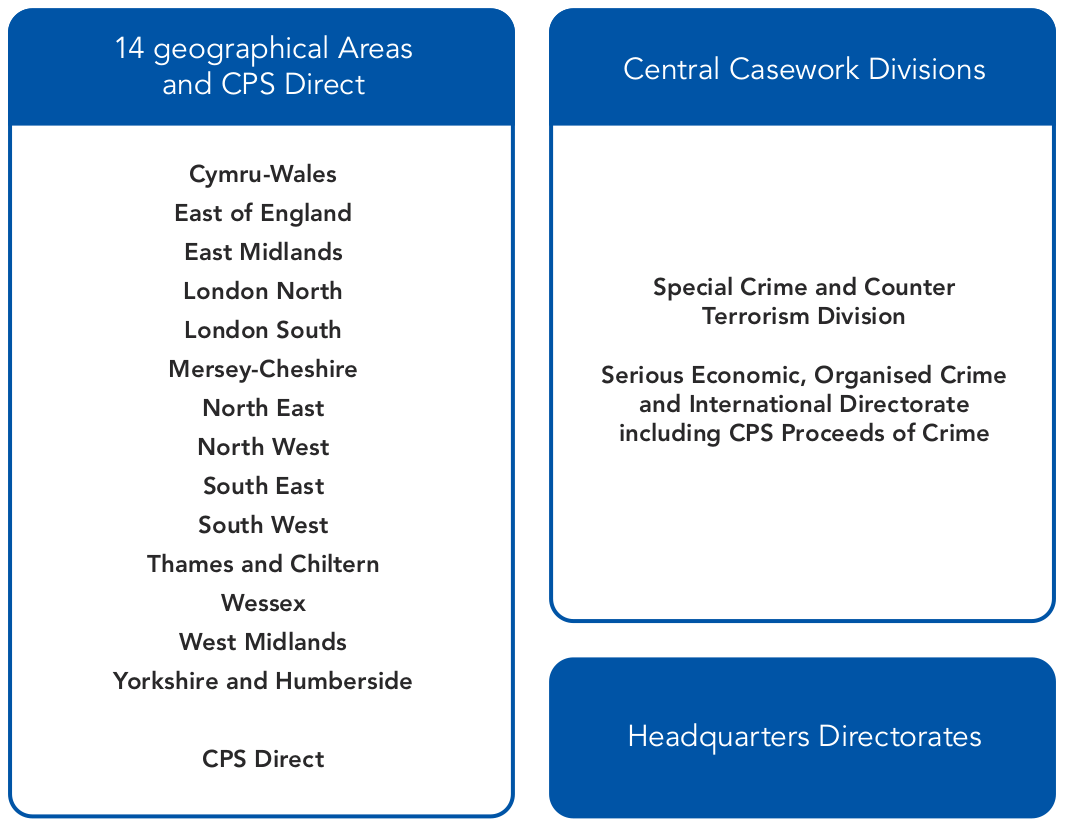
14 geographical Areas and CPS Direct
- Cymru-Wales
- East of England
- East Midlands
- London North
- London South
- Mersey-Cheshire
- North East
- North West
- South East
- South West
- Thames and Chiltern
- Wessex
- West Midlands
- Yorkshire and Humberside
- CPS Direct
Central Casework Divisions
- Special Crime and Counter Terrorism Division
- Serious Economic, Organised Crime and International Directorate including CPS Proceeds of Crime
Headquarters Directorates
Our operating environment and key challenges
This year’s annual report represents our work in the penultimate year of delivering our CPS 2025 Strategy. It’s been another challenging year across both the CPS, and government as a whole, with continuous budget pressures, the upcoming spending review and impending government elections. Despite this unpredictable environment, we continue to strive towards improving our performance, services and public confidence.
Operational Effectiveness
We continue to face the challenge of an increasing backlog of cases due to a number of factors including the legacy of the pandemic and industrial action from the Bar. We continue to work with our partner agencies to increase capacity in the system. We also recognise that this had been a difficult year across governments in terms of spending, with the CPS delivering within a challenging funding envelope. To respond to these challenges, our operational delivery plans needed to ensure we were as effective as possible. As such, our focus has been on retaining our invaluable experienced staff and investing in our workforce, cultivating the competence and experience and providing development pathways that help people progress.
Despite continued pressure on our services, we recognise that time is a critical factor in progressing crime cases and that this has impacts across the criminal justice system. Therefore, through collaboration with police, we have prioritised the roll-out of the new and improved charging model to help improve the timeliness of charging decisions.
Likewise, responding to Inspectorate reports, we have been determined to become more efficient and decisive in the way in which we build our case strategies. Developed and rolled out over the course of this reporting year and the next, the case strategy project breaks down case strategies into ten principles, which have been used to engage staff with targeted resources and learning to build confidence and consistency across the organisation.
Furthermore, we endeavoured to enhance our processes through automation and digitisation of information, identifying and eliminating inefficiencies. Through this we have looked to improve the quality of case files while ensuring streamlined operations.
Operational recovery and improvement
The Operation Recovery and Improvement Programme (ORIP) was formed in September 2021 with a focus on caseload recovery and future improvement.
During recovery, the Chief Crown Prosecutor and Area Business Manager cadre was asked by the ORIP Group to supply proposals to ease frontline pressures. ORIP Group commissioned various pieces of work to address the proposals which included:
- job profiling
- resourcing
- staff development/management support
- standard operating practice (SOP) review
- review of compliance checks/Apps
- recruitment.
In summer 2022 the Central Prosecutor Team was set up by ORIP, working closely with People Function, with the aim of deploying resource differently across the business. This team has been expanded and continues to be directed centrally. Through the 2023-24 period, the team has reviewed over 6,000 cases. The remit of the team has also been expanded so that prosecutors can assist with more complex Crown Court casework. In addition, prosecutors have been redeployed to Areas with particularly high pressures to assist for longer periods so that more complex casework can be managed.
The national Magistrates’ Court Working Group and the Crown Court Working Group report issues and updates to the ORIP at each meeting. In 2023, the Senior Presiding Judge introduced a revised and updated Better Case Management (BCM) Revival Handbook. The Crown Court Working Group ensured this was implemented in the Crown Court teams to achieve a consistent approach to business. In the summer of 2023 revised Transforming Summary Justice (TSJ) principles were launched by the judiciary resulting in a national return to TSJ timescales.
The Magistrates’ Court Working Group launched a new TSJ intranet page and a detailed toolkit for prosecutors to support effective delivery of the criminal justice system-wide TSJ initiative and its ten principles of:
- Quality assured Police files
- Anticipated plea hearings
- Brigading cases
- Optimum bailing patterns
- Early and effective case preparation
- The right personnel at the hearing
- Disclosure of unused material
- Clear expectations of effectiveness at first hearing
- Clear expectations of trial readiness
- Clear expectations of governance
For more information please see: https://www.judiciary.uk/wp-content/uploads/2023/06/New- TSJ-Characteristics.pdf
Violence against women and girls
In recent years, we have come under understandable public scrutiny regarding our handling of some of the most intricate and distressing crimes, particularly cases of rape and serious sexual offences. These crimes have profound, at times life-long, implications for victims and pose significant challenges for our prosecution processes.
Throughout last year, we have continued to work on enhancing our collaboration with the police, improving victim services, and supporting our prosecutors to ensure that they have the necessary resources and training to effectively deal with such cases. We have taken action to improve the standard of our communications with all victims, including a thorough review of our Victim Communication and Liaison Scheme letters. We have taken specific action to improve the service we offer to victims of rape and serious sexual offences, including through the recruitment of new dedicated Victim Liaison Officers in our RASSO units who will provide a consistent point of contact for victims within the CPS.
This work will result in improved experiences of victims and witnesses, and consequently increase public confidence in the criminal justice system.
Fairness for all
Maintaining public confidence in the criminal justice system is an ongoing challenge. This entails providing independent, fair, and proportionate prosecutions that align with public expectations, along with services that treat victims and defendants appropriately. We have continued our work with Leeds University to interrogate the outcomes of our charging decisions, which identified racial disparities in charging decisions. Further research to understand the drivers of disproportionality is underway, and in parallel, we have established a working group to develop an action plan to eradicate disproportionality from our decision-making, in response to the findings of the research. This work is ongoing and we remain dedicated to exploring and addressing these issues.
Our strategy
The organisational strategy CPS 2025 launched in 2020, outlining our five strategic aims. These set out a shared vision for the organisation we want to be by 2025 and help us focus our work where it really matters. There is no hierarchy between the strategic aims; each is equally important if we are to achieve our vision. Our CPS 2025 strategic aims are as follows:
- Our people – Support for the success and wellbeing of our people enables everyone to thrive.
- Digital capability – Our investment in digital capability helps us adapt to the rapidly changing nature of crime and improve the way justice is done.
- Strategic partnerships – The CPS is a leading voice in cross-government strategies and international cooperation to transform the criminal justice system.
- Casework quality – CPS legal expertise, casework quality and collaboration across the criminal justice system keep the public safer.
- Public confidence – We work with partners to serve victims and witnesses and uphold the rights of defendants in a way that is fair and understood by all communities.
These five strategic aims and their respective outcomes ensure that our work is aligned to a long-term strategic goal, and that we are delivering on key priorities while working towards becoming the organisation we want to be in 2025. Everything we do is designed to deliver against these, to help us achieve our organisational vision.
The performance analysis section explores the progress we have made on each of our strategic aims in more detail.
Performance summary
Over the last year, the CPS has delivered significant improvements in a challenging and ever- changing environment. We have done so across a range of key areas, in the context of high caseloads, limited resources and in collaboration with a range of partners. This section touches on the main themes and highlights from the last year, which are then explored in more detail in the Performance Analysis section below.
Casework remains firmly at the heart of the CPS’ role and its quality and progress are essential to fair and independent prosecutions. As always, we have focused on delivering improvements to this key area over the last year. A significant achievement has been the roll-out of the new charging model, jointly agreed between the CPS and policing. This is now fully operational in all but two CPS Areas and police forces. It has brought simplicity, consistency, and digital efficiency to the charging process. The new model is critical to ensuring timely decisions in the most serious cases, focusing on quality and real-time communication between investigators and prosecutors to build better cases. Our case strategy work has also sought to drive up a range of key casework requirements and deliver improved casework quality.
Improving the handling of rape and serious sexual offences cases continues to be a fundamental priority for the CPS. Last year, we launched our National Operating Model for prosecuting adult rape. This consisted of 29 elements required to bring uniformity to CPS activity and was based on best practice arising out of Operation Soteria. This includes joint agreements with policing on early advice, revised and refreshed training, guidance on ‘suspect-centric’ approaches, specialist case progression resources, dedicated communications channels for specialist Independent Sexual Violence Advisors (ISVAs) and consistency in our approach to instructing advocates to present cases in court. These changes are delivering an improved approach to adult rape cases and a better service for victims.
The continued impacts of the pandemic and the Criminal Barristers Association action, amongst other factors, has meant that Crown Court backlogs remain an unprecedented challenge for the criminal justice system. The CPS’ live Crown Court caseload reached a low in March 2022 of 67,716 but currently stands at 72,262; significantly higher than the pre-pandemic February 2020 baseline of 44,317 cases. Nevertheless, we have been able to continue to deliver our full range of core functions throughout these challenging times due to our proactive investment in digital capabilities, strong governance, a nationally led approach and managing regional variances in caseloads with flexible resource. This includes 6,000 cases having been reviewed by our Central Prosecutor Team, consisting of 12 senior prosecutors who review around 200 cases per week, helping Areas to cope in caseload spikes.
| Success Measure | 2023-24 | 2022-23 |
|---|---|---|
| Proportion of all charging decisions that are completed on time | 72.8% | 75.3% |
| Proportion of magistrates’ court cases dropped at 3rd or subsequent hearing | 25.1% | 26.9% |
| Proportion of Judge directions that are complied with on time | 95.2% | 94.4% |
| Proportion of guilty pleas at first hearing | 69.5% | 68.8% |
Charging timeliness has decreased by 2.5 percentage points. This needs to be contextualised within a wider environment that has seen a 6 percentage points increase in the number of police charging referrals to the CPS and the fact that there has been no corresponding increase in the quality of police submissions, leading to over 40% of submissions having Action Plans issued on them for further work to be carried out. The latter impacts adversely on the timeliness of the charging decision outturn data.
The amount of magistrates’ courts cases has increased by a third since the pandemic and this is placing a corresponding pressure on our magistrates’ courts teams. The introduction of the new Magistrate’s’ courts model and introduction of paralegals to these units is enabling prosecutors to free up time to review cases and make earlier decisions and we expect that this will benefit prosecutions moving into the new financial year.
We recognise the complexity and challenges in ensuring the public retains confidence in both the CPS and the wider criminal justice system. This requires us to deliver both the independent and fair prosecutions that they expect of us, as well as a service that treats victims and defendants appropriately.
It is pivotal that the public trusts us to deliver fair and independent services. As such, it is crucial that they have a good understanding of our role within the criminal justice system. We have continued to raise awareness of our role this year and have been successful in utilising digital channels to reach new audiences. This has included utilising social media platforms, including Instagram, where our audience has grown by 70% and our posts have been shown more than 10 million times. Additionally, we doubled the reach of our community newsletter in the last year, taken part in podcasts and co-created digital videos with stakeholders to share with wide and diverse audiences.
We recognise the continued importance of the experiences of victims in the criminal justice system, the CPS’ role in supporting them, and the important impact this can have on people’s trust in the organisation. One of our top priorities has, therefore, been improving the experience of victims in cases of violence against women and girls and obtaining the right outcomes on their behalf. We have put supporting victims at the heart of our work and focused on improving our handling of rape cases. Our efforts have seen tangible results; since the launch of the Joint National Action Plan in January 2021 there has been a 95% increase in referral and a 152% increase in charge volumes for adult rape (based on Q3 2023-24 data).
We have also undertaken research into communication with victims and witnesses. This has provided us with invaluable insights into the improvements we needed to make in order to enhance the service we offer, maintain open communication, and provide relevant updates on cases. All of these elements are vital in securing the right outcomes for our victims and helping them to support a prosecution.
Fair and independent prosecutions are central to our mission and so it is critical that we reflect openly and honestly on where we may not always get things right. To ensure our decisions are fair and proportionate, we commissioned independent academic research into disproportionality in charging decisions, to see what disparities there might be in decision making and identify areas for improvement. We have explored the research findings and are currently developing plans, advised by an independent working group, to set out solutions to address any disproportionality. Publication of this research, alongside a detailed action plan, will follow in 2024-25.
| Success Measure | 2024 | 2023 |
|---|---|---|
| Proportion of the public who are aware of the CPS that have confidence that the CPS is “Fair” | 50% | 52% |
Our people are our greatest asset and central to the delivery of the CPS’ core functions. We use a range of data through the Civil Service People Survey, which looks at civil servants’ attitudes to, and experience of, working in government departments, to carefully monitor the engagement and wellbeing of our people. Whilst the Employee Engagement Index (EEI) has reduced by 2 percentage points to 67% this year, the CPS remains above the Civil Service benchmark for 2023 (64%) and over the long term this represents one of the highest EEI scores in the organisation since 2011.
Against a challenging backdrop of high workloads, our people remain dedicated to the purpose of the CPS and, as a result of this, Organisational Objectives and Purpose remains our highest- scoring theme (91%) – something we are very proud of. It reflects how strongly our colleagues understand and are committed to their part in delivering justice.
Over the last year, many of the core themes in the survey remain close to their highest levels since 2011. As a reflection of the growth and investment in our people across the organisation, the Learning and Development theme for the fourth-year running has maintained its highest ever score (66% positive) and remains +10 percentage points above the Civil Service benchmark. This investment in training and talent will remain key to supporting our strategic workforce plan and developing our people in successful CPS careers.
While results were positive overall in the People Survey 2023, we recognise the continued pressures that our people are experiencing and will keep on taking steps to improve employees experience for everyone at the CPS.
| Success Measure | 2023 | 2022 |
|---|---|---|
| Proportion of staff who agree with “the people in my team can be relied upon to help when things get difficult in my job”1 | 86% | 88% |
| Proportion of staff who agree with “I believe the actions of senior managers are consistent with my organisation’s values”2 | 66% | 68% |
Our values remain critical to the way in which we lead and manage across the CPS, and we ask our staff how they perceived the senior managers to act in line with our values. After a significant increase last year there has been a small reduction of two percentage points this year.
We are determined to create an inclusive workplace culture where employees of all personal characteristics and backgrounds feel included and can thrive and develop. Last year, we renewed our Disability Confident Leader status, and achieved Working Families Top 10 Employers’ status for a seventh year running. Following our ‘Count me in’ campaigns, we also continued to see small increases in declared representation across protected characteristics.
The diversity of our staff representation remains in line with or above Civil Service benchmarks, as we strive for our workforce to be representative of the communities we serve and to recruit talented people. The table below illustrates the current diversity levels of staff in the CPS.
| Diversity of our people | 2023-24 | 2022-23 | Civil Service (2023)3 |
|---|---|---|---|
| Proportion of all staff who are female | 68% | 67% | 54.6% |
| Proportion of all staff who have declared they are from an ethnic minority background | 23% | 23% | 15.4% |
| Proportion of all staff who are declared disabled | 19% | 16% | 15.8% |
| Proportion of all staff who are declared LGBO | 6% | 6% | 6.4% |
Digital capabilities are increasingly important to our ability to operate and ensuring their ongoing security is critical. We have continued to ensure the security of our systems, striving for continual improvements to data protection and user accountability. Last year, the CPS achieved 100% compliance with all mandatory technical standards and our compliance across all the Cabinet Office’s Departmental Security Health Check for 2023 was 98%. Through a range of targeted initiatives, we can have ensured robust security and information assurances practices, policies and procedures have been maintained, audited and evaluated, to make sure that cyber-attacks are mitigated and prevented.
We have maintained our commitment to an ambitious programme of digital projects that enhance our capabilities, release capacity, and protect our vital role in the criminal justice system. The last year has seen the fruition of many years of digital investment and effort, with key initiatives delivering benefits across the organisation. The launch and continuous improvement of the Casework App has been particularly successful, with a million documents viewed and staff reporting that it is simple to use, easy to understand, and saves time.
Working with partners to develop digital solutions across the Criminal Justice System has been a constant feature of our digital work. We are now over halfway through our work on the digital case file project, which represents a significant opportunity to use greater digitisation of information exchanged between the CPS and the police. We have also successfully implemented the required interfaces with Common Platform, meaning that we are linked into the new HM Courts and Tribunals Service (HMCTS) system. This has enabled our people to work collaboratively within magistrates’ courts, with defence professionals and the judiciary, and receive material directly into our system from our cross-system partners.
| Success Measure | 2023-24 | 2022-23 |
|---|---|---|
| Proportion of Investigative Authorities submitting at least one type of multimedia evidence digitally | 48 of 48 (100%) | 48 of 48 (100%) |
As a central part of the criminal justice system, we recognise the importance of developing strong and productive strategic relationships with our partners and stakeholders. Many of the achievements already outlined have been underpinned by key relationships, including the roll-out of the new charging model, the launch of the National Operating Model for prosecuting adult rape, and a new Crown Court Operating Model. These large-scale changes, delivered via joint and cross-system governance, demonstrate how our positive relationships yield results, both for system partners and the public.
Our work with international partners has delivered significant results for domestic cases by providing support to prosecutors and law enforcement partners to secure the successful extradition of individuals to the UK for the most serious offices. We have also finalised over one thousand advice requests from foreign authorities, helping to build strong, reciprocal relationships and effective international collaboration.
We also continue to ensure that our work and insights are available to Parliament and Whitehall and to promote greater awareness and understanding about the CPS’ core role and functions. This has included responding to 60 Parliamentary Questions and providing oral evidence to eight committee inquiries.
Overall, the CPS has delivered significant and important achievements over the course of the last year. Key advances have been made in charging and casework quality, engaging and motivating our people, improved work on RASSO cases and our services to victims and witness, enhanced digital benefits for case progression, strong strategic relationships and greater awareness about who we are and what we do. The following section sets out in more detail how these have been achieved and what benefits they are having for the CPS and the people we serve.
- In the Civil Service People Survey 2022, this question was ‘Proportion of staff who agree with’ “the people in my team genuinely care about my wellbeing”
- In the Civil Service People Survey 2022, this question was ‘Proportion of staff who agree with’ “I believe the actions of my Chief Crown Prosecutor, Deputy Chief Crown Prosecutor, Area Business Managers, or Head of Directorate or Division are consistent with the CPS’ values”
- Source: Statistical bulletin – Civil Service Statistics: 2023 – GOV.UK (www.gov.uk)