
Performance overview
The Performance Overview provides a summary of the Crown Prosecution Service (CPS) and our purpose, objectives, and performance during the year. It sets out at a high level the key risks and issues we have faced and how we have managed these. Further detail can be found in the Performance Analysis.
Who we are and what we do
The CPS is at the heart of the criminal justice system in England and Wales, working with our partners to deliver justice through independent and fair prosecutions. Our vision is to become:
“a leading voice in transforming the criminal justice system, using our legal expertise and digital capability to make the public safer and build the confidence of our diverse communities.”
We have more than 7,000 highly trained staff whose duty is to make sure the right person is prosecuted for the right offence, and that trials are fair so that offenders are brought to justice whenever possible. We are proud to be recognised as a leading employer, committed to supporting a diverse workforce that reflects the community we serve.
The CPS:
- decides which cases should be prosecuted – every charging decision is based on the same two-stage test in the Code for Crown Prosecutors;
- determines the appropriate charges in more serious or complex cases, and advises the police during the early stages of investigations;
- prepares cases and presents them at court; and
- provides information, assistance and support to victims and prosecution witnesses.
We do not investigate crime or choose which cases to consider; our prosecutors must review every case referred to us by the police or other investigators. We provide expert legal advice early in investigations to help build strong cases or identify where a suspect should not be charged.
We make our decisions independently of the police and of government. We must always be fair, objective, and impartial to secure justice for victims, witnesses, defendants and the public.
Last year the CPS brought around 402,000 prosecutions, with five in every six cases leading to a guilty plea or verdict. However, our success is not measured by the conviction rate alone. A fair trial, properly brought, can lead to a guilty or not guilty verdict. Our job is not to seek an ever-higher proportion of guilty verdicts, but to make sure that every case which satisfies the legal test set out in the Code for Crown Prosecutors goes before the courts and is prosecuted independently and fairly.
We work with criminal justice partners across borders to tackle international, organised and economic crime and use our powers to confiscate the proceeds of crime at home and abroad.
Because we review every case sent to us, our work is extremely varied and can be complex in nature. We prosecute offences ranging from burglary and terrorism to domestic abuse and multi-million-pound fraud cases. What these cases all have in common is that they can have a devastating impact on victims.
Our values
Our values are central to everything we do.
We will be independent and fair – We will prosecute independently, without bias and will seek to deliver justice in every case.
We will be honest and open – We will explain our decisions, set clear standards about the service the public can expect from us and be honest if we make a mistake.
We will treat everyone with respect – We will respect each other, our colleagues, and the public we serve, recognising that there are people behind every case.
We will behave professionally and strive for excellence – We will work as one team, always seeking new and better ways to deliver the best possible service for the public. We will be efficient and responsible with taxpayers’ money.
How we are organised
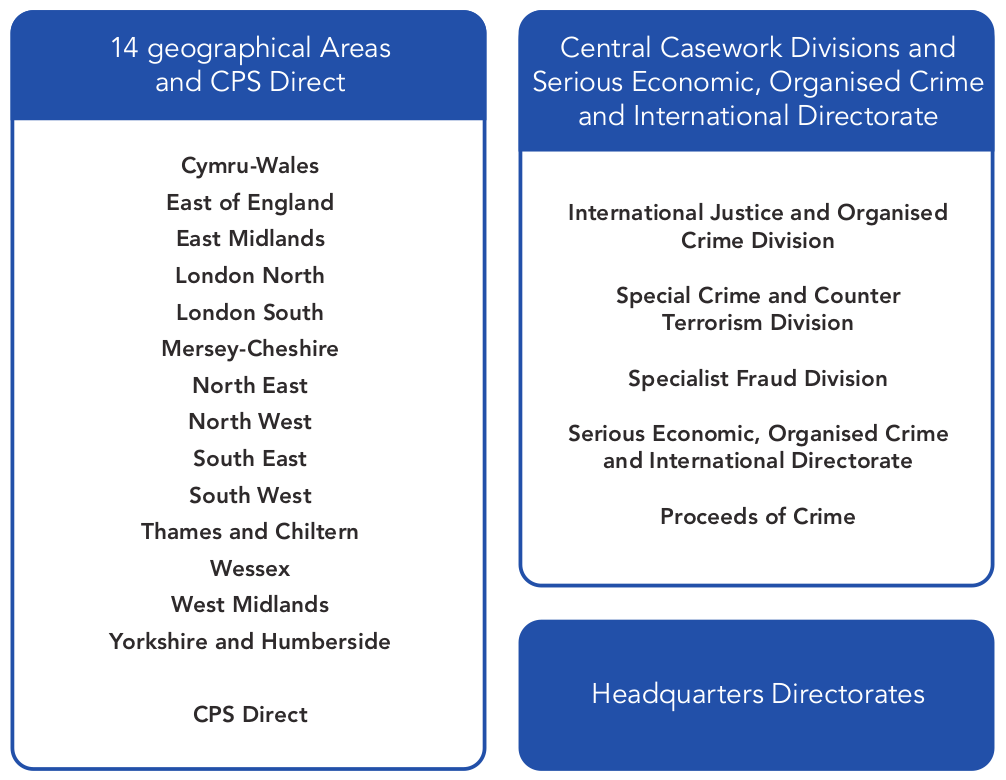
The CPS operates across England and Wales, with 14 geographical Areas prosecuting cases locally. Each Area is typically structured into magistrates’ and Crown Court teams, in addition to specialist teams for Rape and Serious Sexual Offences (RASSO), and complex casework. Each Area is headed by a Chief Crown Prosecutor, and works closely with local police forces and other criminal justice partners.
Nationally, we have an out-of-hours team, CPS Direct, who provide charging advice and authorisation to police forces outside of normal business hours, and four Central Casework Divisions, who deal with some of the most complex cases we prosecute.
The four casework divisions are:
- International Justice and Organised Crime Division (IJOCD)
- Special Crime and Counter Terrorism Division (SCCTD)
- Specialist Fraud Division (SFD)
- Serious Economic, Organised Crime and International Directorate (SEOCID)
These teams work alongside CPS Proceeds of Crime Division (POCD), a dedicated division responsible for all restraint, enforcement, and serious confiscation work.
We also have a number of Headquarters Directorates, which provide corporate services and support to the prosecution teams. Our staff also work closely with specialist investigators from a range of organisations, including the National Crime Agency, HM Revenue & Customs and the Independent Office for Police Conduct (IOPC), as well as police forces across England and Wales.
Our operating environment and key challenges
Operational recovery and improvement
This has been a challenging year across government, with economic pressures affecting funding priorities. We have had to make difficult decisions about where we allocate funding while continuing to deliver against our public commitments. Despite this difficult environment, we have strived towards improving our performance, delivering vital enhancements to our services at the same time. Alongside our partners, we have demonstrated resilience in delivering justice and remained fully engaged in recovery work across the criminal justice system. This work has been underpinned by effective recruitment in a challenging employment market and complex partnership working to digitise information and processes across the criminal justice system.
Violence against women and girls
In recent years we have faced understandable public scrutiny on our prosecution of some of the most complex and appalling crimes, especially rape and serious sexual offences (RASSO) cases. These are some of the most challenging crimes that we prosecute, and some of the most devastating for victims. This year we have continued work to improve our relationship with the police, built on our services to victims and supported our prosecutors to ensure they are properly resourced and trained to respond to these cases. Public confidence in how the criminal justice system responds to violence against women and girls has also declined in recent years. We remain absolutely committed to improving prosecutions and working with partners to improve the experiences of victims and witnesses of rape and serious sexual offences, domestic abuse, and other forms of violence against women and girls.
Fairness for all
We recognise the challenges in ensuring the public retains confidence in both the CPS and the wider criminal justice system. This requires us to deliver both the independent and fair prosecutions that the public expect of us, as well as a service that treats victims and defendants properly. This year we have continued our work to reform our service to victims, especially those with the greatest need. We have started to implement the CPS’s first ever Defendants Strategy, focusing on children and young people, ethnic minorities, and those with mental health conditions. We have also worked with Leeds University to interrogate the outcomes of our charging decisions for any evidence of disproportionality in respect of age, ethnicity, and sex, and developed a comprehensive programme, overseen by an independent advisory group, to act on the findings.
Our strategy
In 2020, we launched our five-year strategy, CPS 2025. This sets out a shared vision for the organisation we want to be by 2025 and helps us focus our work where it really matters.
Within CPS 2025 we have outlined five strategic aims. These represent the organisational capabilities that will support us to fulfil our core role and have a truly positive impact, building on our progress each year. There is no hierarchy between the strategic aims; each is equally important if we are to achieve our vision. Our CPS 2025 strategic aims are as follows:
- Our people – Support for the success and wellbeing of our people enables everyone to thrive.
- Digital capability – Our investment in digital capability helps us adapt to the rapidly changing nature of crime and improve the way justice is done.
- Strategic partnerships – The CPS is a leading voice in cross-government strategies and international cooperation to transform the criminal justice system.
- Casework quality – CPS legal expertise, casework quality and collaboration across the criminal justice system keep the public safer.
- Public confidence – We work with partners to serve victims and witnesses and uphold the rights of defendants in a way that is fair and understood by all communities.
These five strategic aims and their respective outcomes ensure that our work is aligned to a long-term strategic vision, and we are delivering on key priorities while working towards becoming the organisation we want it to be in 2025. Everything we do is designed to deliver against these, to help us achieve our organisational vision.
The performance analysis section explores the progress we have made on each of our strategic aims in more detail.
Performance summary
To monitor delivery against our strategic aims outlined in CPS 2025, we identified a range of success measures. This section summarises our performance against the key measures during 2022-23.
A more detailed account of this performance is given in the Performance Analysis.
Casework is at the heart of the CPS’ role and its quality and progress are essential to fair and independent prosecutions.
Improving the handling of rape and serious sexual offences cases is a fundamental priority. Our wide-ranging Joint National Action Plan has been refreshed this year alongside police colleagues and Independent Sexual Violence Advocates. Another major partnership piece of work, Operation Soteria – focusing on developing new operating models for the investigation and prosecution of rape – is underway to develop new operating models for the investigation and prosecution of adult rape. These projects are all designed to improve casework quality, and we are now seeing increased referrals and charge volumes as a result.
The COVID-19 pandemic continues to have an impact on the CPS leading to variations in performance. For example, progress has been made in the magistrates’ courts which is operating in most Areas at pre-pandemic levels. In the Crown Court however, ongoing recovery from the pandemic, combined with Bar strikes this year, have resulted in increased caseloads. Our Areas are having to flex their resources to service the requirements of the caseload backlog as well as their charging caseload. We have deployed Central Prosecution Teams to assist with the volume of cases.
| Success Measure | 2022-23 | 2021-22 |
|---|---|---|
| Proportion of all charging decisions that are completed on time | 75.3% | 70.4% |
| Proportion of magistrates’ court cases dropped at 3rd or subsequent hearing | 26.9% | 26.4% |
| Proportion of Judge directions that are complied with on time | 94.4% | 95.1% |
| Proportion of guilty pleas at first hearing | 68.8% | 67.5% |
In 2022-23, the target for charging decisions being completed on time was updated from 21 days to 28 days as part of the move to the new jointly agreed CPS and police charging model. The comparable proportion of all charging decisions that are completed on time based on a 28-day period for 2021-22 was 80.8%.
The CPS recognises the complexity and challenges in ensuring the public retains confidence in both the service and the wider criminal justice system. This requires us to deliver both the independent and fair prosecutions that the public expect of us, as well as a service that treats victims and defendants properly.
During 2022-23, we have continued improving our understanding of the needs of victims and witnesses, undertaking further research to better understand how service users feel about their communication with the CPS and what we can do to improve. We have maintained communication with our diverse communities through our Inclusion and Community Engagement Strategy, with a range of different events, including Community Accountability Forums on different themes. We have also published a range of resources to provide information on our work and to help the public understand our role and trust the decisions we make.
Data on public confidence in the CPS is not available from the Office for National Statistics’ Crime Survey for England and Wales (CSEW) in 2022-23 as the relevant question was removed from the survey. This year we commissioned a programme of polling to help us understand and track the level of public confidence in our work.
More than half of those surveyed online agreed that the CPS is fair. We will continue our work with partners and stakeholders in the criminal justice system to improve public confidence in the CPS, and we will also continue this polling to track trends against our work programmes.
| Success Measure | 2023 | 2022 |
|---|---|---|
| Proportion of the public who are aware of the CPS that have confidence that the CPS is “Fair” | 52% | N/A |
Our people are our greatest asset. The Civil Service People Survey, which looks at civil servants’ attitudes to, and experience of, working in government departments is the principal measure of staff engagement and wellbeing.
Whilst there was a noticeable decrease in staffs’ perception of pay and benefits, reflecting the impact of an increased cost of living, many of this year’s core theme results were similar to the previous year. Four of this year’s core theme scores matched or exceeded our previous highest core theme scores when comparing to all results since 2011.
The Employee Engagement Index (EEI) has maintained at 69%, however this remains second highest EEI recorded by the CPS since the survey began in 2009. The response rate has increased to 70% from 69% last year and matches our highest ever response rate. With a further increase in staff, the number of colleagues who completed the survey was the highest for six years.
While results were positive overall in People Survey 2022, we recognise the continued pressures that our people are experiencing and will continue to take steps to improve employee experience for everyone at the CPS.
We are constantly striving to find new ways to develop our wellbeing offer. We have re-procured the Thrive app for a further year to support our workforce, piloted Schwartz Rounds to support our RASSO units, reintroduced physical Health Checks, and launched a Financial Wellbeing campaign to highlight and improve support for staff during cost-of-living pressures.
| Success Measure | 2022 | 2021 |
|---|---|---|
| Proportion of staff who agree with “the people in my team genuinely care about my wellbeing” | 72% | 73% |
| Proportion of staff who agree with “I believe the actions of my Chief Crown Prosecutor, Deputy Chief Crown Prosecutor, Area Business Manager, or Head of Directorate or Division are consistent with the CPS’ values” | 68% | 68% |
Our values remain critical to the way in which we lead and manage across the CPS. After a significant increase last year in the proportion of staff perceiving their senior managers to act consistently with the CPS values, there has been a reduction of three percentage points this year. We will focus on further work to develop a leadership framework in 2022-23 to provide a clear vision and underpin the necessary leadership behaviours.
Workforce inclusion is an essential element of the Inclusion and Community Engagement (ICE) Strategy. This year we refreshed our ‘Towards Social Mobility’ plan and achieved 36th place in the Social Mobility Index. Following our ‘Count me in’ campaign, we have seen small increases in declared representation across protected characteristics.
We are committed to creating an inclusive workplace culture where employees of all personal characteristics and backgrounds feel included and can thrive and develop in the workplace. It is significant that the diversity of our staff is increasing, as we strive for our workforce to be representative of the communities we serve. The table below illustrates the current diversity levels of staff in the CPS.
| Diversity of our people | 2022-23 | Civil Service (2021)1 |
|---|---|---|
| Proportion of all staff who are female | 67% | 54.2% |
| Proportion of all staff who have declared they are from an ethnic minority background | 23% | 14.3% |
| Proportion of all staff who are declared disabled | 16% | 13.6% |
| Proportion of all staff who are declared LGBT+ | 6% | 5.6% |
2022-23 marked the first full year of operation for the CPS Hybrid Working Principles, developed to shape our approach to post-pandemic working. Our principles allow our people to blend working in offices, at court and from home, depending on the needs of the organisation, their role, and personal circumstances.
The CPS is committed to an ambitious programme of digital projects that enhance our capability, release capacity and protect our vital role in the criminal justice system. We have invested in the digital tools our colleagues need every day, by upgrading the devices CPS staff use in their work, with new laptops, printing services and better security controls to increase efficiency and connectedness across the CPS. Our internally developed applications have had over 11 million hits and received positive feedback from colleagues on user experience.
We have continued to invest in the security of our systems, with a new phishing programme that has been rolled out across the CPS, which has reduced the overall phishing risk by identifying where further training and support is needed. We have developed a user-centred technology strategy so that we can learn faster with fewer risks. This has been developed collaboratively and informed by experts from across the industry. We are transforming the way we share case material and enhance case progression with our partners, through two major pieces of work, Digital Case File and Common Platform. These programmes will contribute to the digitisation of information in the CPS, and ensure our technology and systems are aligned with HMCTS colleagues for better cooperation.
| Success Measure | 2022-23 | 2021-22 |
|---|---|---|
| Proportion of Investigative Authorities submitting at least one type of multimedia evidence digitally | 48 of 48 (100%) | 47 of 48 (98%) |
- Source: CPS (Crown Prosecution Service) data, Civil Service Diversity, and Inclusion Dashboard*.
*February 2023