
Performance analysis
This section provides a summary of the CPS’ performance against our CPS 2025 strategic aims and outcomes, most of which comes from the delivery of the Business Plan 2021-22. It is important to review and reflect on the achievements and progress made under these key change projects as they will ultimately drive improvements across our key performance metrics.
1. Our people
Support for the success and wellbeing of our people enables everyone to thrive.
Against a backdrop of operational recovery as a result of the pandemic and the need to support the cross-criminal justice system strategy for rape cases, our key focus has been to ensure that the CPS has the right people available at the right time to deliver high quality casework outcomes. To reflect organisational policies as well as recruiting and inducting people into Rape and Serious Sexual Offences (RASSO) units, a new wellbeing support package has been developed to support our teams dealing with the most sensitive topics.
We have developed our hybrid working principles, enabling us to balance flexibility and operational need. Recognising that virtual working is not always the best environment for collaboration and wellbeing, we have ensured our estate is fit to support hybrid working and opening up building capacity back to 100%.
The Civil Service People Survey 2021 was completed by the highest number of people within the CPS in five years. Given the backdrop of the ongoing pandemic and operational recovery, which continued to dominate much of 2021-22, the CPS Employee Engagement Index (EEI) decreased by one percentage point to 69%. This remains the second highest EEI recorded since the survey began in 2009 and, for the third successive year, remains three percentage points ahead of the Civil Service People Survey benchmark, which sat at 66%.
All parts of our workforce are diverse and inclusive
Workforce inclusion is an essential element of our Inclusion and Community Engagement (ICE) strategy, which was launched in September 2021 and informs our understanding of the steps needed to represent the communities we serve. We have achieved 26th place in the Social Mobility Index, an improvement by 29 places, demonstrating our commitment to being an inclusive employer.
Our ‘Towards Social Mobility’ plan has been refreshed to align with our ICE strategy, covering 2021-2025. The overarching aims are to provide a picture of the socio-economic status of our workforce across all professions and functions, to identify and remove barriers to attraction, retention and career progression.
To ensure our recruitment processes remain inclusive and help the CPS to attract the best talent, we have used different methods to recruit candidates. Attraction and marketing strategies through commercial partners combined with working with our Area Business Manager (ABM) leads has further improved the recruitment process for national campaigns and associated processes. As of 31 March 2022, we achieved a 3.1% vacancy rate against a target of less than 4%, with a vacancy rate of 2.2% for our Senior Crown Prosecutor grade.
The ‘Count me in’ campaign raised awareness among colleagues around the benefits of declaration and the ability to disclose their equality information on an ongoing basis. We have seen a small increase in representation rates in both the wider workforce and at senior levels, and representation across each protected characteristic remains at or higher than the Civil Service average.
Table 1 – Success Measure: Diversity of our staff
| 2021-22 | 2020-21 | |||
| Gender | Gender | |||
| Female | Male | Female | Male | |
| All Staff | 67% | 33% | 66% | 34% |
| Grade 6/7 | 62% | 38% | 60% | 40% |
| SCS | 59% | 41% | 59% | 41% |
| 2021-22 | 2020-21 | |||
| Ethnicity | Ethnicity | |||
| Black, Asian and minority ethnic | White | Black, Asian and minority ethnic | White | |
| All Staff | 21% | 79% | 21% | 79% |
| Grade 6/7 | 20% | 80% | 19% | 81% |
| SCS | 10% | 90% | 9% | 91% |
| 2021-22 | 2020-21 | |||
| Disability | Disability | |||
| Disabled | Not disabled | Disabled | Not disabled | |
| All Staff | 15% | 85% | 14% | 86% |
| Grade 6/7 | 14% | 86% | 13% | 87% |
| SCS | 12% | 88% | 9% | 91% |
| 2021-22 | 2020-21 | |||
| Sexual Orientation | Sexual Orientation | |||
| Lesbian, gay, bisexual and other | Heterosexual/ straight | Lesbian, gay, bisexual and other | Heterosexual/ straight | |
| All Staff | 5% | 95% | 5% | 95% |
| Grade 6/7 | 4% | 96% | 5% | 95% |
| SCS | 6% | 94% | 4% | 96% |
Source – Staff declarations on CPS HR system as at Q4 2021-22. Figures for Ethnicity, Disability and Sexual Orientation are expressed as a percentage of those staff who made a declaration.
Our people have the skills and tools they need to succeed
Hybrid Working, launched in February 2022, marked a new approach for the CPS, blending working in offices, at court and from home, depending on the needs of the organisation, role, and personal circumstances. It is an open and flexible system designed to support people to make the best decisions about where they work based upon three principles: attending with purpose; focused on wellbeing; and collaboration being key.
We have a comprehensive training offer at the CPS, and at the heart is the practical Manager Induction course, which is supplemented with a programme of learning for aspiring and experienced managers. A critical success has been the focus upon remote and distance management during and post-pandemic, with a broad range of accessible learning supporting the challenges and opportunities of managing a hybrid model of working.
Research was undertaken to understand how productivity was measured and it’s relevance to employee experience and business demands. The findings informed the People and Change Committee’s considerations on performance management in January 2022 and led them to identify priorities for 2022-23 around updating guidance and supporting focused all-year-round performance conversations.
Our supportive culture promotes wellbeing
We have procured the Thrive app for an additional year as both a preventative and a supportive tool for staff’s mental health, which includes psychologist support. We also procured our Employee Assistance Programme/Occupational Health service through a new supplier in January and the EAP service is embedding well.
The ‘Take 5’ wellbeing campaign is also encouraging people to take regular, sensible breaks throughout the day to support mental, physical and social wellbeing. Hybrid working and a return to more of a physical office presence will also support social wellbeing and we run activities for staff to encourage social connections.
Health checks were suspended throughout the lockdown period and we are liaising with our Employee Assistance Programme to establish a new health check offer. In addition, the Mental Health Awareness for Line Managers course, which was rolled out over the last two years, is still available as part of the induction process for new managers and as a support tool for any existing managers that missed out on the initial training.
Table 2 – Success Measure: % of staff who agree with “The people in my team genuinely care about my wellbeing”
Source: People Survey 2020 and 2021 https://www.cps.gov.uk/publication/civil-service-people-survey-reports
Our people lead with our values
Our values remain critical to the way in which we lead and manage across the CPS, and influence and work across the wider criminal justice system. The way in which we lead with our values has been evidenced through how we collaborate, listen and engage with our people to shape the culture of the CPS. Development of the hybrid working principles was an excellent example of engaging our people at all levels of the organisation, truly listening and developing the CPS as an organisation which provides an environment where everyone can thrive.
There is more to do and we will focus on further work to develop a leadership framework in 2022‑23, which will provide a clear vision and charter to underpin the leadership behaviours, skills and development to be demonstrated at each step of the career journey from aspiring manager to director. The approach to developing the framework will assist leadership conversations at all levels across the CPS.
Table 3 – Success Measure: % of staff who agree with “I believe the actions of my Chief Crown Prosecutor, Deputy Chief Crown Prosecutor, Area Business Manager or Head of Directorate or Division are consistent with the CPS’ values”
Source: People Survey 2020 and 2021 https://www.cps.gov.uk/publication/civil-service-people-survey-reports
2. Digital capability
Our investment in digital capability helps us adapt to the rapidly changing nature of crime and improve the way justice is done
The CPS remains committed to an ambitious programme of digital projects and, critically, we continue work to ensure the security of our systems.
As an organisation, we recognise the advantages of better and earlier data-driven insights and have been progressing the implementation of systems and platforms that make the most of our information. Better data, analysis and insights will ultimately mean decision-makers will have more real-time information at their disposal than ever before.
We have also benefitted from continued digital innovation, driven by our increasing capabilities in providing tailored apps and platforms. We recognise the holistic value of innovation, with improved tools and functions being made available across the CPS, from casework to our staff awards.
We remain absolutely committed to investing in digital capability so that our work on the digitisation of information and processes, including with our partners in the criminal justice system, is transformative. Our prioritisation of this will enable cases and information to be shared securely and efficiently, supporting better outcomes and the progression of fair and independent prosecutions.
We have confidence in the security of our systems
Demonstrating that our systems are secure and that data subjects – both internal and external – can rely on their integrity is essential in maintaining public confidence in the CPS.
All new and existing risks are regularly reviewed by a multi-disciplinary group to ensure that they are treated holistically and that remedial action is promptly identified and undertaken. We also work closely with the National Technical Authorities, the Government Security Group, and other members of the criminal justice system to recognise and address cyberattacks.
A review of access to our main case management system has resulted in more stringent controls, and refinements to our Movers/Leavers Policy will ensure enhanced application of the ‘Need to know’ principle. Additional resources provided across the business also allow more regular checks as to how staff are applying their individual permissions, thereby ensuring greater accountability.
Mandatory data protection training for all staff, together with bespoke sessions for our senior staff and those with specific security or data roles, have further reinforced the personal responsibility we all have for maintaining the security of our systems. Our examination of the data we hold – particularly in shared drives – has allowed us to simplify our approach and reduce the amount of legacy data.
We use data to drive change
The CPS Performance and Success Measure reporting for internal and external stakeholder reviews is now processed and presented via a modern analytical service hosted in the CPS data cloud platform. Our data cloud platform has continued to provide improvements to the timeliness and accuracy of our data via increased automation of the extraction and processing of casework and application data.
The data, system and business process changes delivered to date have laid the foundations for our Modern Analytics Platform. A programme is underway to enhance our current data platform to build a Future Management Information System (FMIS). The FMIS will provide the capability to aggregate data sources drawn from across the CPS. This will enable the discovery of new business insights by providing staff access to powerful, self-service analytical and enterprise tools that drive better, faster decision making.
The CPS Analytical Network was set up to build a community that can enhance analytical expertise and make the CPS a truly data-driven organisation. The network has promoted the 10DU Data Masterclass training, with over 100 staff joining the course in November 2021 to learn the value of data. A quarterly, analytical newsletter also highlights analytical developments both internally and across government, along with ‘lunch and learn’ sessions.
We innovate, including with emerging technology
To support our ambition and vision, we are now transitioning into scaled internal delivery of digital solutions, using our Digital Platform hosted in Azure and Application Development platform (OutSystems). We now have a suite of 24 apps that have been developed internally receiving around 30,000 hits daily by internal and external users. These enable a range of functions from supporting the management of international casework and tracking individual quality assessments, through to colleague recognition programmes and staff awards. We have also cemented our internal capability to develop, test, release, and support application development at scale.
A particularly exciting tool, which we have now prototyped and which has entered development, will support reviewing lawyers to manage materials that come in from the police. It will enable lawyers to access and navigate around the documents quickly and to easily undertake searches across all documents in a case. This will enable staff to get to grips with the case more rapidly and isolate specific information for redaction, delivering efficiencies on casework progression while retaining the importance of human decision making.
We are proactive in investing in our digital capability
We have continued working with the police to improve how we share case materials between our organisations by introducing more digitisation of information via the Digital Case File. Development is well-progressed, and the system will launch as soon as the first police supplier has completed development on their side.
In light of the impact the pandemic has placed on the criminal justice system, the CPS and HM Courts and Tribunals Service jointly reviewed our plans to replace our existing case management systems with a common digital platform. A joint decision was made for the CPS to retain our case management systems and, instead of the capabilities being rebuilt into Common Platform, develop a series of interfaces. This approach allows us to maximise working collaboratively, effectively share case material and improve case progression, while reducing the challenges and barriers associated with large-scale redevelopment and migration.
We have continued to work with police forces to agree consistency of the user interfaces for multimedia sharing capability. This includes preparation for joint sign-off for photographic principles, Memorandum of Understanding and large file sharing capability. Work with Police Digital Services to agree national standards for phone download, extraction of material, review and criminal justice system sharing is also in progress. This year with the police we also jointly released multimedia processes for the clipping of material to the relevant evidential, unused and rebuttable presumption selections and redaction requirements. This will continue to be reviewed in 2022-23.
To support hybrid working, we have created a new Modern Workplace team who are working with third party providers to explore hybrid working challenges. We have also expanded our use of Microsoft Teams through equipping meeting rooms, have embarked upon a radical transformation of end user device management, and are exploring new and innovative technologies to support our future ways of working.
We have implemented a full end-to-end learning management solution for all CPS staff. Integrated into our complete cloud HR suite, this allows employees to access learning opportunities alongside all other HR functions. Through self-service, both optional development and mandatory learning is managed and tracked, providing robust management information and giving staff better insights into meeting business objectives.
We have also established our Central Operational Training Team to provide training on operational processes and procedures. This complements the bespoke training provision legal professionals receive from the Central Legal Training Team and the wider leadership and management training delivered by Learning and Development.
Table 4 – Success Measure: Number of partners who share multimedia evidence with us on digital systems
| Period | Q1 2020-21 | Q2 2020-21 | Q3 2020-21 | Q4 2020-21 | Q1 2021-22 | Q2 2021-22 | Q3 2021-22 | Q4 2021-22 |
|---|---|---|---|---|---|---|---|---|
| Total Forces/ Investigative Authorities | 48 | 48 | 48 | 48 | 48 | 48 | 48 | 48 |
| Submitting at least one type of multimedia evidence digitally | 42 | 42 | 44 | 43 | 47 | 47 | 47 | 47 |
| Submitting Body Worn Video digitally | 23 | 42 | 44 | 44 | 44 | 46 | 47 | 47 |
| Submitting Achieving Best Evidence digitally | 16 | 39 | 41 | 41 | 41 | 42 | 44 | 44 |
| Submitting CCTV digitally | 18 | 40 | 43 | 43 | 43 | 43 | 45 | 45 |
| Submitting 999 calls digitally | 18 | 41 | 42 | 42 | 42 | 44 | 46 | 46 |
| Submitting other types of multimedia evidence digitally | 18 | 23 | 26 | 26 | 26 | 34 | 34 | 34 |
3. Strategic partnerships
The CPS is a leading voice in cross-government strategies and international cooperation to transform the criminal justice system
The CPS is a critical organisation in the criminal justice system and must work effectively and efficiently with a range of key partners. This requires creating and developing the essential capabilities, skills and relationships that allow us to deliver fair and independent prosecutions.
We must ensure that we are supplementing our operational knowledge and performance with long term futures thinking and high-quality research products. This year we have been building capacity in these functions so that critical insights can be fed in to planning early and decisions informed as much as possible by key evidence.
Utilising operational knowledge, research and insights so that they support improvements across the system both requires and supports the development of important relationships. Over the past year we have focused on how we can be more consistent in our strategic partnership work and on ensuring we have the skills and tools necessary to build the partnerships that can tackle some of the most complex and entrenched issues we face.
We have also invested time this year in ensuring the CPS’ operational expertise has been fully available to parliamentarians so that policy development and legislation is informed by our insights. As such, our efforts this year have focused on both high-profile engagements in Westminster, as well as on ensuring our role is understood as firmly as possible through direct contact with parliamentarians.
We lead on futures thinking to understand issues across the criminal justice system
This year we have made establishing futures thinking within the CPS a priority, designing and recruiting new futures and strategic research functions within the CPS. Working with colleagues across the organisation and the wider criminal justice system, these new functions are helping us incorporate new insights into our decision-making and strategic planning in the CPS.
This was particularly valuable in our planning for the 2021 Comprehensive Spending Review, where the futures function worked closely with senior leaders across the CPS and criminal justice system to develop a compelling and ambitious plan for the CPS over the next three years and beyond. Using our futures insights and a comprehensive evidence base we developed a strong plan for the medium-term in the CPS, with the resources to deliver it.
We also developed a strategic research plan for the organisation, to be delivered by the new research team. This plan covers a range of key research priorities for the organisation, setting out a detailed plan for delivery over the next 12 months and beyond. This plan is designed to target some of the key outcomes from CPS 2025 and will help us achieve them. We have also for the first time published our Areas of Research Interest, as a guide for those wishing to collaborate with the CPS on research.
We influence change across the criminal justice system through trusted relationships
The development and direction of the Government’s Criminal Justice national and local scorecards has been influenced by key CPS insights, helping to ensure they are a practical tool that criminal justice system partners at a national and local level can collectively use to identify issues and work collaboratively.
This year we have continued to be an active player in cross-criminal justice system governance arrangements that are driving progress in achieving the ambitions of the Government’s Rape Review and broader priorities for criminal justice system recovery and reform.
We have also focused on developing the organisational infrastructure (the processes, structures and skills) to ensure that the CPS is consistently an influential and outcomes-focused partner within the criminal justice system. Building on the recommendations of several independent reviews of CPS relationship management, we have designed and developed a corporate programme to build capability across the organisation, supported by a suite of online support resources for those who frequently engage with external partners. We have also built strong relationships with the NPCC Strategic Hub, which has informed and supported successful involvement in national policing events with police chiefs and their Police and Crime Commissioners. Our aim is to build on these successes by developing a wider suite of joint thematic activity, modelled on the collaborative approach adopted by the Joint National Action Plan.
We advise Parliamentarians and Ministers on the operational implications of law and policy
Given our role in the criminal justice system, the CPS has an important responsibility to advise parliamentarians and ministers on the operational implications of law and policy proposals that impact criminal justice, making sure that any future changes assist in prosecuting cases effectively and efficiently.
Over the past year, we have delivered a programme of activities with key parliamentarians intended to explain the role and general function of the CPS as well as our policy and operational responses to priority issues. This has included MP roundtables on rape and serious sexual offences and economic crime, one-to-one meetings between senior officials including Chief Crown Prosecutors and MPs in their Areas, and new shadowing opportunities for members on the Justice and Home Affairs select committees to learn more about our work and hear from frontline prosecutors. We have also worked closely with parliamentary select committees, providing written and oral evidence to inquiries on COVID-19 and the criminal law, fraud and the justice system, and the investigation and prosecution of rape cases.
We have also welcomed the opportunity to take part in the Law Commission’s public consultation on its fourteenth programme of law reform, where members of staff across the CPS contributed a wide variety of innovative project ideas and we submitted a list of strong, evidence-based proposals that we continue to work with the Law Commission in developing.
4. Casework quality
CPS legal expertise, casework quality and collaboration across the criminal justice system keep the public safer
Casework is at the heart of the CPS’ role and its quality and progress are essential to fair and independent prosecutions. It remains a challenging time for the CPS as we deliver improvements at the same time as addressing continued backlogs caused by the pandemic. Nevertheless, we have worked closely with our criminal justice system partners, especially the police, to deliver key changes.
We have relentlessly focused on efforts to tackle issues relating to cases concerning rape and serious sexual offences (RASSO). This has involved extensive joint working with partners in the criminal justice system and the launch of an ambitious pilot to test offender-centric approaches. We have also been prioritising the recruitment and training of specialist prosecutors. Improvements to the handling of RASSO cases remain a fundamental priority for the CPS and changes delivered in 2021-22 will enable further improvements in 2022-23
Case progression remains a focal point of our plans and 2021-22 saw key improvements utilised in our Case Management Systems that will allow us to identify areas for improvement as well as provide key data for CPS Areas to help drive up file quality.
We have also piloted and agreed a new Charging Model with the police that prioritises higher threat and harm cases, whilst focusing on the quality of the file submission from policing to the CPS and then on the timeliness of charging decisions arising.
November 2021 saw the introduction of Criminal Justice System Scorecards, drawing on data held by the Ministry of Justice, the CPS and the Home Office. The scorecards will measure progress against key criminal justice priority areas (e.g. improving timeliness, improving victim engagement), as well as metrics on volume and quality at each stage of the system. The scorecards can be found at: https://criminal-justice-scorecard.justice.gov.uk/.
The right person is prosecuted for the right offence
Getting disclosure right remains of paramount importance to the CPS and it is vital for public confidence in the criminal justice system. In July, we launched the third phase of our National Disclosure Improvement Plan, which sets out our continued joint commitment to improve the way we handle disclosure – a key aspect to this is ensuring compliance with the updated Attorney General’s Guidelines on Disclosure.
The guidelines represent a significant shift in the culture around handling unused material, ensuring investigators and prosecutors adopt a proactive approach to disclosure at an early stage in a case. This means that more unused material is provided to prosecutors at the pre-charge stage to ensure its impact can be taken into account in any decision to charge.
In October, we held a National Disclosure Week for prosecutors and investigators that delivered a series of training seminars to over 2,300 participants and updated the Disclosure Manual, which is the primary guidance for prosecutors and investigators on disclosure.
Cases are progressed in a timely manner
Following a review of the previous National File Quality Assessment process, and in order to align with the changes brought about by the Director’s Guidance on Charging (6th Edition) (DG6), a new joint DG (Charging) Assessment tool was launched on our Case Management System in October 2021.
This model captures compliance with DG6 on anticipated contested cases (NGAP). It will enable us to identify key themes and issues relating to file submissions, identify where improvements can be made, and provide valuable data to support local joint discussion and action.
In November, the new prosecution team structure (renamed joint operational improvement meeting) was revised. This standardises and formalises the local relationship between police and the CPS and ensures that the focus is on identifying joint areas for improvement and agreeing actions to drive improvement in casework quality. Any complex issues that could impact on national operational practice are escalated to the CPS-police Joint Operational Improvement Board (JOIB). All Areas had implemented the structure by the end of January 2022 and the process is still bedding-in. This will be reviewed in the second quarter of 2022-23.
Table 5 – Success Measure: % of charging decisions completed on time
The proportion of charging decisions completed on time has continued to decrease during 2021‑22. This is due to ongoing high caseload numbers following the closure of courts in the initial stages of the COVID-19 pandemic. These cases require ongoing resource input, which therefore impacts on overall timeliness. The Interim Charging Protocol, introduced in 2020-21, continues to ensure priority is given to serious cases that involved higher risk of threat or harm.
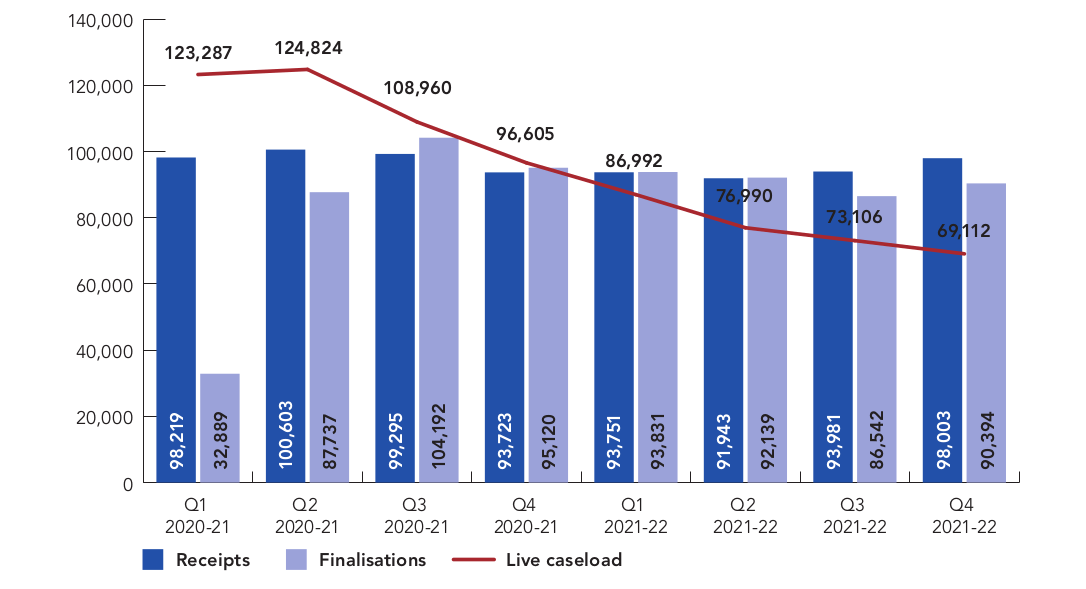
In the magistrates’ courts, caseloads have been decreasing steadily during the year, and have now recovered to 17% above pre-pandemic levels. A return to previous levels is expected by the end of summer 2022.
Table 6 – Magistrates’ court caseloads
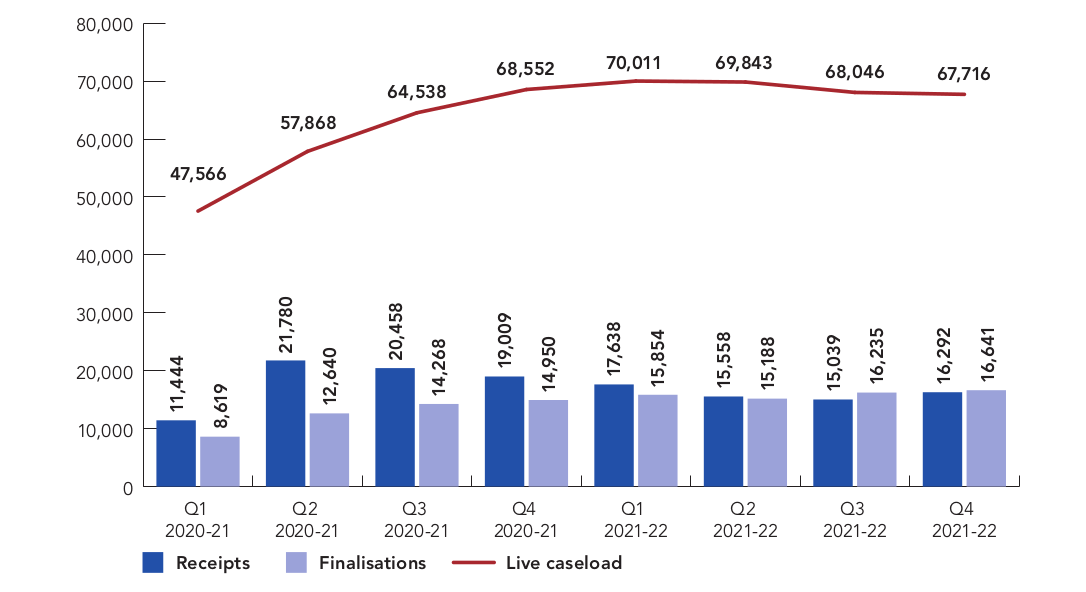
Recovery of Crown Court caseloads remains in its early stages, with caseloads now at 53% above pre-pandemic levels. There is further variation in caseloads between CPS Areas, with cross-circuit listing being employed to help address this by moving cases to other Areas.
Table 7 – Crown Court caseloads
The CPS has a responsibility to continually review cases and take account of any change in circumstances. If the prosecutor considers that the case no longer meets the evidential or public interest test of the Code for Crown Prosecutors then it is their duty to drop the case. If a prosecution is to be dropped it is fairer and more efficient to drop it at the earliest opportunity. The following table shows the proportion of dropped cases that were not dropped until the third or subsequent hearing. Dropped cases includes those discontinued in advance of the hearing, where the CPS offered no evidence, those withdrawn at court, and cases where the defendant was bound over to keep the peace.
Table 8 – Success Measure: % of Magistrates Court cases dropped at 3rd or subsequent hearing
The percentage of cases dropped at third or subsequent hearing saw a sharp drop in Q1 2020-21 to 18.0% rising to 28.1% in Q4 2020-21 and has been on a falling trend since to 24.7% in Q4 2021-22. This reflects changes in listing during the period, with the introduction of social distancing measures and fewer cases being listed. The number of hearings per case has risen throughout the period as cases were increasingly triaged and case-managed before being listed for trial, resulting in more hearings before a case was dropped. This has seen an increasing percentage of cases being discontinued, as prosecution was no longer sustainable due to increased witness attrition. As social distance restrictions have eased courts have started to increase throughput and the number of triage hearings has declined. This is resulting in a decrease in the rate as the criminal justice system moves back to standard ways of working.
Cases are dealt with effectively
We are committed to delivering and implementing our commitments under Rape and Serious Sexual Offences Strategy (RASSO 2025). In February 2022, the CPS published the Rape Strategy Update. It provides an overview of the work we have undertaken since the publication of our RASSO 2025 Strategy, affirming our ambition to build on this foundation and to make significant year-on-year increases in the number of rape cases we bring to court.
Close joint working between the police and prosecutors is key to driving up the number of successful prosecutions. We have launched a wide-ranging Joint National Action Plan and have established Operation Soteria. This takes an offender-centric approach, which means looking closely at the actions of the suspect before, during and after the alleged assault, so that their behaviour is the focus of the investigation. This joint work will provide the foundation for a new operating model for how we manage these complex changes.
All rape and serious sexual offences cases referred to the CPS are handled by highly trained prosecutors working in specialist units. Having the right number of prosecutors and frontline CPS staff is critical to ensuring delivery against this strategy. In the last year, we have successfully recruited 532 new members of staff into the CPS across a mix of roles to contribute to efficiency and resilience, and provided 115 more prosecutors with specialist training so that they can now consider and review RASSO cases.
We are now seeing increases in the number of referrals of rape cases and charges. Since the last quarter of 2020-21, receipts of rape cases have increased by 31% and charges for rape have increased by 22%.
Table 9 – Rape receipts and charges
After extensive piloting in seven police forces and five CPS Areas and evaluation of that activity, a new charging model approach was agreed between the NPCC and the CPS in August 2021. The approach prioritises higher threat and harm cases whilst focusing on the quality of the file submission from policing to the CPS and then on the timeliness of charging decisions arising.
The new model will also contribute to CPS aims regarding digital capability, as it is predicated on digital submissions that will improve the efficiency and effectiveness of the charging activity, supporting overall case progression ambitions. It involves strategic partnership working with the police through joint leadership by the NPCC charging lead and the nominated CPS Director of Legal Services. Ultimately the model will contribute to casework quality through file pre-conditions and improved communications between investigators and prosecutors and greater public confidence through more timely decision making.
The CPS 2025 Advocacy Strategy, launched in March 2021, describes what we expect of our advocates and how we will support them to develop the expertise and behaviours needed to be exceptional.
Much has been delivered in the past 12 months, including the introduction of a new Crown Advocate Framework, publication of the CPS Briefing Principles and Diversity & Inclusion Statement for the Bar, extension of the CPS Advocate Panel to include solicitor agents, and launch of development pathways for advocates aspiring to become Crown Advocates or Treasury Counsel.
The Domestic Abuse Steering Group was established to oversee the delivery of our ambitious domestic abuse programme and ensure policy changes translate into operational change. The programme is underpinned by a commitment to prioritise joint working and increase the volume and quality of domestic abuse prosecutions.
Our domestic abuse policy statement articulates our commitment to tackling domestic abuse and the challenges associated with prosecuting this crime. We have also refreshed our domestic abuse legal guidance, which has become more practical and streamlined, and includes legal updates that incorporate relevant case law and strengthened sections on victim support. It ensures protective orders and risk management are fully considered. Following consultation with stakeholders across sectors to challenge common misconceptions, a new myths and stereotypes section has also been developed.
We have worked across the criminal justice system and with the third sector to implement a domestic abuse best practice framework for use in all magistrates’ courts. This encourages effective case handling and holistic support for victims.
A training review has been undertaken, with strategic priorities identified for delivery in the new business year. New training modules will include: the application of legislation and case building relating to non-fatal strangulation; stalking or harassment and controlling and coercive behaviour; and victim voice and victim trauma work in relation to domestic abuse.
Table 10 – Success Measure: % of Judge directions that are complied with on time
Table 11 – Success Measure: % of guilty pleas at first hearing
Guilty pleas at first hearing are expressed as a percentage of all guilty pleas.
The quality of our casework is enhanced through partnership working
The Changing Nature of Crime Review has been progressed at pace and led to the development, management and evolution of a robust project management framework. As a result, the new Serious Economic, Organised Crime and International Directorate (SEOCID) was launched on schedule on 1 April 2022.
In the past year, we have embedded Operation Soteria into five pathfinder CPS Areas, working in partnership with policing colleagues to drive reform to ensure an offender-centric approach in investigating and prosecuting rape cases. In January 2022, we expanded Operation Soteria into London North, to enable a full pan-London approach complementing a Metropolitan police deep dive, and bringing the total to six Areas. Following further expansion in April 2022, three new CPS Areas have now been invited to participate in Operation Soteria, piloting innovative measures in our response to rape prosecutions. This means nine CPS Areas, over half of all CPS Areas, are now taking part in Operation Soteria.
Operation Soteria sits alongside the CPS and police’s Joint National Action Plan (JNAP). Published in January 2021, the JNAP delivers a wide-ranging programme of work to address issues including case progression, building the strongest possible cases from the outset and accelerating the time taken to bring them to court.
5. Public confidence
We work with partners to serve victims and witnesses and uphold the rights of defendants in a way that is fair and understood by all communities
We recognise the complexity and challenges in ensuring the wider public retains confidence in both our organisation and the wider criminal justice system. This requires us to deliver both the independent and fair prosecutions that the public expect of us, as well as a service that treats victims and defendants properly.
In order to best serve victims and witnesses, we have focused on improving our understanding and evidence base. This has included greater use of research into how the CPS communicates with victims and what they need and expect from us. We have worked with victim groups and experts to inform better guidance, sought to pin-point attrition points in the system and identify how we can best support victims.
We have continued to reach out to our diverse communities through our Inclusion and Community Engagement Strategy and a range of different engagement and events. The insights we gain allow us to feed into live projects as well as help identify new areas for us to reflect on and where to take action.
We also recognise that more needs to be done to communicate the vital role the CPS plays in the criminal justice system. The more people understand what we do, why and how, the more they will value and have confidence in the CPS. Over the past year, we have focused on taking a more consistent approach to our public communications and have reached more and more audiences.
Victims and witnesses have a fair experience interacting with us, regardless of outcome
Last year, the CPS commissioned a victims’ needs assessment by an independent external research agency in recognition of the fact that how we communicate with victims is currently not meeting their needs. This is the first time we have commissioned research of this kind, and it has been informed by input from support services, statutory partners and practitioners and, crucially, victims themselves.
Our internal victims’ hub went live in December 2021 and compiles a range of guidance for staff, including on Witness Care Unit correspondence, Section 28 (option to pre-record evidence in advance for vulnerable complainants and witnesses, including children), intermediaries and other special measures. We have refreshed our Victim Communication and Liaison letters that are sent out to victims when a significant decision has been made on a case, designed with cross-organisational input.
In October 2021, we published a ‘Guide for Victims of Rape and Serious Sexual Offences’ on the CPS website to explain what rights victims have, how we make charging decisions, what happens at the various hearings in the courts and what support is available to help victims give their best evidence, including special measures.
We have also developed a National Framework and national minimum standards for Independent Sexual Violence Advisers (ISVA), striving to improve the support available to victims of rape and serious sexual offences. This has been informed by insights from ISVAs, ISVA services, the police and support services.
Last year, we published substantially updated legal guidance on RASSO, following extensive consultation with experts and victim groups. Key changes in the guidance, its first full revision since 2012, include: updated sections on the impact of trauma, specifically the impact on memory, behaviour and demeanour; an offender-centric approach; and reasonable lines of enquiry, including digital data.
In addition to the victim’s guide mentioned above, the police and the CPS jointly developed a rape data analytics tool to act as a ‘proof of concept’ that rape data can be joined across the criminal justice system for the first time. The tool provides insights into attrition points and where improvements can be made to support victims and ultimately increase the number of RASSO cases that progress through the criminal justice system.
We understand how best to serve our diverse communities
The new 2025 Inclusion and Community Engagement strategy, which is jointly led by the Director of Strategy and Policy and the Chief People Officer, was launched in September 2021 and sets out how we can be our very best and achieve our core purpose – delivering justice through fair and independent prosecutions in line with our public sector equality duties.
We have well established community engagement mechanisms in place at national and local level. These include our National Community Accountability Forum (CAF), External Consultation Groups, local Scrutiny Involvement Panels and Community Conversations facilitated by Chief Crown Prosecutors and listening exercises. These have covered topics on economic crime, hate crime, public sexual harassment and drill music. This enables us to hear directly from our communities about issues that matter to them, informs the development of guidance and best practice and enables our communities to scrutinise CPS decision making.
In addition to our existing community engagement initiatives and casework scrutiny panels, we have been working closely with academic partners to analyse our data for any evidence of disproportionality in our decision making. The findings of this research will inform work we will be driving forward, including as part of our defendants’ strategy.
Table 12 – Success Measure: % of community panel members who agree with “The CPS responds to our feedback”
Responses recorded at panels in Wales, London North, London South, North West, South West and West Midlands Q2 2021-22.
We are a leading voice in ensuring defendants are treated fairly by the CPS
Our commitment to ensuring that the right person is prosecuted for the right offence and protecting the rights of suspects and defendants underpins the development of our CPS Defendants: Fairness for All Strategy 2025. This strategy will represent a clear articulation of the role that the CPS plays in contributing to a fair and just system that prosecutes wrongdoing whilst enabling those who may face additional barriers or with additional needs to participate fully in the criminal justice process.
We know that there are some areas where suspects and defendants may face particular challenges when involved in the criminal justice system and in this strategy we focus on three areas: mental health, youth justice and the proportionality of our decision making. The defendants’ strategy will set out our high-level vision, with an action plan in place to set out the work we will undertake to deliver our objectives.
The public understand our value
It is important for the public to understand our role and trust the decisions we make. Our focus this year has been on providing clear and accessible information highlighting our work on the issues that matter most to people. We have developed a range of digital and hard-copy resources that explain who we are and how we make our decisions, which supports work with victims, witnesses and communities as part of our outreach work.
We have expanded our digital capability and social media presence to reach key audiences. We launched the CPS Instagram account, with our posts seen more than 1.2 million times in the five months since launch. Working with partners on shared priorities is central to our digital strategy; our collaboration with Chelsea Football Club on tackling hate crime attracted 879,000 views – the highest organic reach on Instagram Reels of any government account.
We have prioritised work to build confidence in the criminal justice system’s efforts to improve our service to victims of violence against women and girls. This has been wide ranging, from increasing transparency on performance data, to partnering with campaigner Gina Miller and award-winning podcast The Guilty Feminist to explain the law on upskirting.
Table 13 – Success Measure: % of the public who agree with “I am confident that the CPS is effective at prosecuting people accused of committing a crime”
Source – Office for National Statistics: Crime Survey for England and Wales (CSEW). Data from CSEW is not available for 2019-20 and 2021-22 as the relevant question was removed from the survey for those years. For 2019-20 and 2021-22, other independent research was used for this measure. This rated the CPS’ reputation, as a score from 1 to 100, at:
- 60.0 in quarter 4 of 2018
- 60.7 in quarter 4 of 2019
- 61.5 in quarter 4 of 2020
- 59.3 in quarter 4 of 2021.