
Performance overview
The Performance Overview provides a summary of the Crown Prosecution Service (CPS) and our purpose, objectives and performance during the year. It sets out at a high level the key risks and issues we have faced and how we have managed these. Further detail can be found in the Performance Analysis.
Who we are and what we do
The CPS is at the heart of the criminal justice system in England and Wales, working with our partners to deliver justice through independent and fair prosecutions. Our vision is to become:
“a leading voice in transforming the criminal justice system, using our legal expertise and digital capability to make the public safer and build the confidence of our diverse communities.”
We have more than 6,500 highly trained staff whose duty is to make sure the right person is prosecuted for the right offence, and that trials are fair so that offenders are brought to justice whenever possible. We are proud to be recognised as a leading employer, committed to supporting a diverse workforce that reflects the community we serve.
The CPS:
- decides which cases should be prosecuted – every charging decision is based on the same two-stage test in the Code for Crown Prosecutors;
- determines the appropriate charges in more serious or complex cases, and advises the police during the early stages of investigations;
- prepares cases and presents them at court; and
- provides information, assistance and support to victims and prosecution witnesses.
We do not investigate crime, or choose which cases to consider; our prosecutors must review every case referred to us by the police or other investigators. We provide expert legal advice early in investigations to help build strong cases, or identify where a suspect should not be charged.
We make our decisions independently of the police and of government. We must always be fair, objective and impartial to secure justice for victims, witnesses, defendants and the public.
Last year the CPS brought around 426,000 prosecutions, with five in every six cases leading to a guilty plea or verdict. However, our success is not measured by the conviction rate alone. A fair trial, properly brought, can lead to a guilty or not guilty verdict. Our job is not to seek an ever-higher proportion of guilty verdicts, but to make sure that every case which satisfies the legal test set out in the Code for Crown Prosecutors goes before the courts and is prosecuted independently and fairly.
We work with criminal justice partners across borders to tackle international, organised and economic crime, and use our powers to confiscate the proceeds of crime at home and abroad.
Because we review every case sent to us, our work is extremely varied and can be complex in nature. We prosecute offences ranging from burglary and terrorism to domestic abuse and multi-million pound fraud cases. What these cases all have in common is that they can have a devastating impact on victims.
Our values
Our values are central to everything we do.
We will be independent and fair – We will prosecute independently, without bias and will seek to deliver justice in every case.
We will be honest and open – We will explain our decisions, set clear standards about the service the public can expect from us and be honest if we make a mistake.
We will treat everyone with respect – We will respect each other, our colleagues and the public we serve, recognising that there are people behind every case.
We will behave professionally and strive for excellence – We will work as one team, always seeking new and better ways to deliver the best possible service for the public. We will be efficient and responsible with taxpayers’ money.
How we are organised
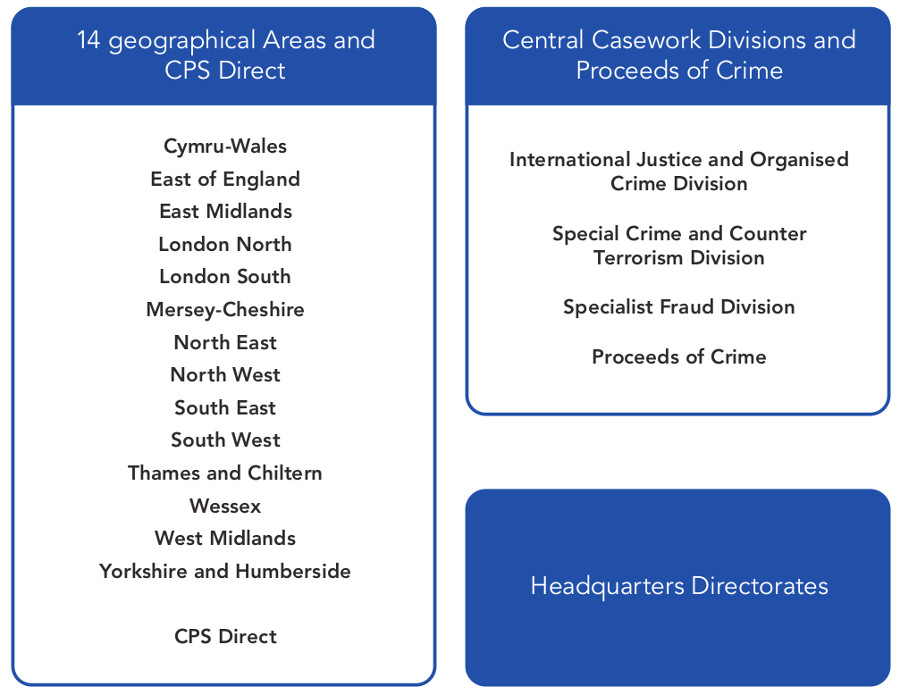
The CPS operates across England and Wales, with 14 geographical Areas prosecuting cases locally. Each Area is typically structured into magistrates’ and Crown Court teams, in addition to specialist teams for Rape and Serious Sexual Offences (RASSO), and complex casework. Each Area is headed by a Chief Crown Prosecutor, and works closely with local police forces and other criminal justice partners.
Nationally, we have an out-of-hours team, CPS Direct, who provide charging advice and authorisation to police forces outside of normal business hours, and three Central Casework Divisions, who deal with some of the most complex cases we prosecute.
In 2021-22, the CPS had three casework divisions:
- International Justice and Organised Crime Division (IJOCD)
- Special Crime and Counter Terrorism Division (SCCTD)
- Specialist Fraud Division (SFD)
These teams worked alongside CPS Proceeds of Crime Division (POCD), a dedicated division responsible for all restraint, enforcement and serious confiscation work.
In response to the changing nature of crime, the CPS reviewed the structure of its casework divisions, and created the new Serious Economic, Organised Crime and International Directorate in time for 2022-23.
We also have a number of Headquarters Directorates, who provide corporate services and support to the prosecution teams. Our staff also work closely with specialist investigators from a range of organisations, including the National Crime Agency, HM Revenue & Customs and the Independent Office for Police Conduct (IOPC), as well as police forces across England and Wales.
14 geographical Areas and CPS Direct
- Cymru-Wales
- East of England
- East Midlands
- London North
- London South
- Mersey-Cheshire
- North East
- North West
- South East
- South West
- Thames and Chiltern
- Wessex
- West Midlands
- Yorkshire and Humberside
- CPS Direct
Central Casework Divisions and Proceeds of Crime
- International Justice and Organised Crime Division
- Special Crime and Counter Terrorism Division
- Specialist Fraud Division
- Proceeds of Crime
Headquarters Directorates
Our strategy
In 2020, we launched our five-year strategy, CPS 2025. This sets out a shared vision for the organisation we want to be by 2025 and helps us focus our work where it really matters.
Within CPS 2025 we have outlined five strategic aims. These represent the organisational capabilities that will support us to fulfil our core role and have a truly positive impact, building on our progress each year. There is no hierarchy between the strategic aims; each is equally important if we are to achieve our vision. Our CPS 2025 strategic aims are as follows:
- Our people – Support for the success and wellbeing of our people enables everyone to thrive.
- Digital capability – Our investment in digital capability helps us adapt to the rapidly changing nature of crime and improve the way justice is done.
- Strategic partnerships – The CPS is a leading voice in cross-government strategies and international cooperation to transform the criminal justice system.
- Casework quality – CPS legal expertise, casework quality and collaboration across the criminal justice system keep the public safer.
- Public confidence – We work with partners to serve victims and witnesses and uphold the rights of defendants in a way that is fair and understood by all communities.
Under these overarching strategic aims we have outlined specific aims and outcomes, and everything we do is designed to deliver against these, to help us achieve our organisational vision.
Our annual Business Plan sets out the specific steps being taken to make progress towards this shared vision. In the coming pages, after summarising the operating environment and the key challenges we faced this year, we will report on our business plan commitments made for 2021-22 and our performance against them.
Our operating environment and key challenges
COVID-19
The pandemic had a seismic impact in our ways of working and it has brought with it unforeseen challenges to the CPS and wider criminal justice system, including producing a backlog of cases and a rise in caseload per prosecutor. Our operational contingencies have evolved throughout the response phase, and we have fully engaged in recovery work to date across the criminal justice system.
We have an established Operational Recovery and Improvement Programme which brings together, under a clear governance structure, strands of work covering Charging, Magistrates and Crown Court Working, People, Finance and Data. The programme co-ordinates both recovery and improvement across the service and members of the programme engage with a range of work strands across the criminal justice system to manage and take us through recovery.
We have played a central role in making sure that essential work to deliver justice can continue, whilst doing everything possible to protect our people, our partners and the public. Our focus in 2021-22 was to mitigate the impact of the pandemic and to support our operational frontline to deliver justice. We are proud to have accomplished this by keeping our people working in the frontlines and from home, continuing the essential job of delivering justice.
Rape and serious sexual offences
Rape and serious sexual offences are some of the most challenging crimes that we prosecute, as well as some of the most devastating for victims. Too few cases are getting to court, and the CPS is determined to make significant year on year increases so that more victims see justice done. In 2021-22 we delivered extensive actions to improve collaboration with the police from the very start of an investigation, find better ways to support victims throughout the process and support our prosecutors so they are properly resourced to respond to these challenging cases.
This area of work remains a fundamental priority for the CPS and key priorities this year, including the Operation Soteria pilots, have provided strong foundations on which to build in 2022-23. We recognise many challenges lie ahead and we remain firmly committed to addressing the shortcomings identified in dealing with rape and serious sexual offence cases.
CPS 2025
The change projects delivered by the CPS continue to be guided by our five-year strategy, CPS 2025. Our five strategic aims are our people, digital capability, strategic partnerships, casework quality and public confidence. These aims, and their respective outcomes, ensure that our work is aligned to a long-term strategic vision and that we are both delivering on key issues while working towards becoming the organisation we want it to be in 2025.
The priorities this year under our people have been varied, representing the complexity of meeting the needs of the organisation, as well as its employees. Key areas, such as operational recovery and rape and serious sexual offence cases, are underpinned by effective recruitment and, this year, this has been supported by a review into recruitment methods, as well as refreshing our strategic workforce planning. Wellbeing is another key area and we have undertaken a review of our offer on mental health and instigated events and forums encouraging informal interactions between colleagues, which remote working can make more difficult. We also launched our hybrid working principles that set out clear expectations and rationales for hybrid office working that balances the needs of the organisation with those of a modern workforce.
Under digital capability, we have seen major pieces of work undertaken in 2021-22. This includes recruiting specialist trainers to assist the organisation in making the most of new systems, as well as the rolling out of new devices across the CPS, modernising equipment and laying the foundations for greater digital innovation. We have made advances in the utilisation of digital multimedia evidence in partnership with the police, as well as enhancing digital platforms and managing the need to interface effectively with the cross-criminal justice system Common Platform.
The CPS, being part of a much larger criminal justice system, needs to ensure our strategic partnerships are supporting work at all levels. We have created a strategic partnerships framework to underpin and guide our work going forward and laid the foundations for supporting relationship building, with training scheduled for 2022-23. We have also rigorously engaged with key stakeholders in Parliament, helping to provide operational insights into our work and ensure that these feature in key discussions in Westminster.
We have added to our capacity in terms of setting up much needed functions to support long term work, including a research function that will assist with ensuring research is of the appropriate standard and is always relevant to our aims. In addition, a new function looking at long term trends will provide insights for areas across the CPS and has already delivered a project on productivity for Human Resources.
The CPS is of course fundamentally concerned with fair and independent prosecutions and this inevitably means casework quality is a central tenet of our work. Under this aim, we have seen major deliverables across a range of complex and challenging work areas. Improving our work on rape and serious sexual offence cases has been an absolute priority, guided by the recommendations of the Joint National Action Plan and the Rape Review. We have launched Operation Soteria in partnership with the police to pilot a new approach into investigating and dealing with rape and serious sexual offence cases. We have also prioritised work on early investigative advice and on offender-centric approaches. This area of work remains an absolute priority and will be built upon in 2022-23.
Major strides have also been made on developing and implementing a new Charging Model between the CPS and the police, which will assist with prioritisation, as well as on more effective case progression to ensure high quality casework is maintained, whilst allowing cases to progress in a timely manner. Furthermore, our Changing Nature of Crime Review has informed the move to create a new Serious Economic, Organised Crime and International Directorate to better support work in this vital and volatile area.
Our work on public confidence incorporates key priorities, including those which build upon areas of work mentioned above, in particular the treatment of victims and witnesses. The experiences of victims and witnesses in relation to rape and serious sexual offence has been a key area of focus and this year we launched our digital walkthrough to help guide people through the process and to support them as their case progresses.
We have also been appraising our victims and witnesses work more widely and have made improvements to our existing communications, while undertaking research into the user-needs of those we communicate with, in order to better understand what they need from the service going forward. The CPS has also sought to reach more audiences, as seen through our new digital strategy, and to ensure we are taking on lessons and insights from the diverse communities we serve, including through numerous Community Accountability Forums.
Performance summary
To monitor delivery against our strategic aims outlined in CPS 2025, we identified a range of success measures. This section summarises our performance against the key measures during 2021-22.
A more detailed account of this performance is given in the Performance Analysis.
Casework is at the heart of the CPS’ role and its quality and progress are essential to fair and independent prosecutions. During 2021-22, we piloted and agreed a new Charging Model with the police that prioritises higher threat and harm cases, whilst focusing on submission quality and timeliness of charging decisions.
November 2021 saw the introduction of Criminal Justice System Scorecards, drawing on data held by the Ministry of Justice, the CPS and the Home Office. The scorecards will measure progress against key criminal justice priority areas (e.g. improving timeliness, improving victim engagement), as well as metrics on volume and quality at each stage of the system.
Improving the handling of rape and serious sexual offences cases is a fundamental priority. In February 2022, we published the Rape Strategy Update, providing an overview of the work we have undertaken since publishing our Rape and Serious Sexual Offences Strategy. We have launched a wide-ranging Joint National Action Plan and have established Operation Soteria, an ambitious pilot to test offender-centric approaches. We have also prioritised the recruitment and training of specialist prosecutors to consider and review rape and serious sexual offence cases.
Across all cases, getting disclosure right is vital for public confidence in the criminal justice system. This year we launched the third phase of our National Disclosure Improvement Plan, which sets out our continued commitment to improve the way we handle disclosure. The guidelines represent a significant shift in the culture around handling unused material; ensuring investigators and prosecutors adopt a proactive approach to disclosure at an early stage in a case.
The COVID-19 pandemic continues to have an impact on the CPS leading to variations in performance. For example, during 2020-21, reduced court capacity because of the pandemic, led to more resources being allocated to charging decisions. However, the ongoing recovery from the pandemic in 2021-22 has resulted in increased caseloads and Areas having to flex their resources to service the requirements of this additional caseload whilst servicing the requirement of their charging caseload.
| Success Measure | 2021-22 | 2020-21 |
|---|---|---|
| Proportion of all charging decisions that are completed on time | 70.4% | 78.6% |
| Proportion of magistrates’ court cases dropped at 3rd or subsequent hearing | 26.4% | 25.4% |
| Proportion of Judge directions that are complied with on time | 95.1% | 94.4% |
| Proportion of guilty pleas at first hearing | 67.5% | 70.8%1 |
The CPS recognises the complexity and challenges in ensuring the public retains confidence in both the service and the wider criminal justice system. This requires us to deliver both the independent and fair prosecutions that the public expect of us, as well as a service that treats victims and defendants properly.
During 2021-22, we have focused on improving our understanding of the needs of victims and witnesses, including commissioning a victims’ needs assessment to inform how we communicate. We have also continued to reach out to our diverse communities through our Inclusion and Community Engagement Strategy. We have developed a range of resources to provide information on our work and to help the public understand our role and trust the decisions we make.
Data on public confidence in the CPS is not available from the Office for National Statistics’ Crime Survey for England and Wales (CSEW) in 2021-22 as the relevant question was removed from the survey. The following data has been taken from other independent research, which rated the CPS’ reputation as a score from 1 to 100 and shows a slight reduction from the previous year.
| Success Measure | 2021 | 2020 |
|---|---|---|
| Proportion of the public who agree with “I am confident that the CPS is effective at prosecuting people accused of a crime” | 59.3 | 61.5 |
Our people are our greatest asset. The Civil Service People Survey, which looks at civil servants’ attitudes to, and experience of, working in government departments is the principal measure of staff engagement and wellbeing. Many of our results this year were similar to or slightly down from the previous year, reflecting the impact of the pandemic and ongoing operational recovery. Our Employee Engagement Index (EEI) fell to 69%, but this remains the second highest EEI recorded by the CPS since the survey began in 2009. The percentage response rate also fell slightly from 70% to 69%, however due to an increase in staff, the number of colleagues who completed the survey was the highest in five years.
We recognise the continued pressures that our people are experiencing, and we will continue to take steps to improve the employee experience for everyone at the CPS.
We are constantly striving to find new ways to develop our wellbeing offer. This year we have procured the Thrive app for a further year to support our workforce, as well as launching our ‘Take 5’ campaign to encourage regular, sensible breaks throughout the day.
| Success Measure | 2021 | 2020 |
|---|---|---|
| Proportion of staff who agree with “the people in my team genuinely care about my wellbeing” | 73% | 74% |
| Proportion of staff who agree with “I believe the actions of my Chief Crown Prosecutor, Deputy Chief Crown Prosecutor, Area Business Manager, or Head of Directorate or Division are consistent with the CPS’ values” | 68% | 71% |
Our values remain critical to the way in which we lead and manage across the CPS. After a significant increase last year in the proportion of staff perceiving their senior managers to act consistently with the CPS values, there has been a reduction of three percentage points this year. We will focus on further work to develop a leadership framework in 2022-23 to provide a clear vision and underpin the necessary leadership behaviours.
Workforce inclusion is an essential element of our Inclusion and Community Engagement (ICE) strategy. This year we refreshed our ‘Towards Social Mobility’ plan and achieved 26th place in the Social Mobility Index. Following our ‘Count me in’ campaign, we have seen small increases in declared representation across protected characteristics.
| Diversity of our people | 2021-22 | Civil Service (2020) |
|---|---|---|
| Proportion of all staff who are female | 67% | 53.8% |
| Proportion of all staff who are declared Black, Asian, or Minority Ethnic background | 21% | 13.2% |
| Proportion of all staff who are declared disabled | 15% | 12.8% |
| Proportion of all staff who are declared lesbian, gay, bisexual or other | 5% | 4.9% |
| Source: CPS data, Civil Service Diversity and Inclusion Dashboard. | ||
In February 2022 we launched Hybrid Working, which will blend working in offices, at court and from home, depending on the needs of the organisation, an individual’s role, and personal circumstances. It is an open and flexible system based upon three principles: attending with purpose; focused on wellbeing; and collaboration being key.
The CPS is committed to an ambitious programme of digital projects that enhance our capability, release capacity and protect our vital role in the criminal justice system. This includes a programme to enhance the current CPS data platform to build a Future Management Information System (FMIS). This will provide the capability to aggregate data sources drawn from across the CPS, enabling new business insights and better, faster decision making.
We have developed our capacity for internal delivery of digital solutions, and now have a suite of 24 apps receiving around 30,000 hits daily by internal and external users. These enable functions from managing international casework to colleague recognition programmes and awards for excellence.
We have continued to ensure the security of our systems, striving for continual improvements to data protection and user accountability. A review of access to our main Case Management System (CMS) has resulted in more stringent controls and we have delivered mandatory data protection training for all staff.
We continue to work with our partners on the digitisation of information and processes to transform the criminal justice system. We have a number of key cross-criminal justice system initiatives to ensure cases and information can be shared securely and efficiently with our partners, as well as initiatives to manage multimedia evidence across the justice system.
| Success Measure | 2021-22 | 2020-21 |
|---|---|---|
| Proportion of Investigative Authorities submitting at least one type of multimedia evidence digitally | 47 of 48 (98%) | 43 of 48 (90%) |
In light of the impact of the pandemic, the CPS and HM Courts and Tribunals Service (HMCTS) jointly reviewed our plans to replace our existing case management systems with a common digital platform. A joint decision was made for the CPS to retain our case management systems and develop a series of interfaces to the Common Platform. This approach allows us to maximise the benefits and opportunities of working collaboratively while reducing the challenges and barriers associated with large-scale redevelopment and migration.
- Method of calculation revised in 2021-22. 2020-21 figure updated to reflect new methodology.